Clocks:
Pendulum Clocks New Haven Chauncey Jerome Sessions Seth Thomas Ingraham Ansonia Waterbury Gilbert Owari Takano Emes Cuckoo Clocks Schmeckenbecher Cuckoo Clock Mfg Co. Balance Wheel Clocks Ansonia
Timepieces:
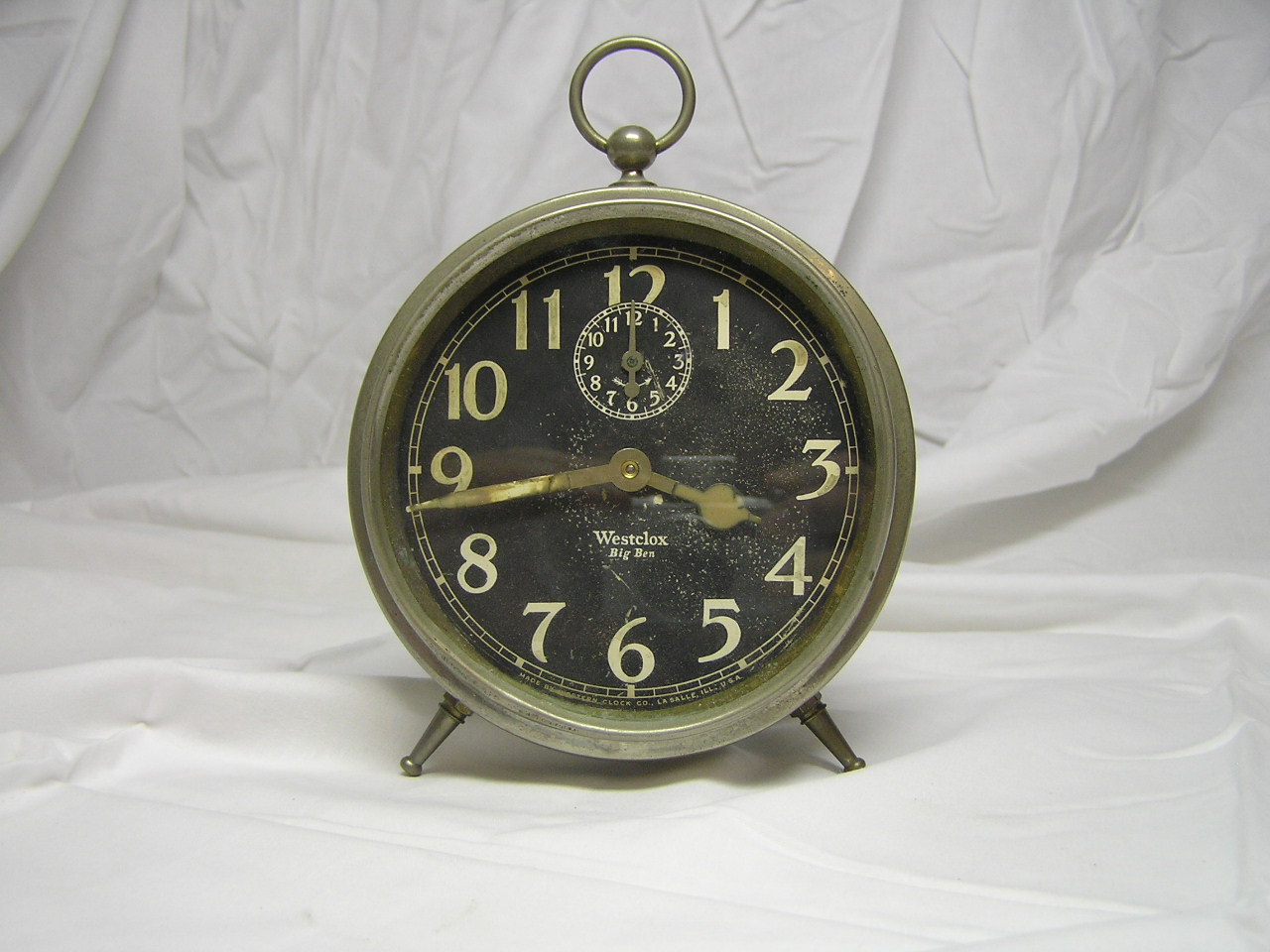
Pendulum Timepieces Seth Thomas Torsion Pendulum Timepieces Kundo Schatz Balance Wheel Timepieces Hartford Time Switch Reliance Automatic Lighting Westclox Big Ben with Seconds Hand? Which to use? Mauthe Ansonia Ingraham New Haven Secron General Electric Electric Timepieces General Electric
Note! Clocks on this page are not for sale. Do not ask!
New Haven Clock Co. 8-day kitchen clock, circa 1900-1905 "Camden" series. Clock, movement, and stamp. Note the countwheel strike has a slot for hours and half-hours. A total of three different embossed patterns were offered as part of the Camden series. All were 8-day in oak cases with alarms as an extra cost option. The New Haven Clock Company traces its roots back to the first brass clocks and was founded in 1850 as a result of the business failures of Chauncey Jerome. Clock uses a single-ended #6 key.
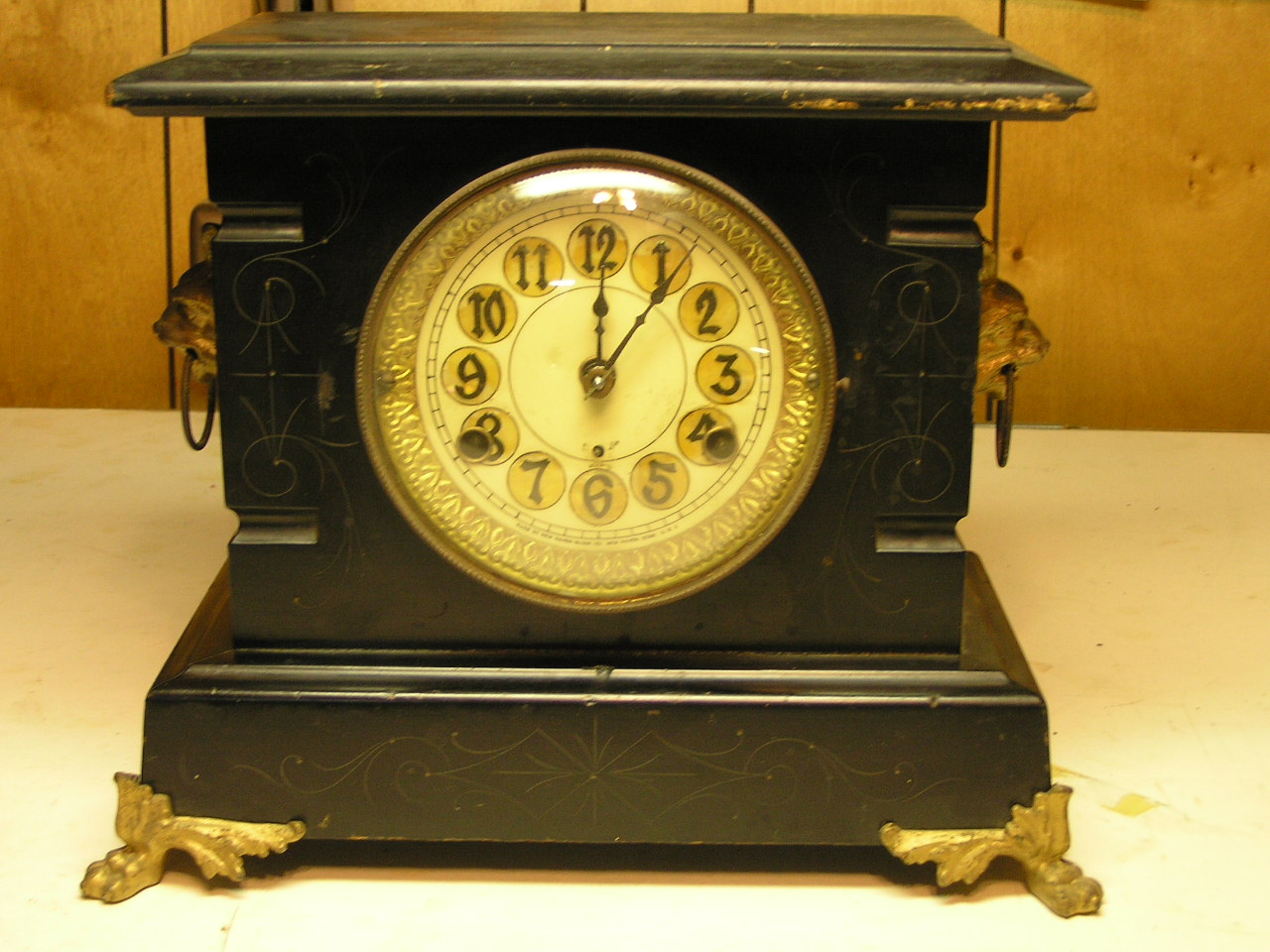
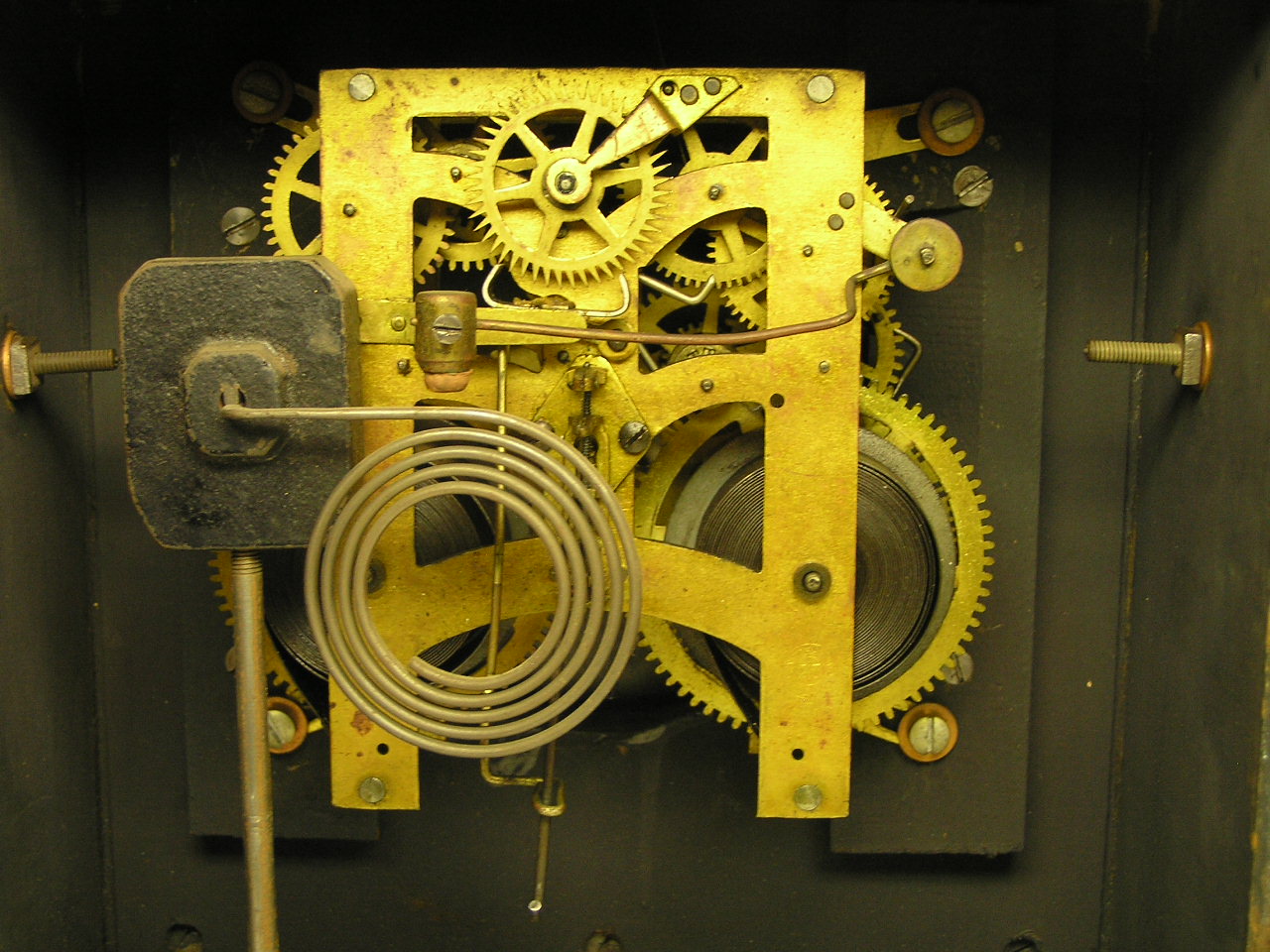
New Haven Black Mantle clock, circa 1900 This is a very nice original condition clock also made by New Haven Clock Co, and thus bears some similarities to the clock pictured above. However, like most mantle clocks, this one features regulation from the front, and short pendulum mounted to the back of the movement. An additional interesting feature of this clock is a fiber fly pinion in the strike train to make it more quite. Like the New Haven clock above, this one uses the strike train for both hours and halves. This clock uses a strip-pallet deadbeat escapement. Like most mantle clocks, it can be regulated from the front without stopping the pendulum. Clock uses a double-ended #6 and #00000 key.
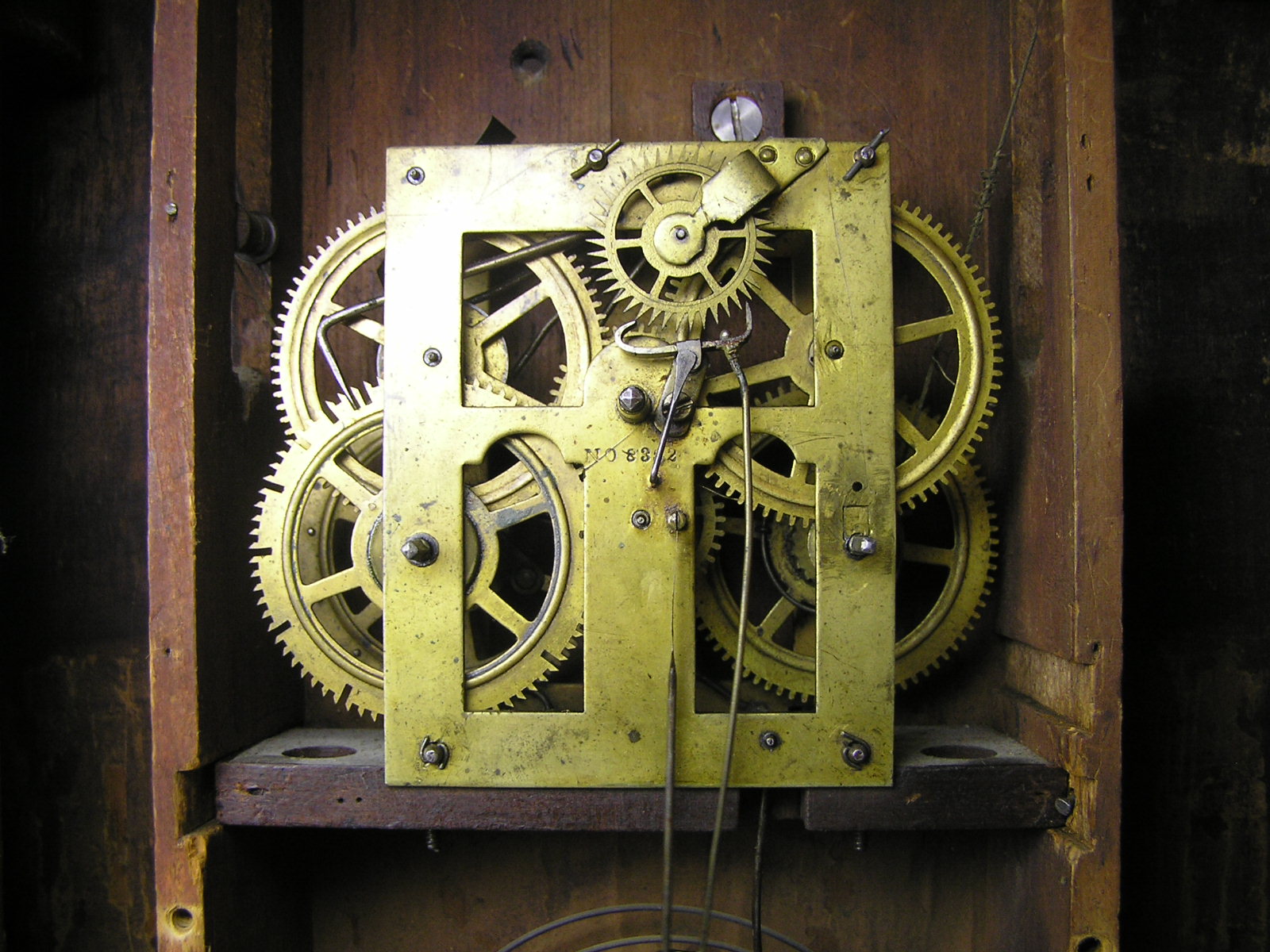
Chauncey Jerome Thirty Hour Ogee clock circa 1841-1842 This is the oldest clock in my collection, and appropriately, one that changed American clockmaking. Chauncey Jerome began his career in clockmaking under Eli Terry. By 1822, Jerome and his brother, Noble, had their own shop making a mass-produced wooden movement 30-hour and 8-day clocks. Around 1838, Jerome started making clocks with stamped brass movements using the mass-production techniques they had used with their wooden movement clocks. Previous to this, brass clock movements were made by hand and were usually one-off bespoke pieces. With this development, the wooden clock movement was obsolete overnight, and for the first time dependable and inexpensive clocks were available to the masses. All did not go smoothly for Jerome. In April 1845 the Bristol factory burned, and the company relocated to New Haven. By the mid 1850's Jerome had lost his company and his factories were taken over by the newly formed New Haven Clock Company in 1853. Most of the mechanical features of American clock movements were found in the Jerome weight driven movements: lantern pinions, countwheel strike, bent-wire levers, center arbor driven by the train and not part of it.
The tablet has a lot of paint loss, and the dial is very worn. The case has had a coating of reddish-brown varnish applied very sloppy. A few pieces of veneer are missing, but nothing major. The glass is original and held in with putty. You can see a bull's-eye or bubble in the lower right corner of the tablet. The back of the clock has many holes from wall mounting and I used some to wall mount it. It is a weight-drive clock and needs a stable place to operate. A website on Jerome clocks identifies the movement as a type 1.211. These are numbers given by collectors to identify variations in the movements, and would not have been used by the manufacturer. Clock uses a single-ended #4 crank.
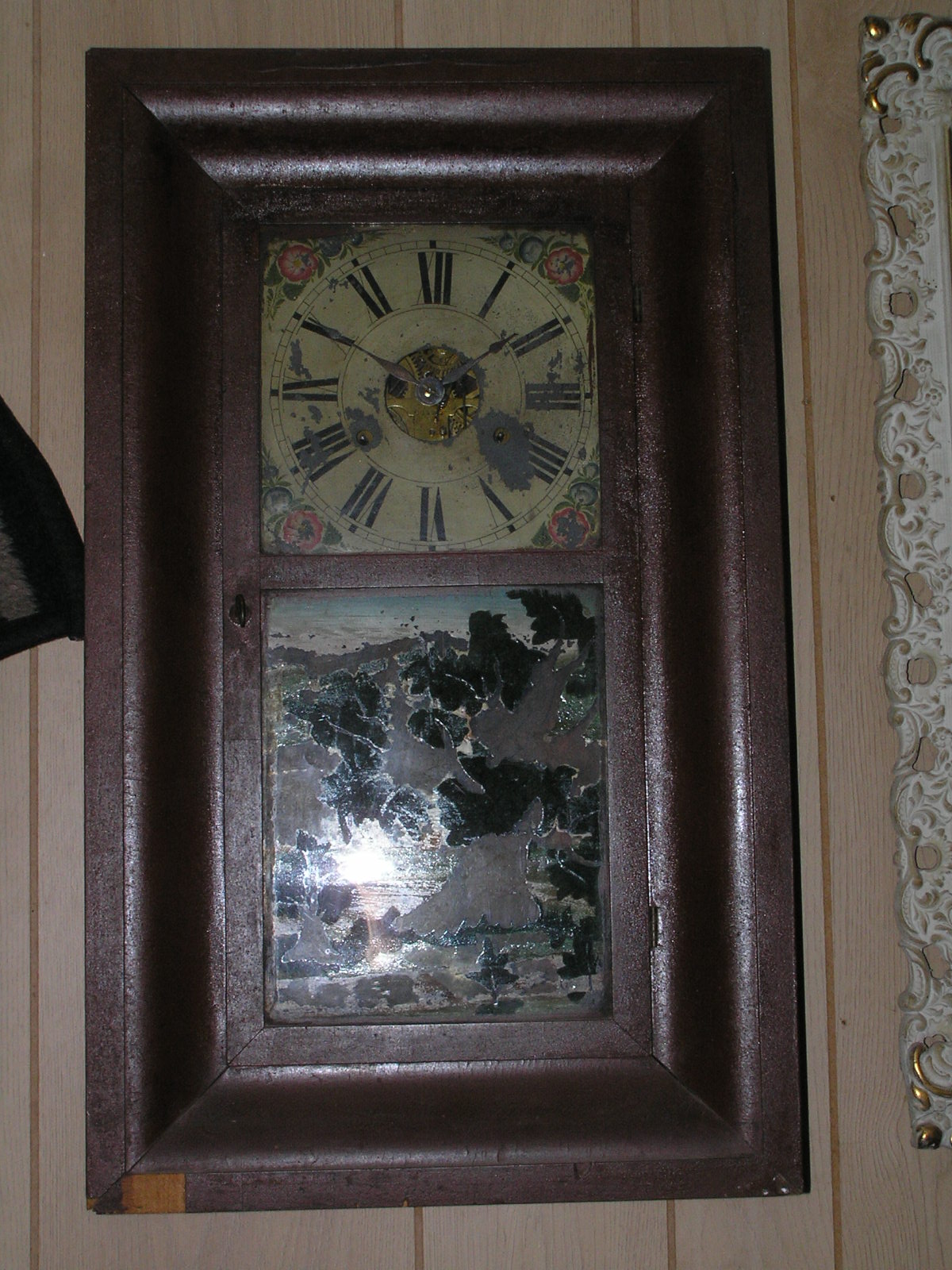

Remarkably, much of the label is intact and readable. It reads "Patent Brass Clocks Made and Sold By Chauncey Jerome Bristol, Conn. Warranted Good." The label was printed by Elihu Greer. The label simply lists his address as Hartford. The label describes Greer as an "Ornamental Printer" in the left corners, and as a "Book & Job Printer" in the right corners. The label also includes instructions on using the clock.


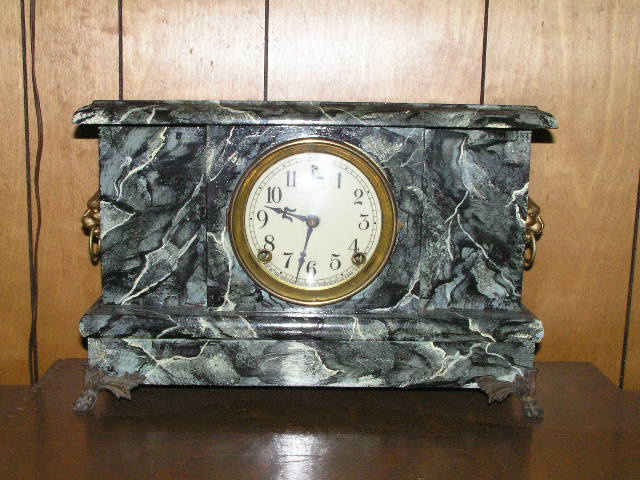
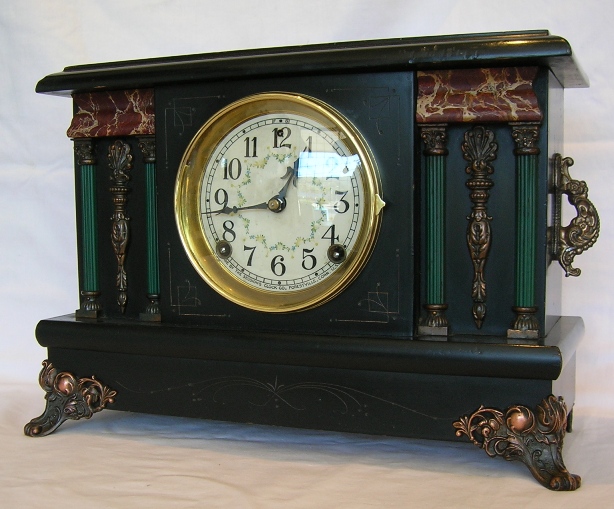
Sessions Black Mantle clock, circa 1912. Someone has stripped the case of all of its decorations and then painted it to resemble green marble. First picture shows it bare as I found it, second picture is the movement, a spring-wound 8 day. Clock counts the hours on a coil gong, and sound a single note on a bell at the half. Third picture shows the case after I found some original Sessions feet and some repro lions for the sides. An interesting feature of this clock is that it can be regulated without stopping it. The last picture is one I found online and is basically the same clock, but with the decorations still intact. Clock uses a double-ended #6 and #000 key.


Sessions Westminster Chime & Strike clock, mid 1920's. This tambour clock features Session's unique chiming movement. This is a full 4/4 Westminster chime clock using a chime movement based on Session's conventional time & strike movement, such as the movement used in the black mantle clock above. To make one mainspring & gear train do the work of two springs & trains, Sessions incorporated some novel features. Some of these included two racks and two snails, a rotating chime barrel that locks into place on the hour, and an extra wheel and pinion assembly. More details can be seen looking at US patents 1,837,462 and 1,883,387.
In addition to the photos below, I have made a movie that demonstrates the operation of this clock's unique chiming and striking mechanism. Clock uses a double-ended #7 and #000 key.


Seth Thomas 8-day Ogee Clock circa 1865-1868 A very fine clock with nice veneer. This clock has a painted zinc metal dial with a raised hour ring. The dial is hand painted. The case has some details that the Jerome clock above does not. The door frame is concave, and the outer surround of the case is convex. The glass over the dial appears original, but I think the tablet is a replacement. The clock appears to have been refinished about 30 or 40 years ago. This clock uses an interesting version of the Seth Thomas Lyre Movement that is not often seen. It is weight driven. A 7 pound 9 ounce weight operates the strike side, while a 8 pound 15 ounce weight operates the time. The clock also features an alarm. The case on this clock is the same size as most 30-hour ogee clocks, compared to this the more common 8-day Seth Thomas ogee clocks are massive in size. This type of clock is much easier to get along with than a 30-hour clock, since it does not require daily attention. Clock uses a single-ended #6 crank.

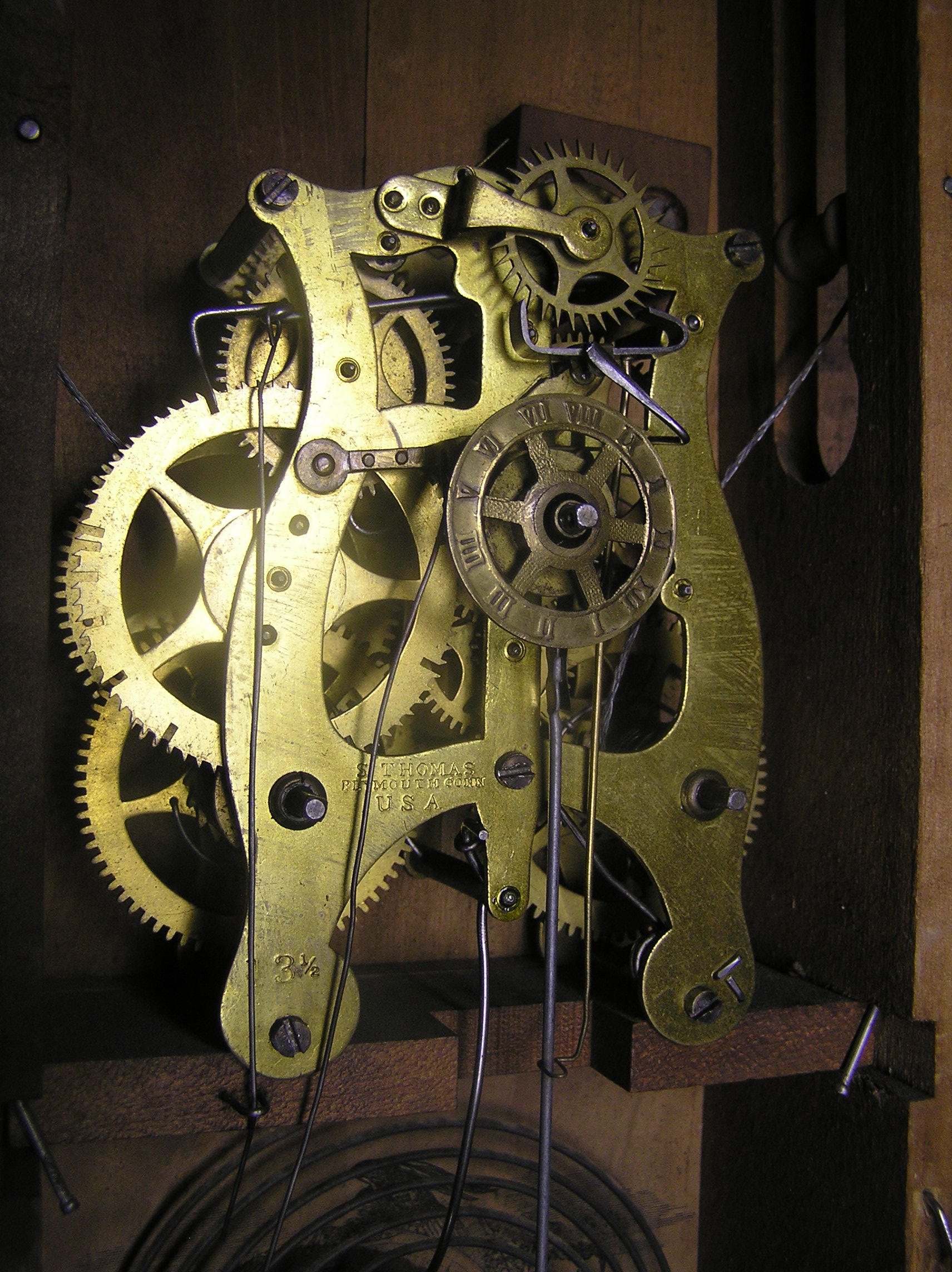


The label has great instructions for using the clock. It is too bad that American clock makers moved the label to outside the case in later years where the label was more easily damaged.

Seth Thomas 30-hour Cottage Clock with peaked top, c1868-1875. This little cottage clock is a nice example of the clocks Seth Thomas was making in the mid 19th century. The date range for when this clock was made is given is based on the stamp on the movement and the label. The movement is stamped Plymouth Conn., but the label identifies the location of manufacture as Thomaston. It is well known by many that the name of Plymouth, Connecticut was changed to Thomaston on honor of Seth Thomas in 1865, but the name did not legally change until 1875. This clock was probably made after 1868 because it lacks the flowers on the dial that the ogee clock above has. This clock was in rough shape when I received. The case was falling apart and both mainsprings were broken. Much to my surprise, the original key & minute hand were inside the clock. Other than the piece of molding on the door, it is complete. Clock uses a single-ended #4 key.


Seth Thomas 8-Day Flat-top Cottage Clock with alarm circa 1868-1875. This cottage clock was made during the same time period as the 30-hour clock shown above. The case is veneered with rosewood. It uses a series 44 movement. You will likely notice that Seth Thomas was rather fond of using movements that were decidedly unique when compared to most other American makes. This movement also has what are known as stop-works or Geneva stops. These limit how much the springs can be wound or unwound. The dial on this clock is in very good condition, and I suspect it has been painted over, especially since "Seth Thomas" is visible as ghost lettering on the dial. Clock uses a single-ended #6 key.


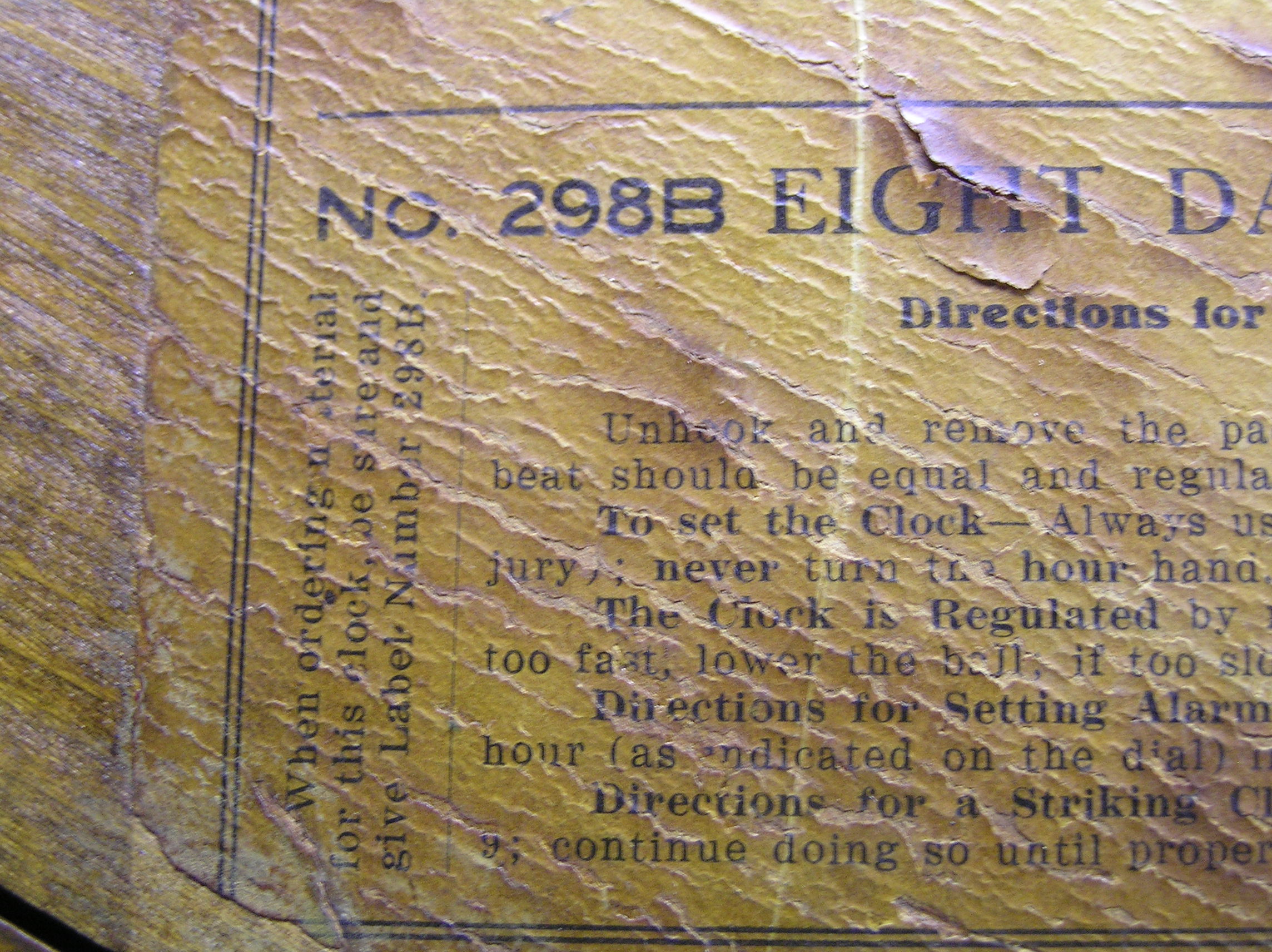
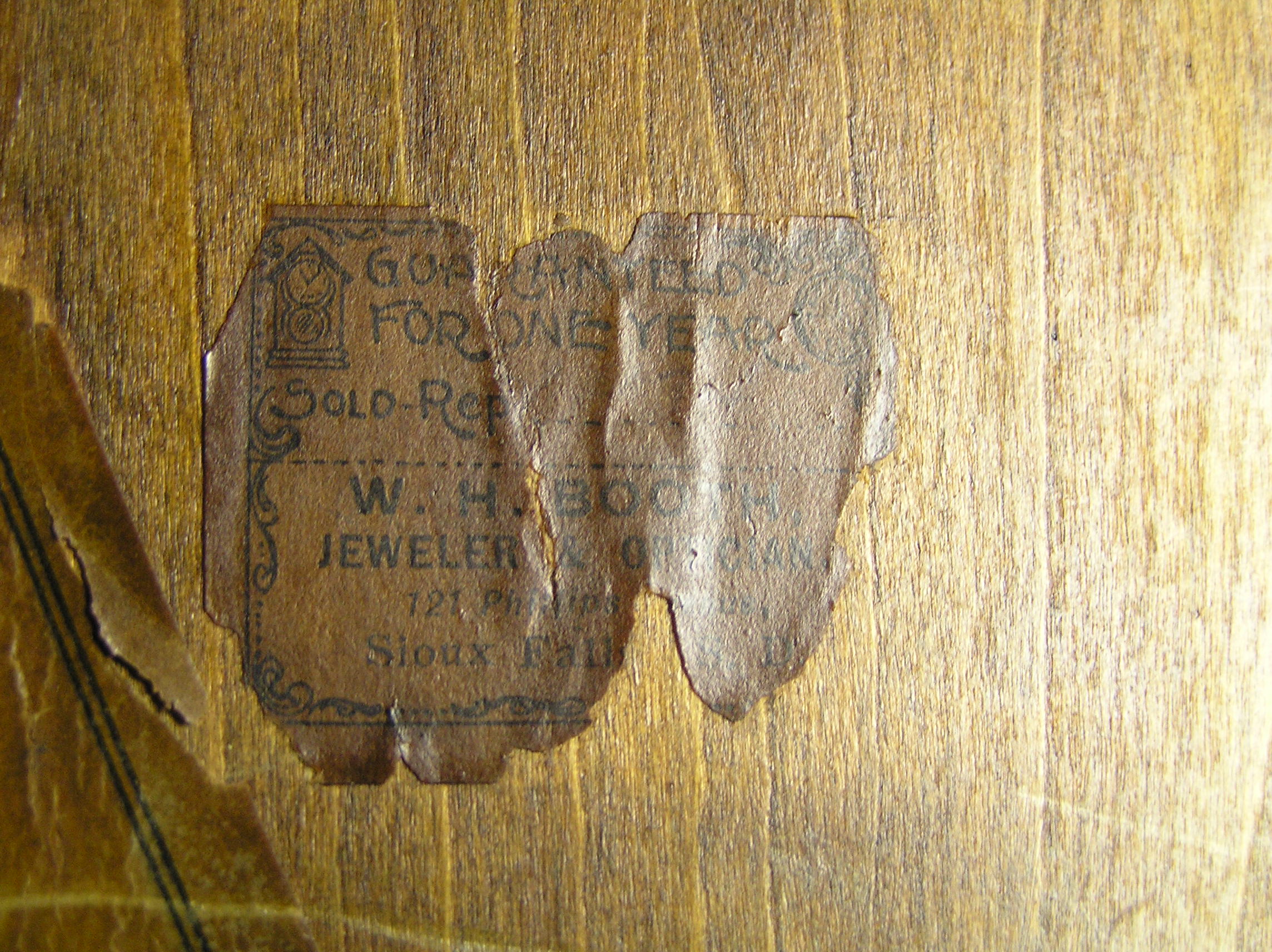
Seth Thomas Fleet Series "kitchen clock" circa 1909 This clock is in really great shape, and at the same time, it is not. It is a good example of what can happen to clocks in their 100-years or so of existence. The case has been modified to make the clock more like a cottage clock than a kitchen clock. The finish is very good, and all the labels are still present. It is just a pity such a clean clock was butchered. Nonetheless, in its altered form it is a nice clock. I have decided to wall mount it and use it as an alarm clock. The hour and half-hour strike do not effect sleep, and I sleep right thru them. This clock uses the reliable Seth Thomas model 89 movement. I've included a picture of an intact fleet series clock from an ebay auction for reference. There were 3 or 4 different case designs that all sold under the same model number, 298B. A label on the back indicates this clock was originally sold by W H Booth, Sioux City South Dakota. Clock uses a single-ended #6 key.



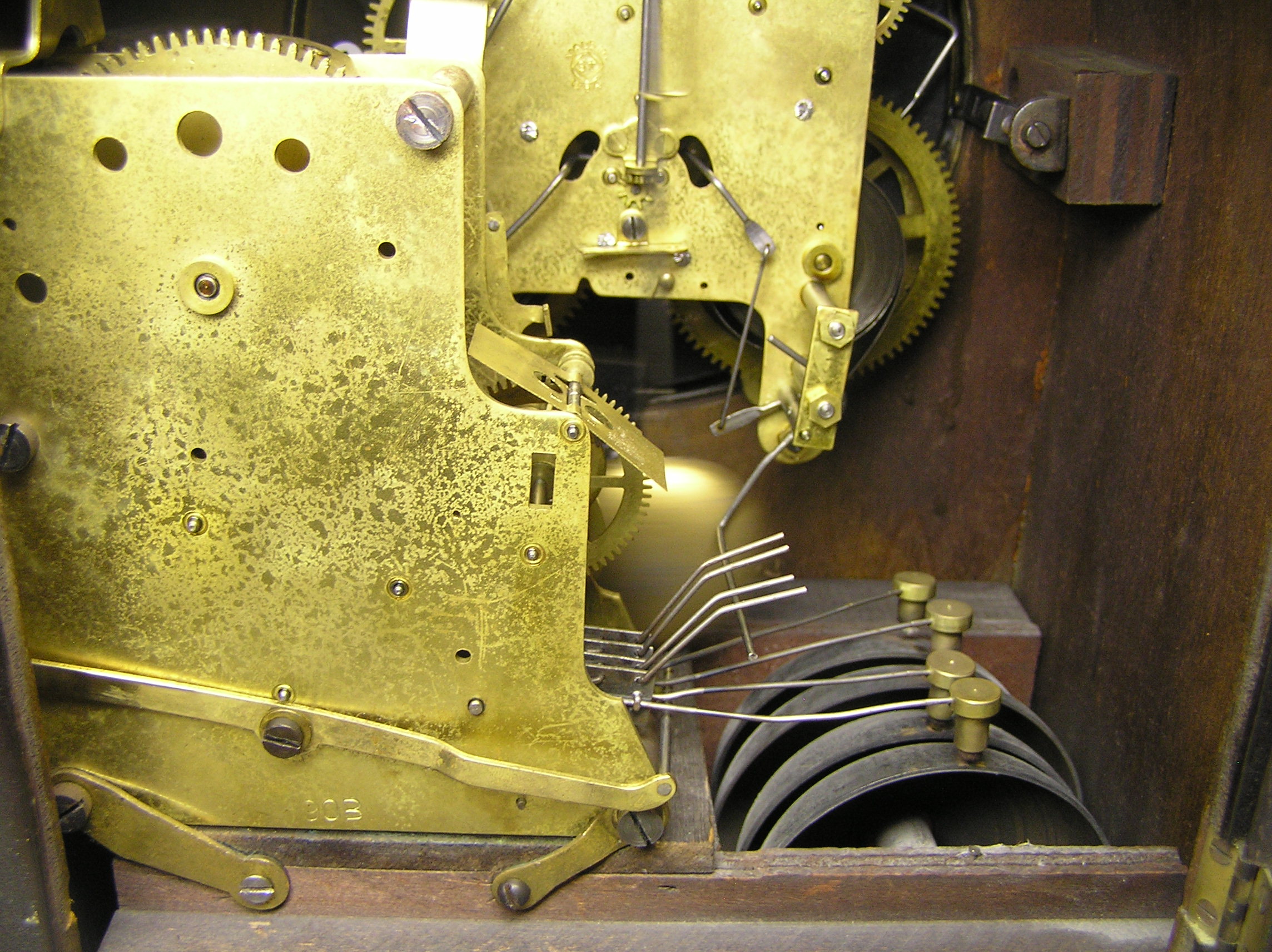
Seth Thomas 4 Bell Sonora Chime circa 1916. This clock is rather unusual as far as chiming clocks go. A model 89 movement, similar to the one used in the fleet clock above, is used for the time and strike functions. To this, a model 90 movement is added to chime the quarters. The quarters and hours are sounded on a nest of 4 bells. The bells are so arranged to take advantage of a tone chamber mounted adjacent to them. You may read more about it by viewing US patent 879,170. In the first Sonora chime clocks, the Sonora Chime Co. made the chime movements, and sold them to other clock makers. Seth Thomas and New Haven were perhaps the only two companies to manufacture Sonora chime clocks. The New Haven models are quite rare compared to the Seth Tomas models. Eventually Seth Thomas bought the rights and made the entire mechanism in house. 4-bell, 5-bell and 8-bell Sonora chime clocks were made until about 1919-1921 when more conventional chime rods replaced the bells. The 8-bell models were dual-chime clocks and could play either Westminster or Whittington chimes.
In addition to the photos below, I have made a short movie that demonstrates the clock chiming and striking. Clock uses a double-ended #7 and #000 key.


Seth Thomas 5-bell Sonora Chime Circa 1915. Much like the 4-bell chime clock shown above, but with a 5th bell on which the hours are struck. This clock also has a gothic style case instead of the beehive case of the 4 bell clock . Sonora bell clocks were available in several different case styles, and a search of ebay will reveal a wide assortment of cases. The 5 bell clock is very slightly rarer and more desirable than the 4 bell, but not nearly as rare or desirable as the 8 bell. Notice that the dial on this clock actually says "Sonora Chime" on it. These are simply wonderful clocks to listen to and to have chiming. Clock uses a double-ended #7 and #000 key.


Ingraham "Superior" gingerbread or kitchen clock, 1897. The movement for this clock carries a date stamp of January 1897, it also uses steel plates. The plates originally had a brass-toned wash to make them look as if they were made of brass. Several American manufacturers were using steel for their movement plates instead of brass during this period. The 8-day movement in this clock was used with slight variations in many clocks. Note the clean, very uncluttered lines of the case. This model clock was made well into the 1920's. Clock uses a single-ended #7 key.

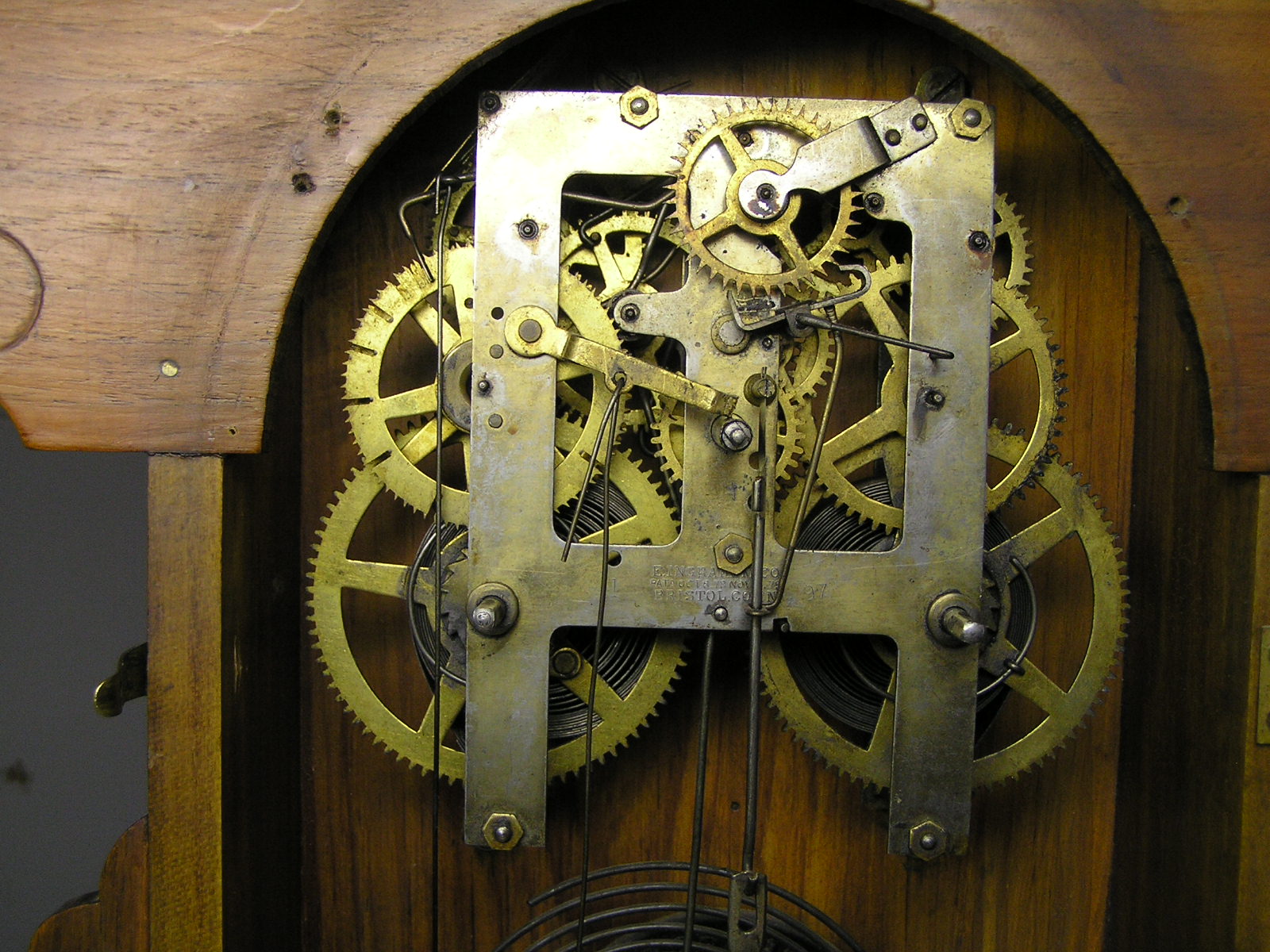
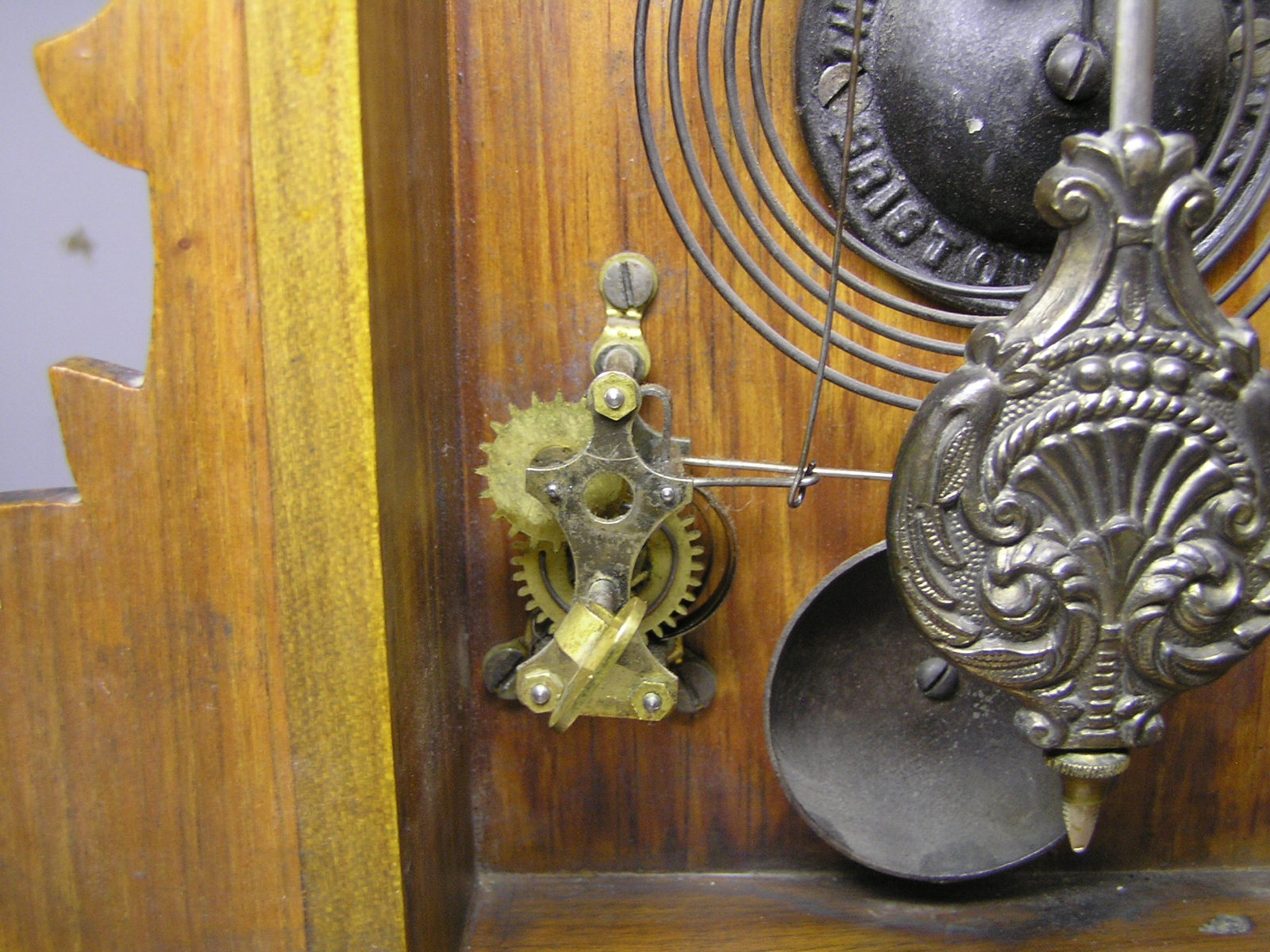

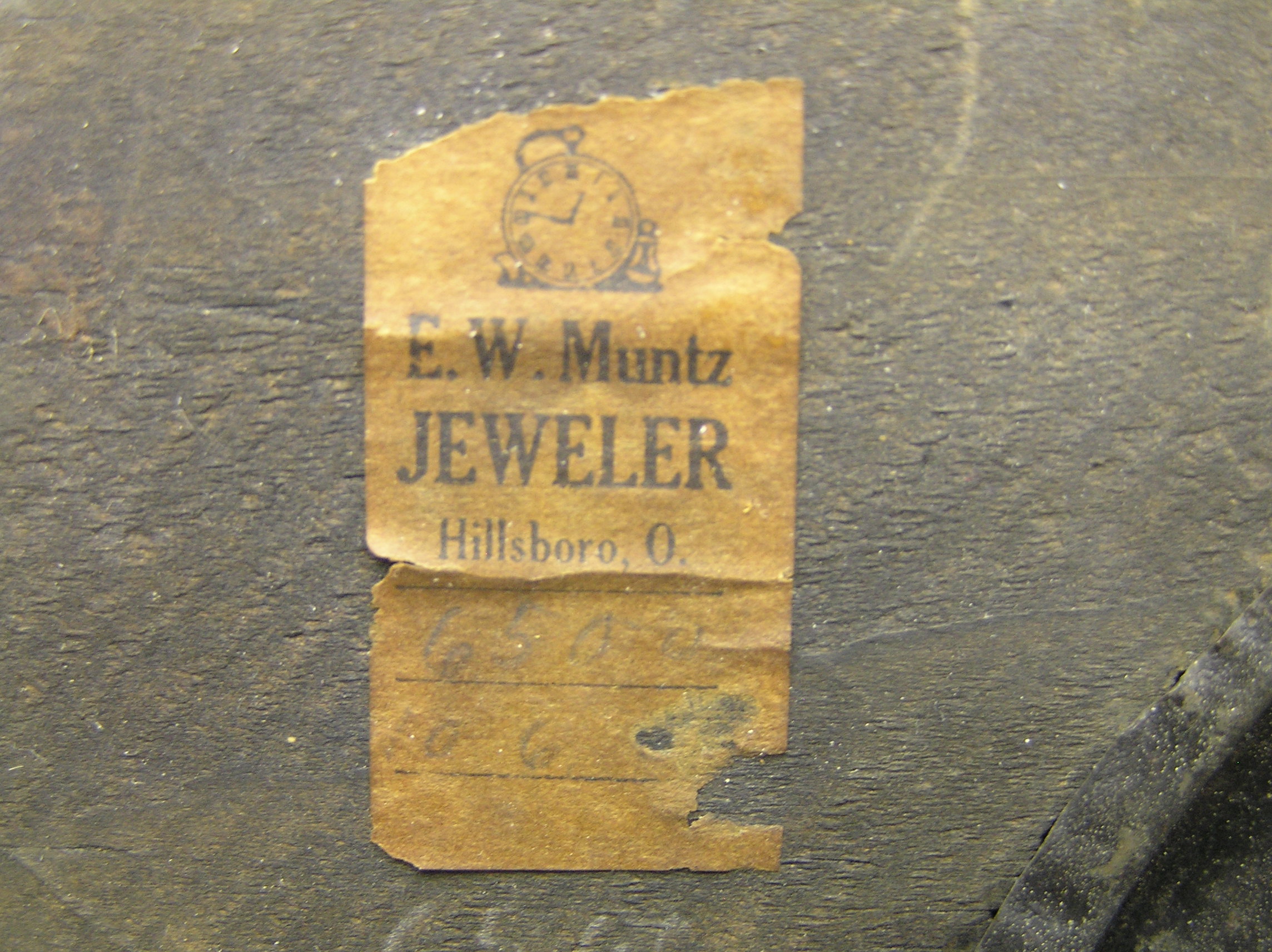
Ingraham Black Mantle Clock 1905. When I first started collecting clocks as a teenager back in the early 1990's, it was an Ingraham black mantle clock that I always wished to have. And at long last, in 2013, I came into possession of this one, after having a Sessions, and then a New Haven black mantle first. Other than the case being loose in a few places and the side ornaments missing, this clock was in overall fine shape. The movement is the standard Time and strike type that Ingraham used with a semi-deadbeat escapement. It is interesting to note that Ingraham did not modify its movements to rear mount or between the plates mount the escapement on mantle clocks, and used the front mount pendulum just as they would on a kitchen clock. As such, virtually all Ingraham mantle clocks will have an access on the bottom of the case to attach the pendulum. Like many black mantle clocks, this clock strikes the hours on a gong, and sounds the half hour on a bell. This clocks appears to have an original jeweler's tag on the back from E.W. Muntz of Hillsboro Ohio. Clock uses a single-ended #7 key. Ingraham used a thumb-wheel to front regulate its mantle clocks.



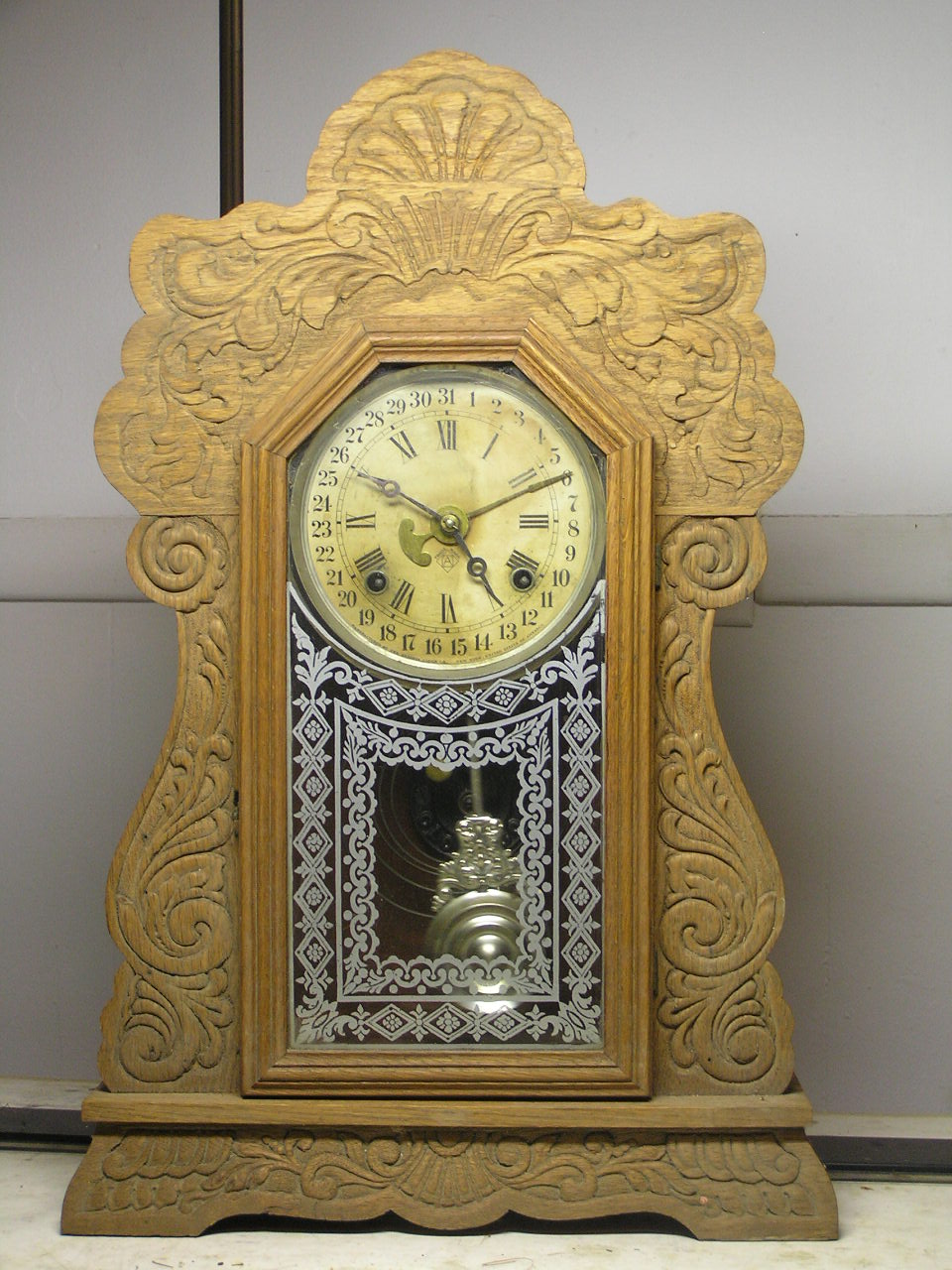
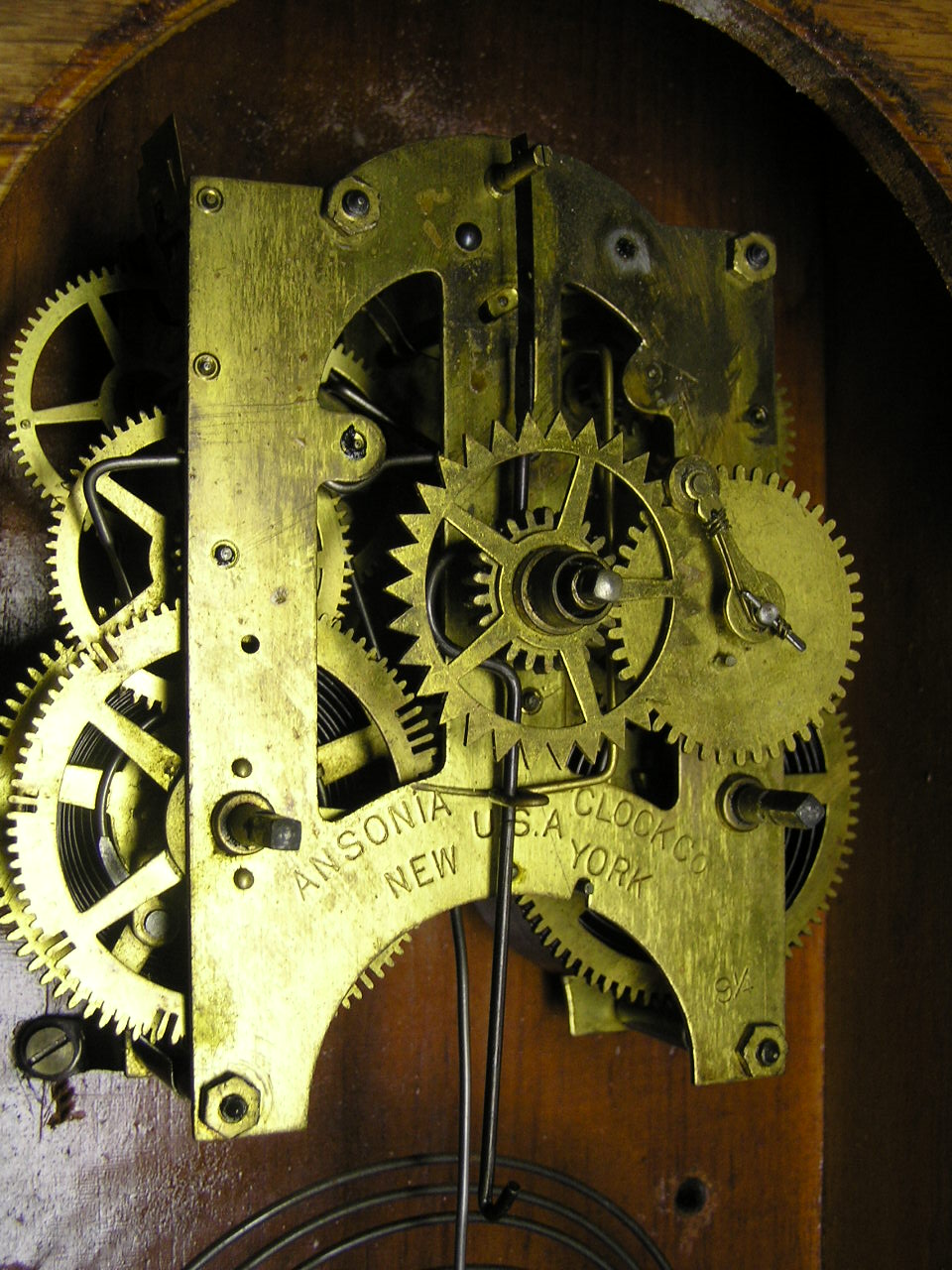
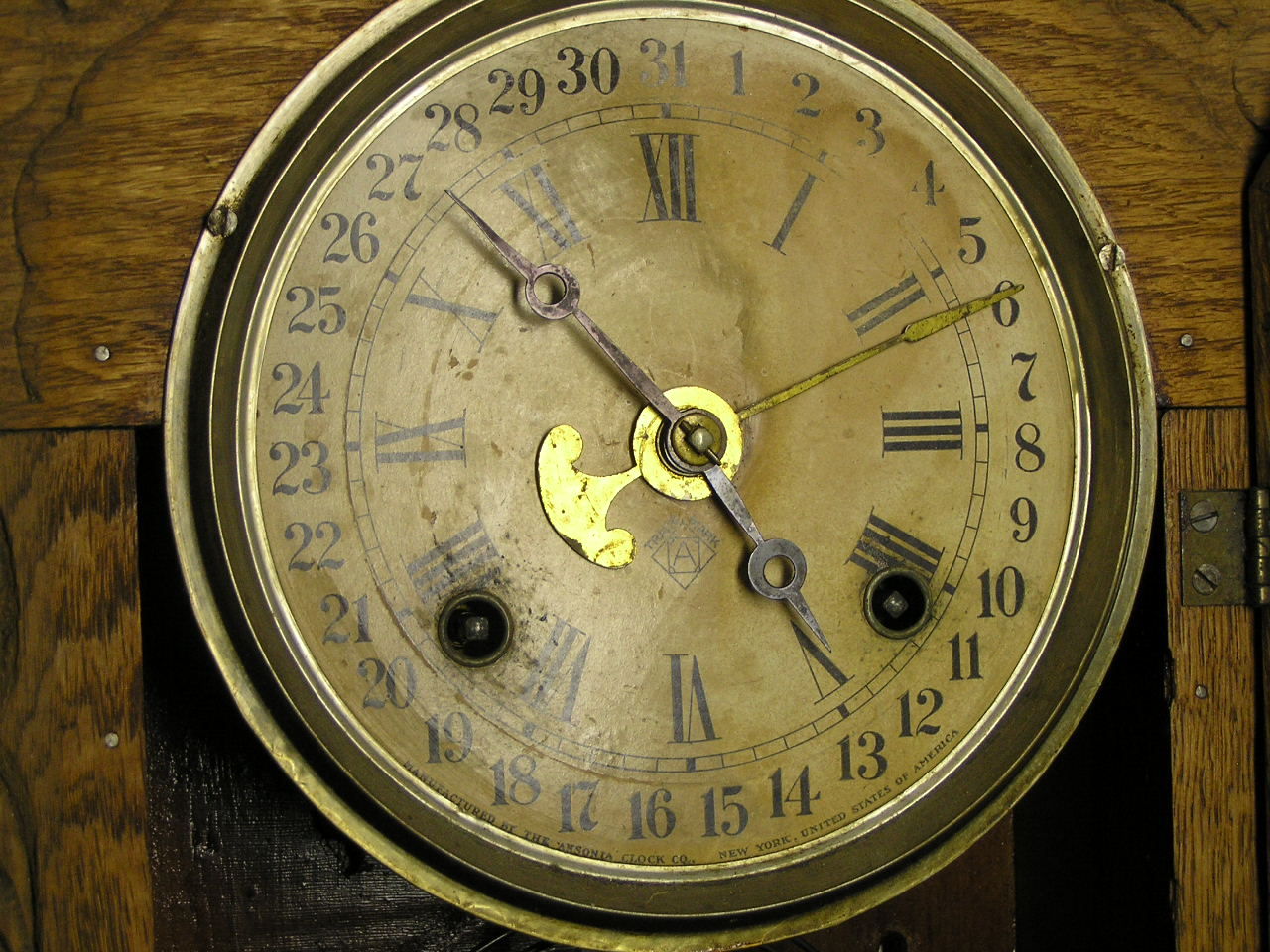
Ansonia Kitchen or Gingerbread Clock circa 1905. This Ansonia kitchen clock with pressed oak case is very typical of the clocks that were popular from the late 1890's to about 1910. Instead of an alarm, this clock has a calendar attachment. This clock is a great example of a more conventional clock made by a company best remembered today for their novelty clocks. Ansonia was started in 1853 by Anson G Phelps. Phelps was a brassmaker who started making clocks as a way of having a ready market for his brass products. In 1929, several months before the crash, Ansonia declared bankruptcy & all equipment was sold to Russia. The photos all show the case and movement before cleaning. Clock uses a single-ended #6 key.
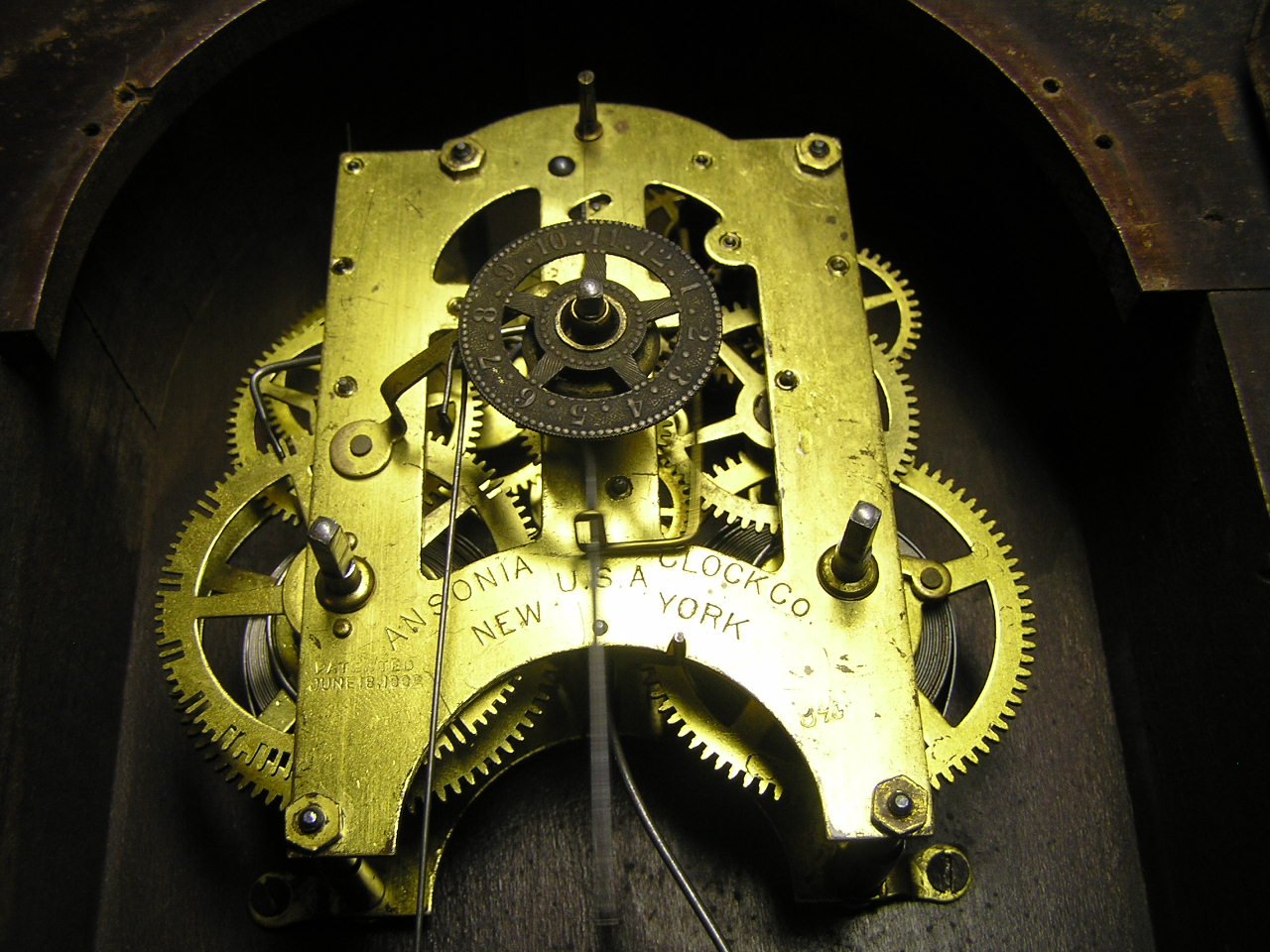
Ansonia/Waterbury Walnut Parlor Clock circa 1876-1890. This clock is a marriage. The case is a Waterbury case made in 1876 with an 1890s-1900s Ansonia movement, alarm and dial. This clock would have originally had a Waterbury alarm, as the holes at the bottom match the Waterbury alarm footprint. It is suprising that the time was taken to replace everything so completely, excepting the pendulum, which I believe is the Waterbury pendulum original to the case. Apparently this case design was made only 1 year, but I have seen two different styles of this case, the variations being in how the top of the case is made behind the front. Some have a round top, as this one does, and some have a flat top. It may be the round-top case was made only 1 year before Waterbury switched to flat-top cases. The case is walnut, and several decorations are missing. I have cleaned the case & repaired a few splits in the wood. I've included before and after photos of the movement. The fourth photo is from an ebay auction and shows a non-alarm version of this clock with the case details intact. The name of the clock is on a label on the back and is Fon__a, with the blank areas illegible because the label has been damaged. Clock uses a single-ended #6 key.



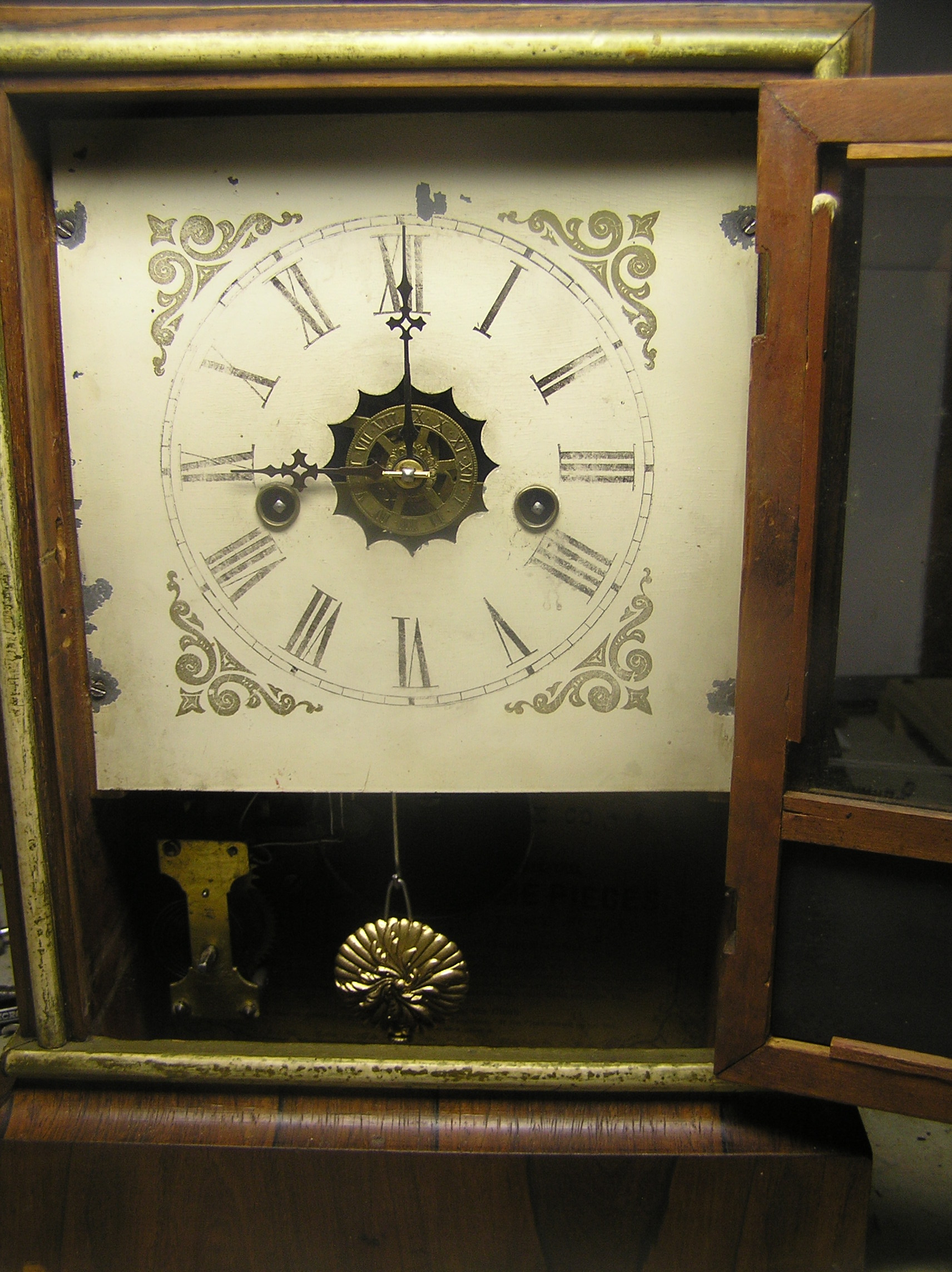
Waterbury Cottage Clock circa 1870-75 This little clock is a nice example of a "Cottage Clock" with a 30-hour movement. The clock will run for 2 days easily before it needs rewound. This clock has many features typical of the era in which it was made. The plates are held with pins instead of screws or nuts. The movement is held to the case with slotted wood strips instead of the more familiar feet. The dial is pained zinc rather than paper over metal. This clock also has an alarm. The alarm requires the use of a clock key to wind, unlike later clocks which have the key always attached. This clock sounds the hour only, and does so on the same bell that is used for the alarm. Clock uses a single-ended #4 key.

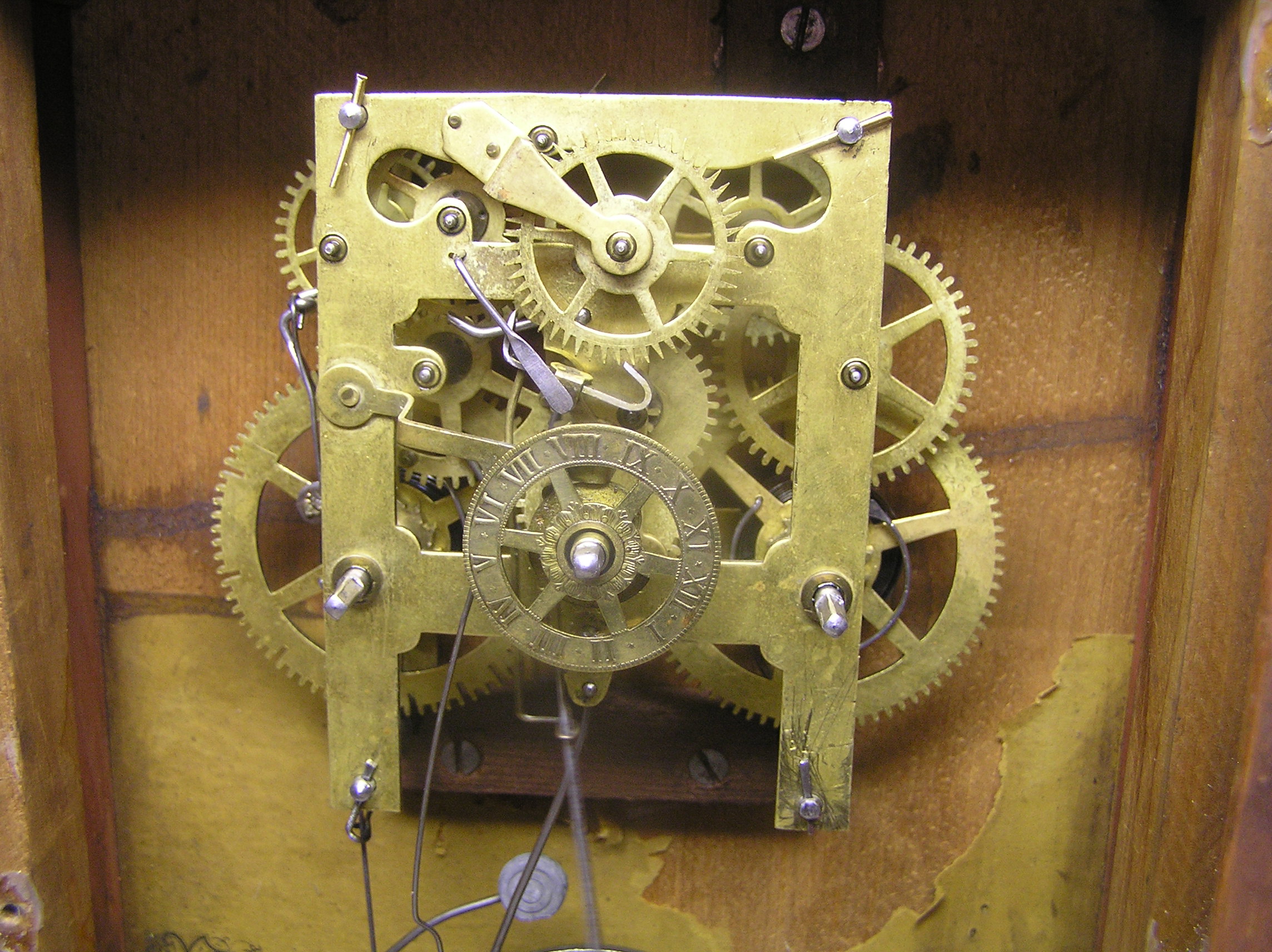
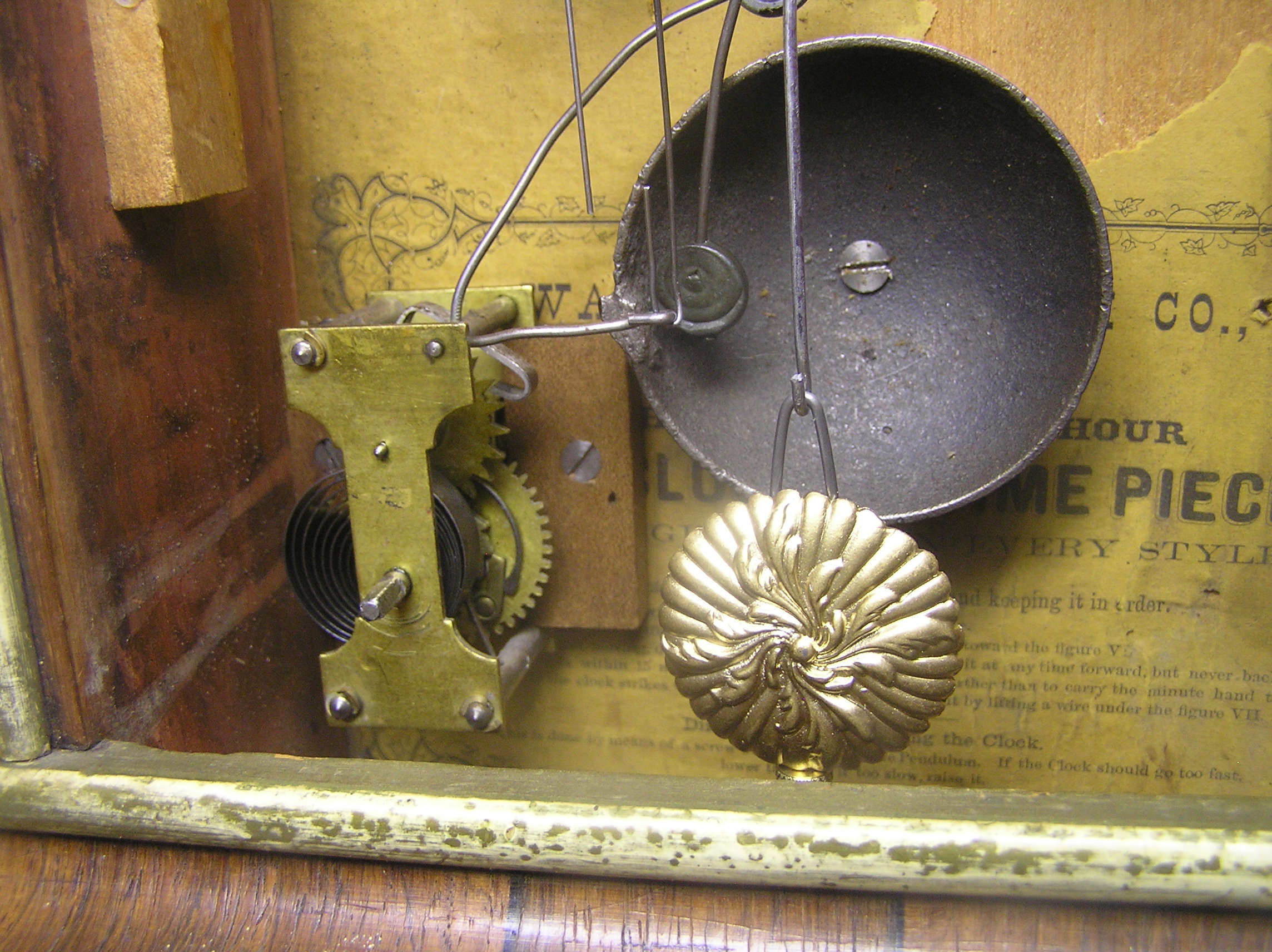
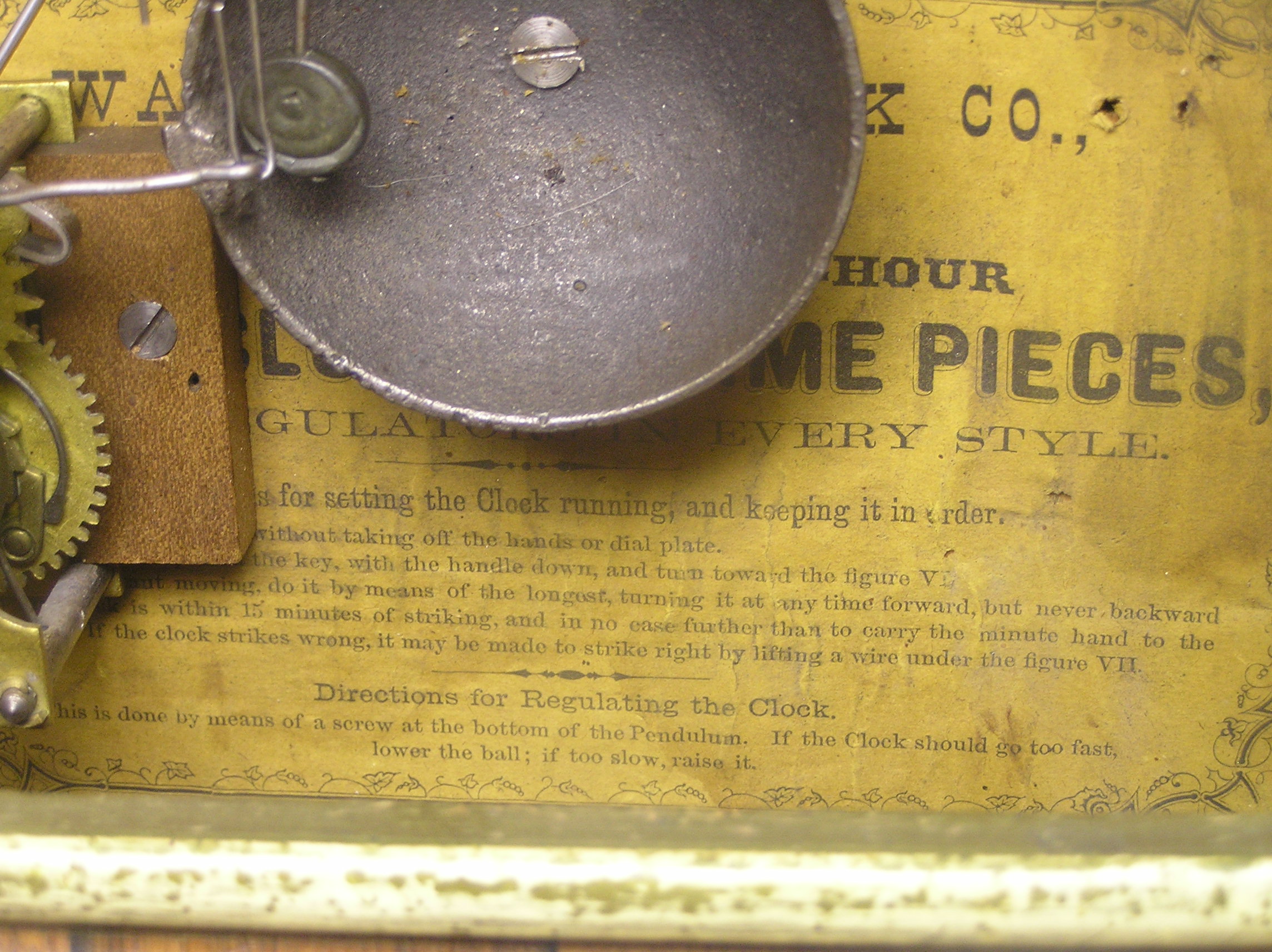
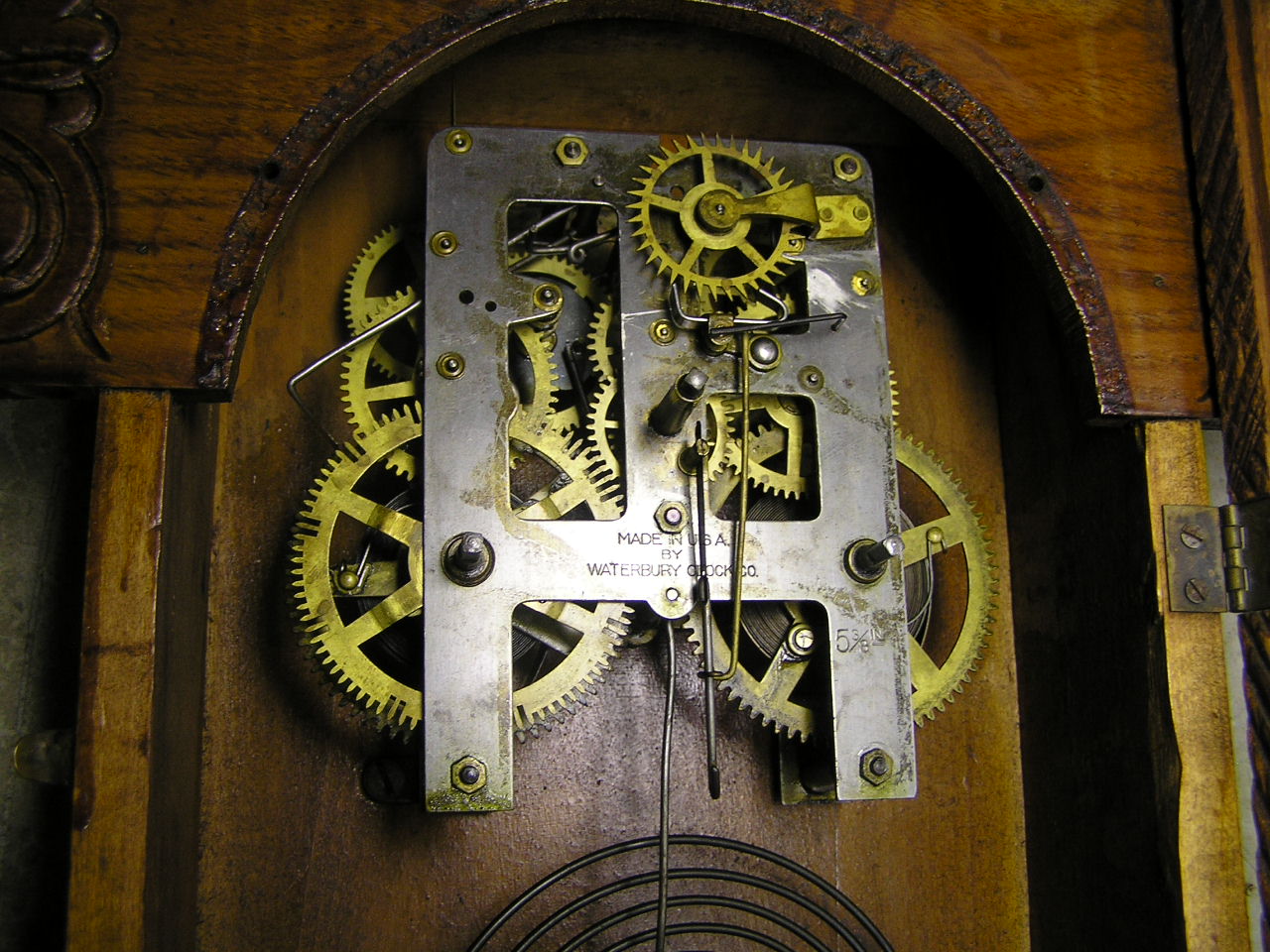
Waterbury Kitchen or Gingerbread Clock Circa 1899-1902. This is a nice Waterbury Kitchen clock with steel plate movement. Several manufactures made steel plate movements around the 1900 time period, possibly because of increased brass prices from military action taking place at the time. The Waterbury Clock Co. was founded in 1854. The company changed its name to United States Time Corporation in 1944, and again to Timex in 1969. All photos show the clock basically as I found it. I was pleasantly surprised to find the rear label intact. Despite the steel plates, the movement uses brass bushings and is just as good as a regular brass movement. The dial is a replacement dial with Arabic figures. I plan to replace it with a proper Roman dial soon. Clock uses a single-ended #6 key.

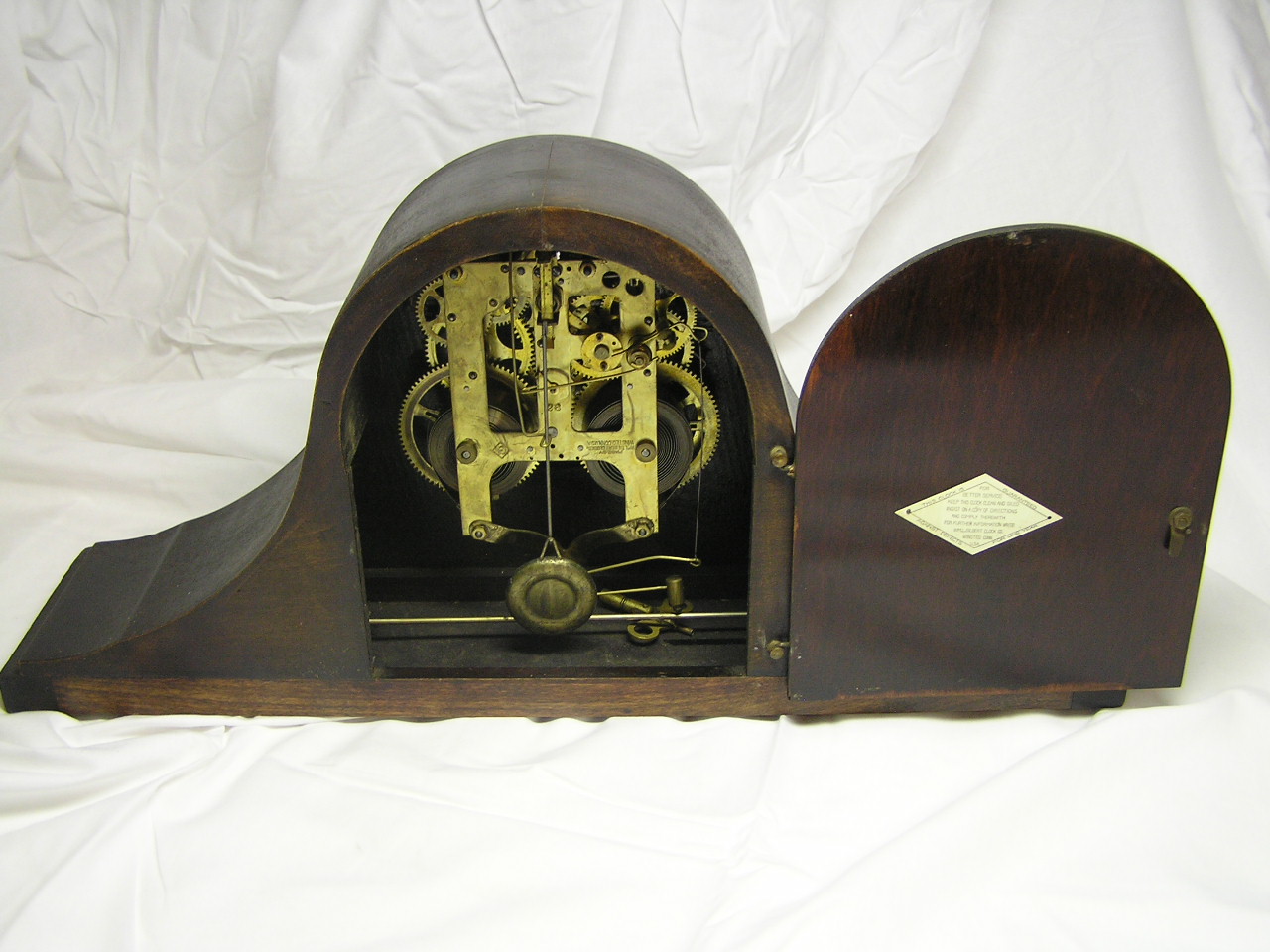
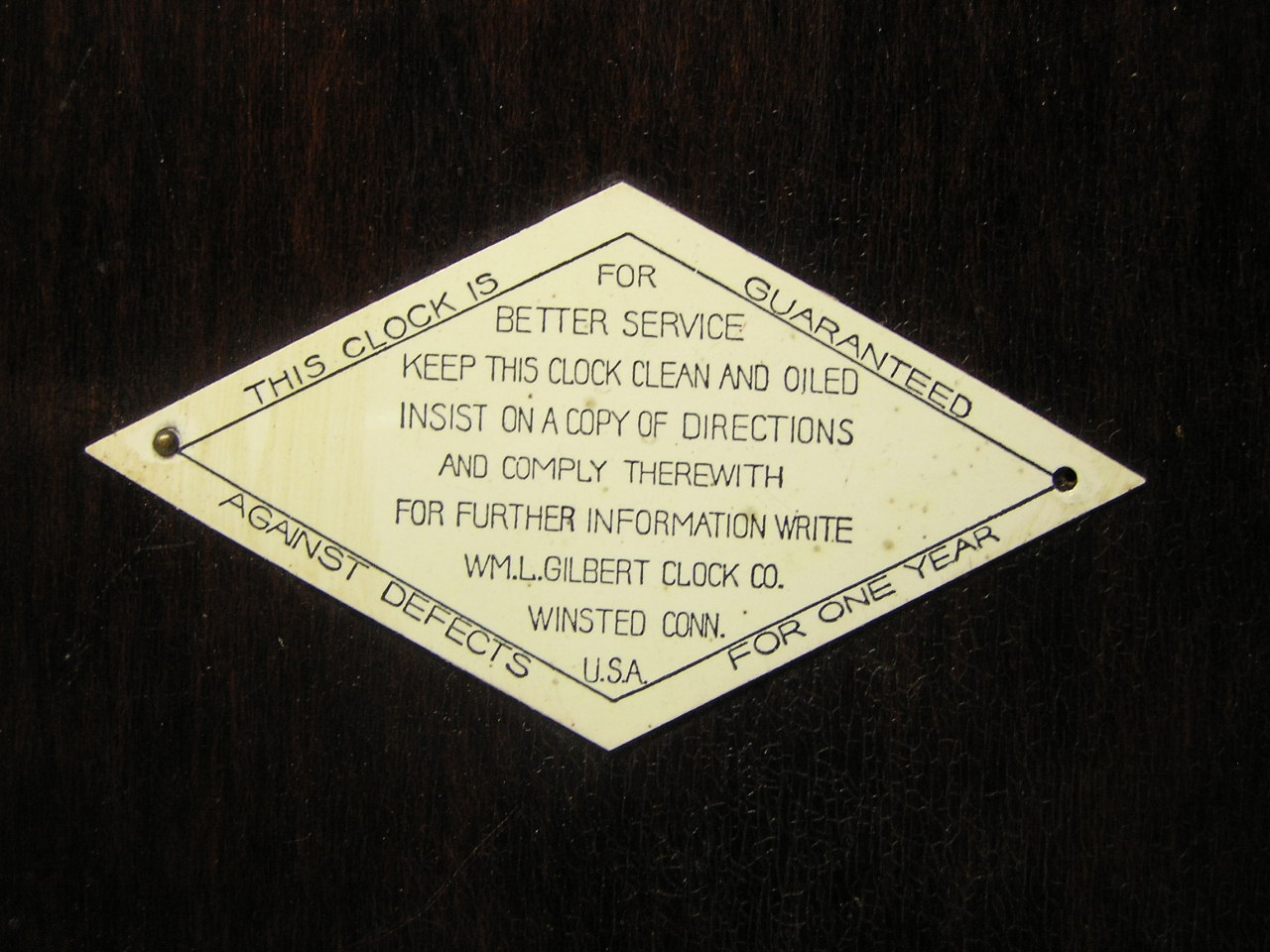
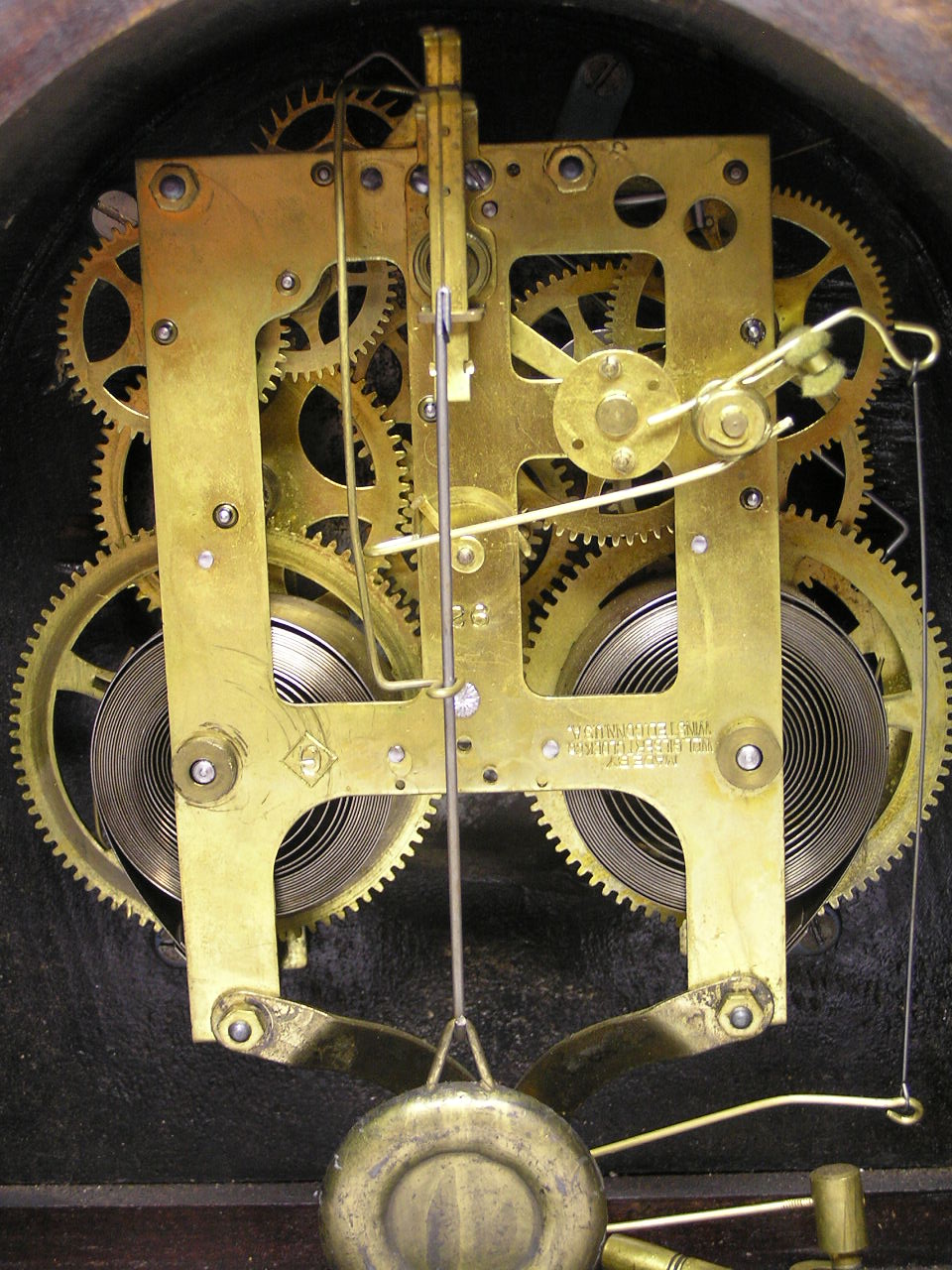
Gilbert Tambour Clock, circa 1926. This is a nice original clock by the William L Gilbert Clock Co. The movement is date stamped 1926. The clock has a nicely made and finished case and a brass 8-day movement with strike. A leather tipped hammer produces a nice tone when striking the hour and half. Like most mantle clocks, this one can be regulated from the front. Gilbert made some really fine clocks. Clock uses a double-ended #6 and #00000 key.

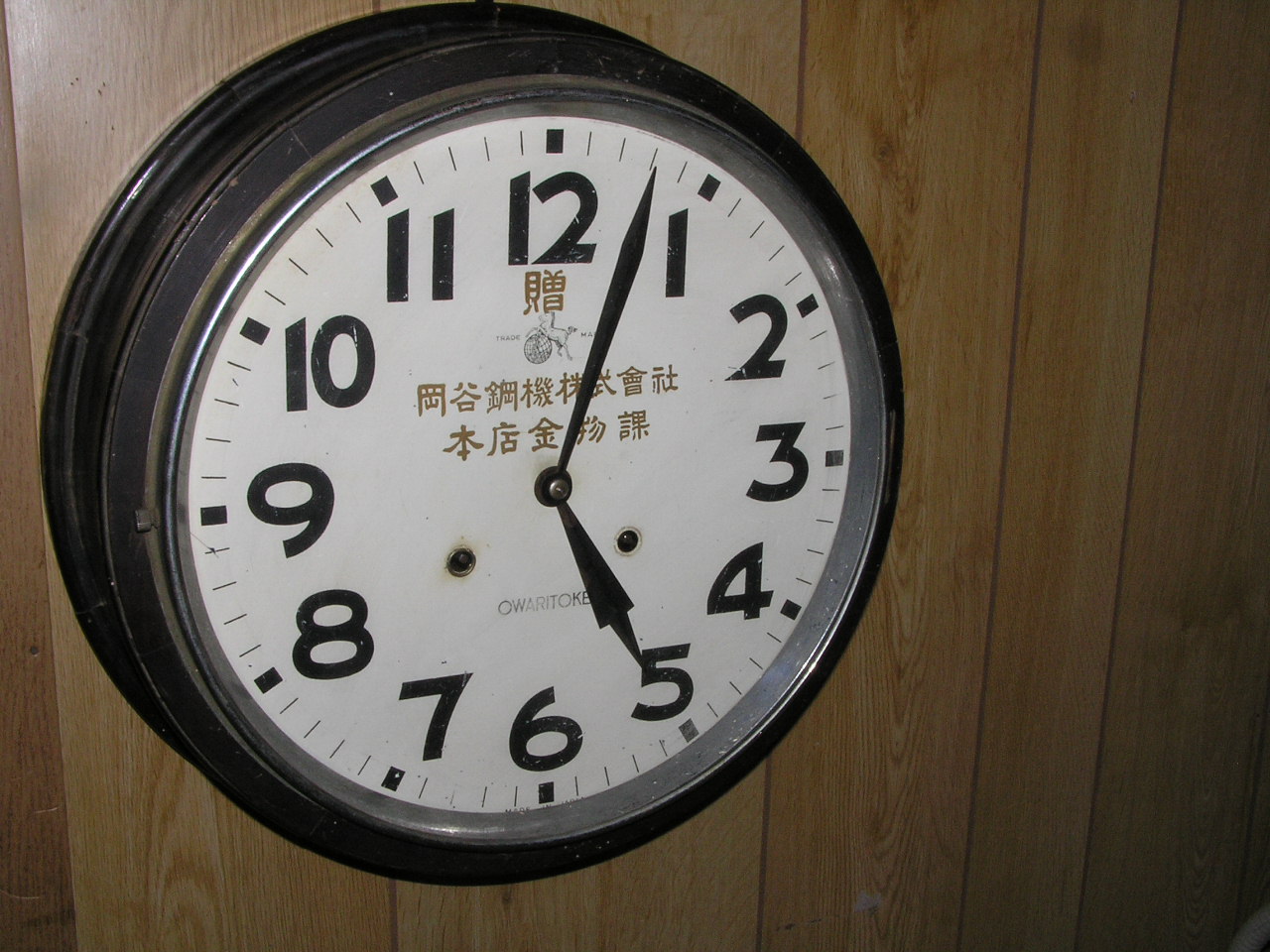
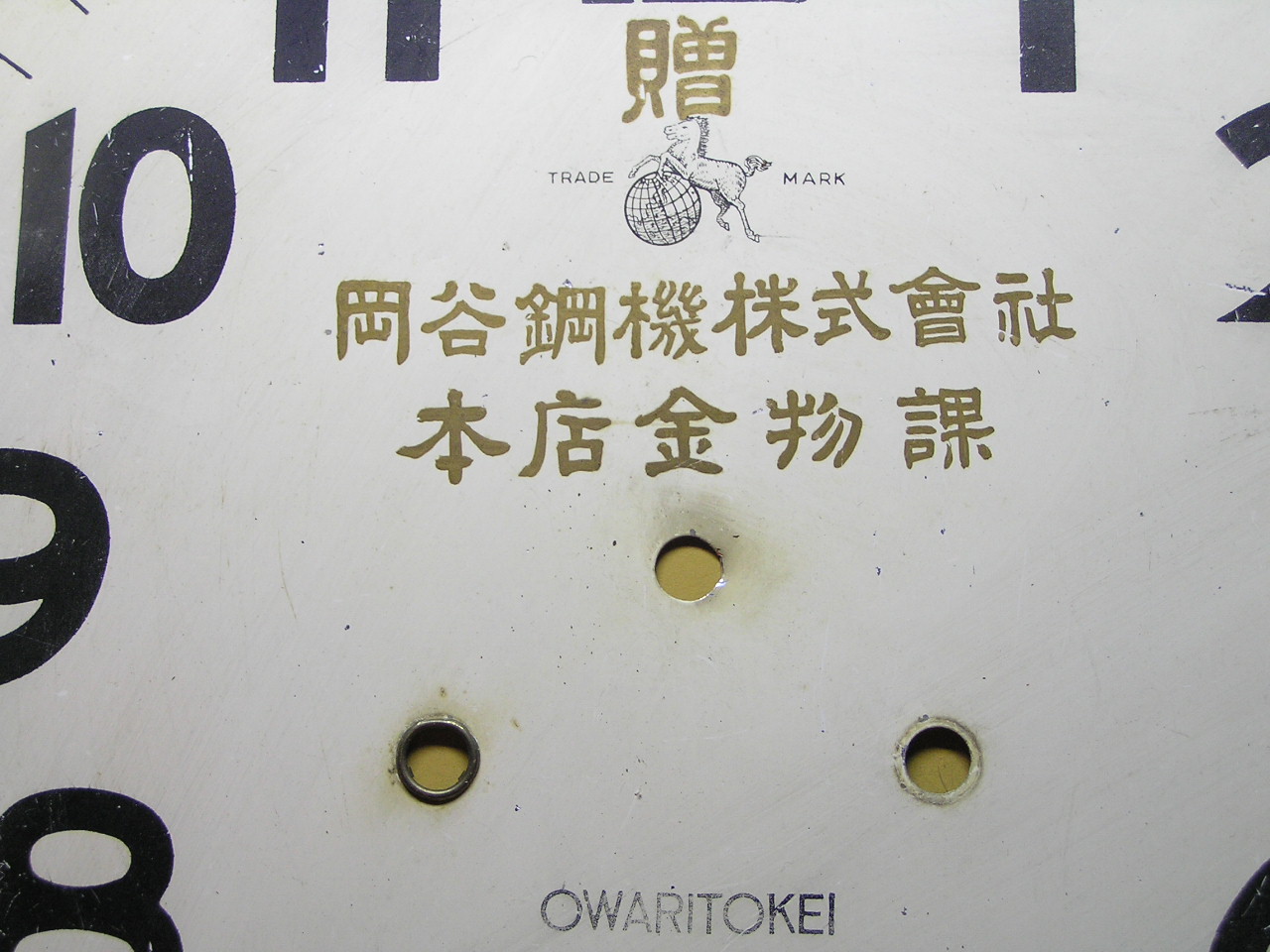
Owari Clock Co. This large dial wood cased clock was made in Japan by the Owari Clock Co (tokei is Japanese for clock, hence the Owaritokei marking on the dial.) Note interesting horse and globe trademark. The Owari Clock Co. apparently existed from 1894 until circa 1965. First photo shows clock after I finally got it back together and running. It was in bad shape, after being in storage in Hawaii for some time. Second photo is of the movement before cleaning. Note that it looks a lot like an Ansonia 8-day movement. This clock strikes the hours and half hours. The second and third photos show the movement before and after cleaning. Fourth photo shows the markings on the dial. Because the dial glass was broken in shipping, a lot of chips and scratches were put in it. Luckily the writing is still clear. The fifth picture shows the stamp on the movement. Clock uses a single-ended #8 key.



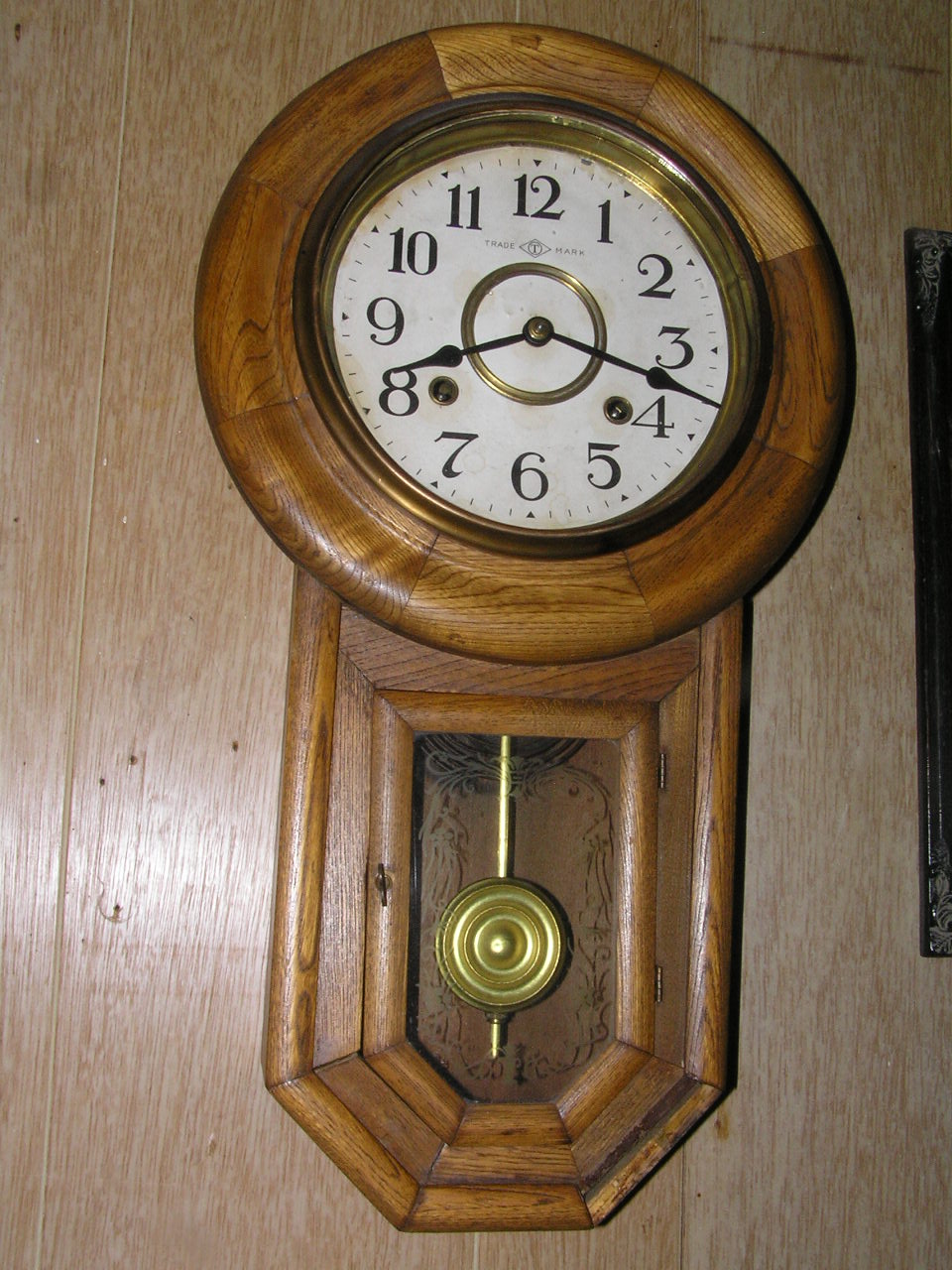
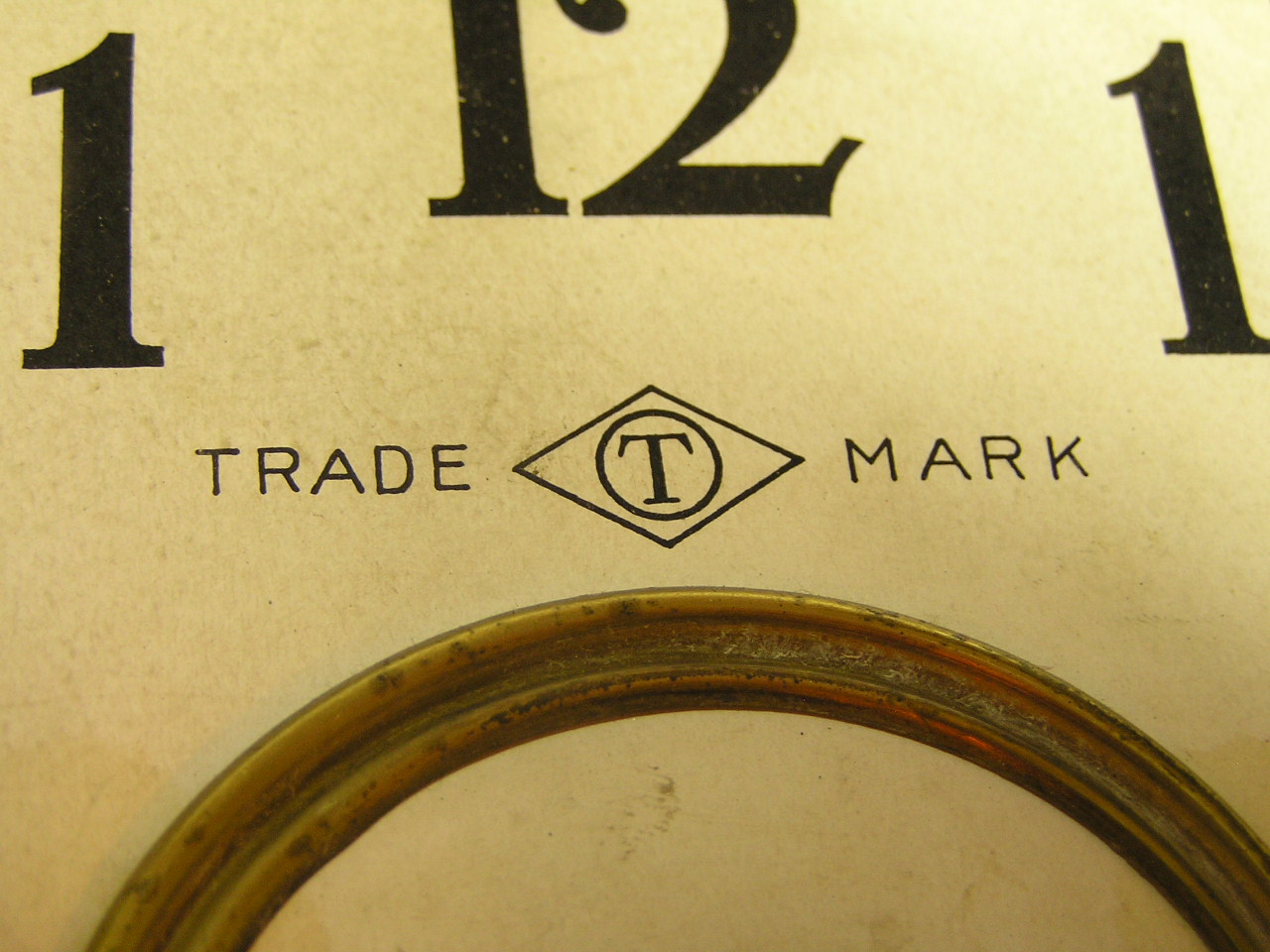
Takano Clock Co., LTD School Clock. Circa 1910-1930 I thought this was a Korean-made clock, but while researching the above Owari clock, I found out the "T" circle and diamond trademark belonged to the Takano Clock Co. LTD, of Nagoya, Japan. Takano was founded in 1895. Like the Owari clock above, the movement is a copy of, or patterned after, movements made by the Ansonia Clock Co. The case appears to be made of Ash. The clock runs for 8 days and strikes the hour only. Clock uses a single-ended #8 key.

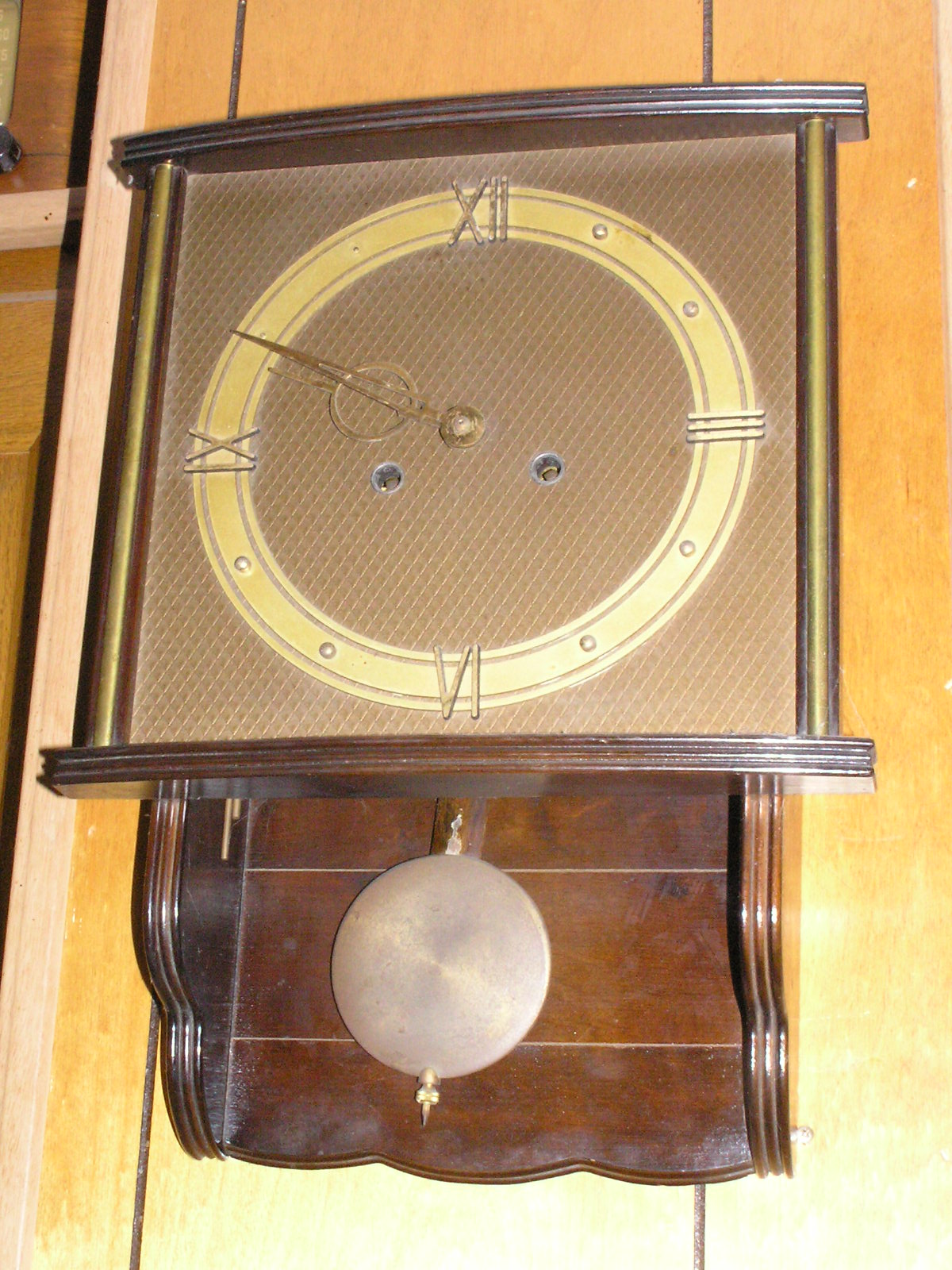
German Emes 8-day wall clock, 1950's era. Features a bim-bam hour and half-hour strike on four tuned rods. Very impressive sound from this very modern-styled clock. When I bought this clock, I had a German console radio that the clock complimented very nicely. The movement is marked Emes Made in Germany. As you can see, a few of the brass hour maker studs have fallen off. One disadvantage of this clock is that it is light and the springs are heavy, so it is a given that the clock will have to be put back in beat almost each time it is wound. Clock uses a single-ended #12 key.
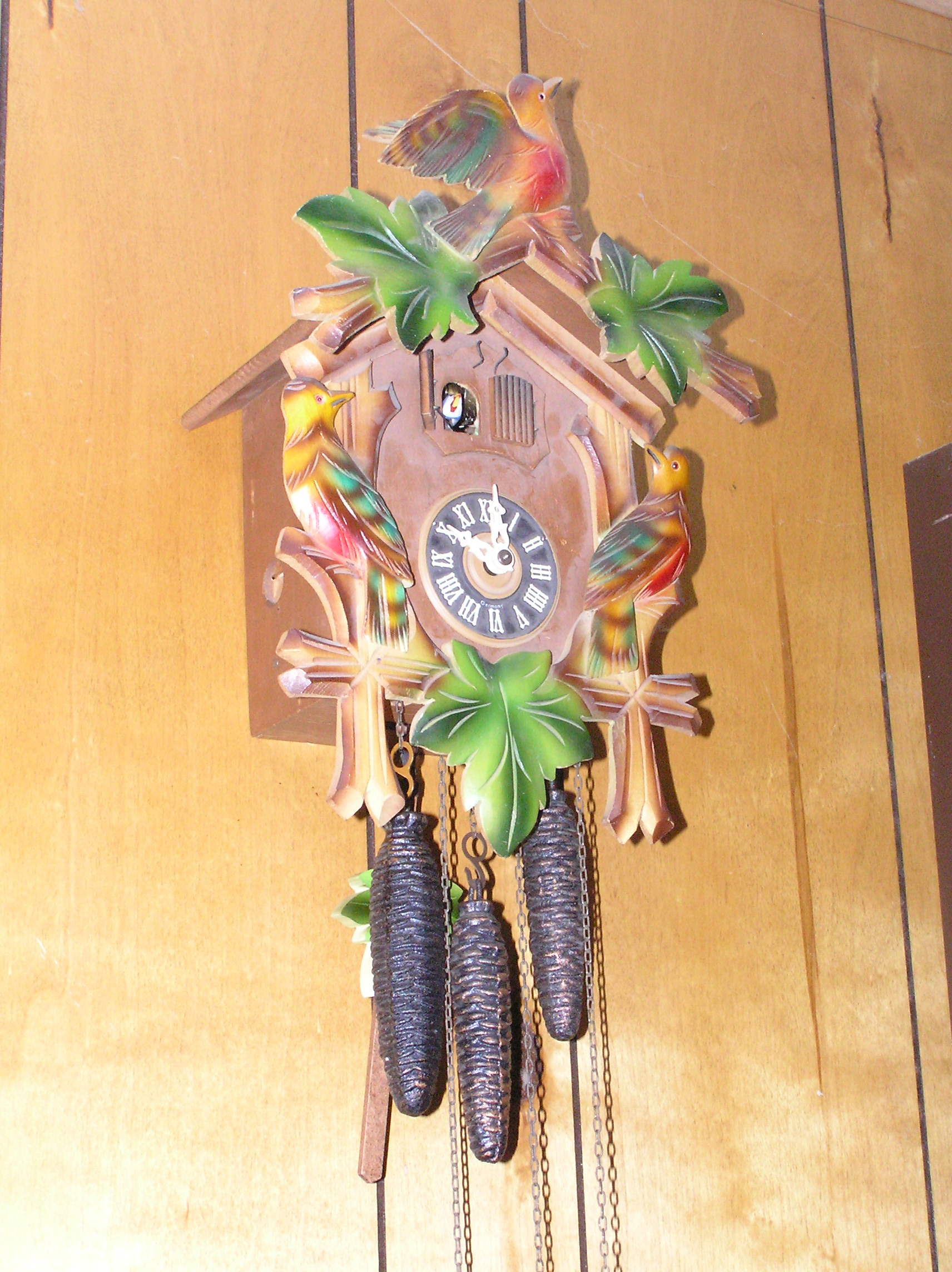
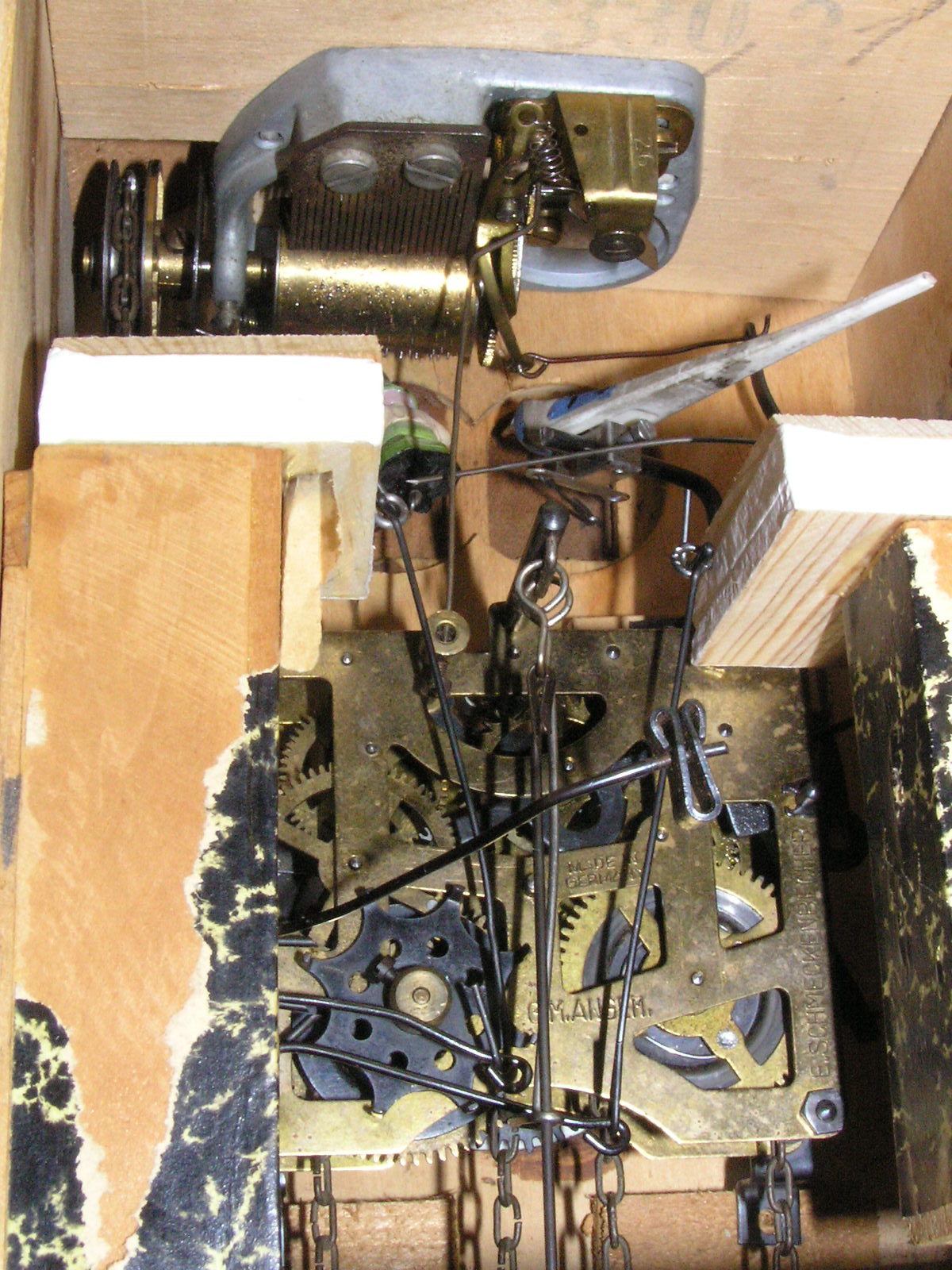
E. Schmeckenbecher Musical 1-day cuckoo. This is a 3-weight clock that plays a melody on a 22-note music movement. The markings on the movement indicate it was made between 1946 and 1966, and it is marked GM Amgen, which means patent pending. After 1966, these movements will be marked Regula. These movements were made by J. Burger Söhne, and are usually stamped with the name of whomever made the rest of the clock, which, in this case, is E. Schmeckenbecher. Emil Schmeckenbecher clocks were made from 1948 to 1996. On the hour, first, the cuckoo counts the hour, then the Zither man comes out and plays two tunes, Tannhäuser March, and Lohengrin. The melody does not play on the half-hour. The cuckoo bird's call is produced by two bellows-blown whistles tuned and played such that they imitate the call of this bird. A coil gong is also struck.
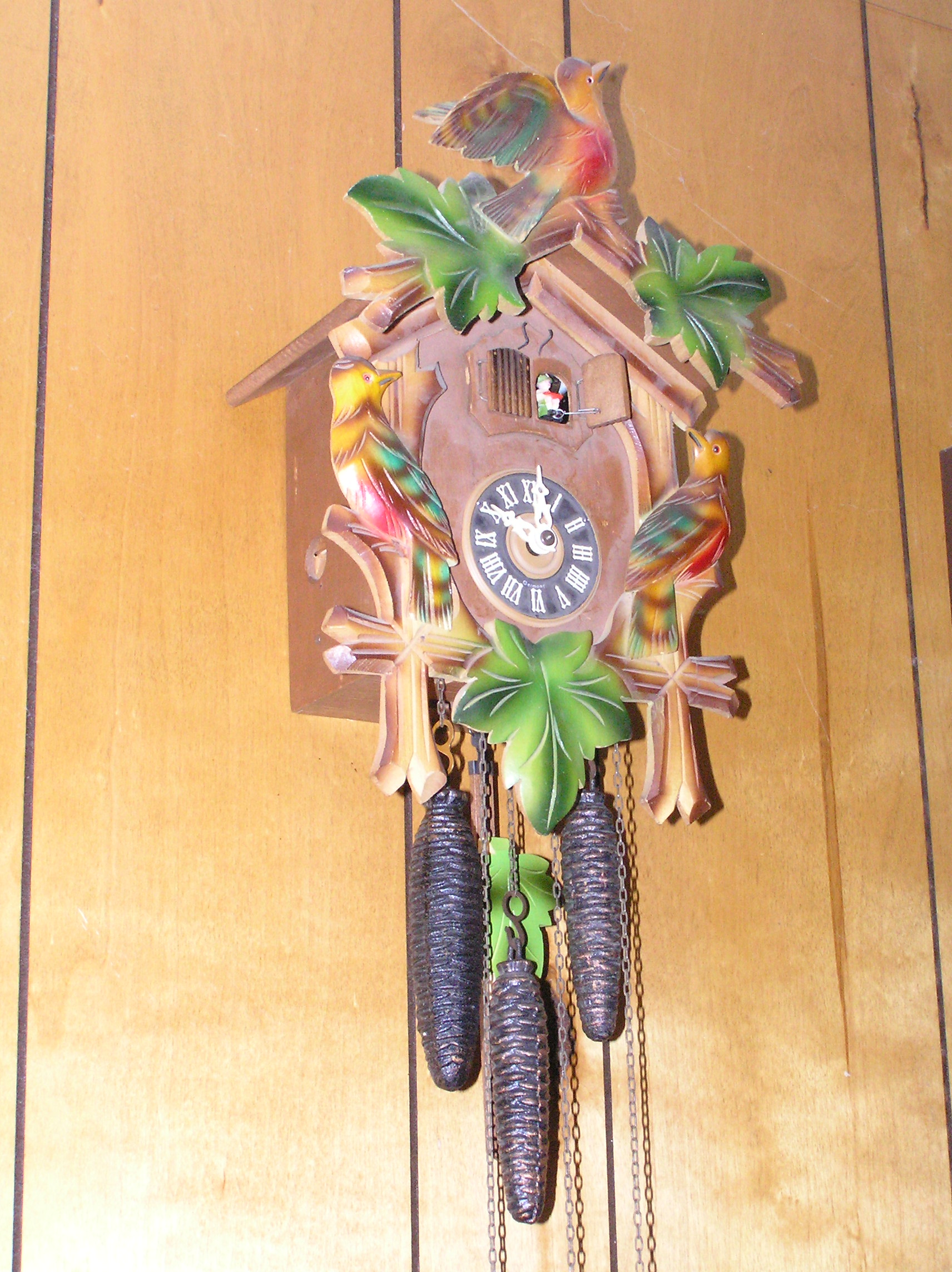
Schmeckenbecher 1-day cuckoo, 1974. Another 24-hour cuckoo clock, made by Schmeckenbecher, hence the 'S' in a diamond on the cuckoo door. The date stamp on the Regula movement indicates this clock was made in 1974. This clock counts the hours and half-hours. A lot of plastic is used in this clock, such as the pendulum, cuckoo door & bird, dial, and the whistles tops. This must have been a very cheap clock when new, or the 70's were just a low-point in cuckoo clock quality.
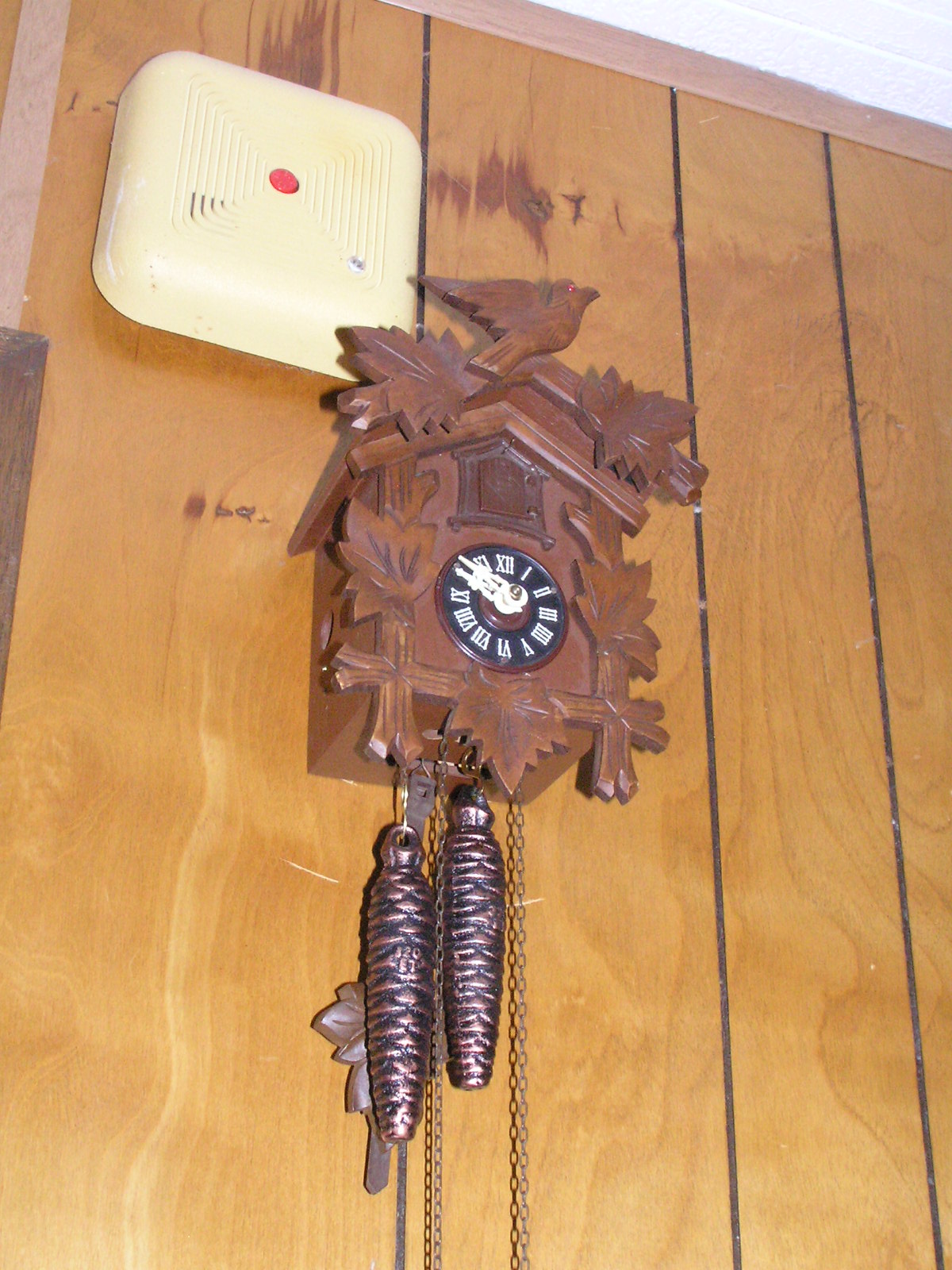

Schmeckenbecher 8-day cuckoo clock 1984. Why would anyone want a 1-day cuckoo clock when they made 8-day clocks? The 1-day clocks are a royal pain to live with, but the 8-day clocks are much more civilized. The chainwheel in a 1-day clock rotates once every hour, in an 8-day it rotates about once every 6 hours. Although this clock feels nowhere near as cheap as the 70's 1-day clock shown above, it still uses a fair amount of plastic.


Cuckoo Clock Manufacturing Co. 8-day cuckoo circa 1966-1970. This is a rather nice 8-day cuckoo clock. It is an older clock and has all-wood whistle assemblies that make the cuckoo calls. The Regula movement is stamped with the clockmaker's name just as in the Schmeckenbecher clocks shown above. Cuckoo Clock Mfg Co. made several other types of clocks in addition to cuckoo clocks.


Ansonia Racket circa 1900. This clock is very interesting. It is a bell-top tin-can case adaptation of the 30-hour time, strike & alarm movement Ansonia also used in its glass-sided carriage clocks. Several of the other American clock companies made movements similar to this one, but Ansonia is the only one, to my knowledge, to use this type of movement in anything other than a carriage clock. The movement is mounted in the case by a cast iron dial ring, with the balance wheel end down. This is an inversion of the carriage clock mounting. The clock strikes hours and half hours on the top bell and uses the rack-and-snail system The case is nearly as big in diameter as a Big Ben case. As further proof of its carriage clock origins, keys and knobs are not fitted to the back, but a holder is provided for storing a double-ended key with a #5 end for winding, and a #00000 end for setting the time and alarm. No alarm shut-off is provided.
Note that you can see in the photos the movement is oily and the dial is oils soaked. This is a sure sing that some so-called 'repairman' has soaked the clock in oil, thinking that it would make the clock run again. All they have done is ruin the dial. Also not the poor repair job done trying to repair the worn pivot hole for the time train great wheel on the front plate. Although this clock wasn't running an the oil and damage are old, believe it or not, there are people selling clocks today on ebay that do this kind of clock recking just so they can say that the clock is running and sell it for a higher price. My advice to anyone wanting to collect clocks: buy unmolested, non-working clocks and learn to repair them. You will be much better off. Nice running clocks will not always be available, and clocks you already have will not be able to go without service forever. Unless you have unlimited funds to blow on repairs and nice clocks, buy a few non-working clocks inexpensively and learn how to do your own repairs. Plus, you'll be able to fund your collection by doing repairs for others. Think about it.


Seth Thomas 8-day Long Alarm circa 1910. This is my new favorite alarm clock. And it is rather interesting. Seth Thomas took their old reliable model 89 movement, which was introduced around 1899, and converted it to an 8-day automatic alarm movement. An escape wheel takes the place of the strike third wheel, and an alarm hammer verge takes the place of the strike fourth wheel. There are no lifting cams on the center wheel. An additional gear set with 2:1 reduction is located outside the front plate for the 24 hour alarm dial. The alarm control lever is located under the dial. When locked to the right, the alarm will not sound. When the lever is to the left, the alarm will sound at the set time. Moving the lever to the right without locking it will silence the alarm and allow it to automatically ring again in 24 hours. The alarm bell shown in the photo of the back plate is not the correct bell. The clock is well made, and like the Sonora chime clocks, is an interesting adaptation of the 89 movement.


Kundo Kieninger & Obergfell Model 54 400 day clock circa 1954. This clock is Horolovar Plate 1371AAA. The Horolovar book is indispensible when you work on 400-day clocks.
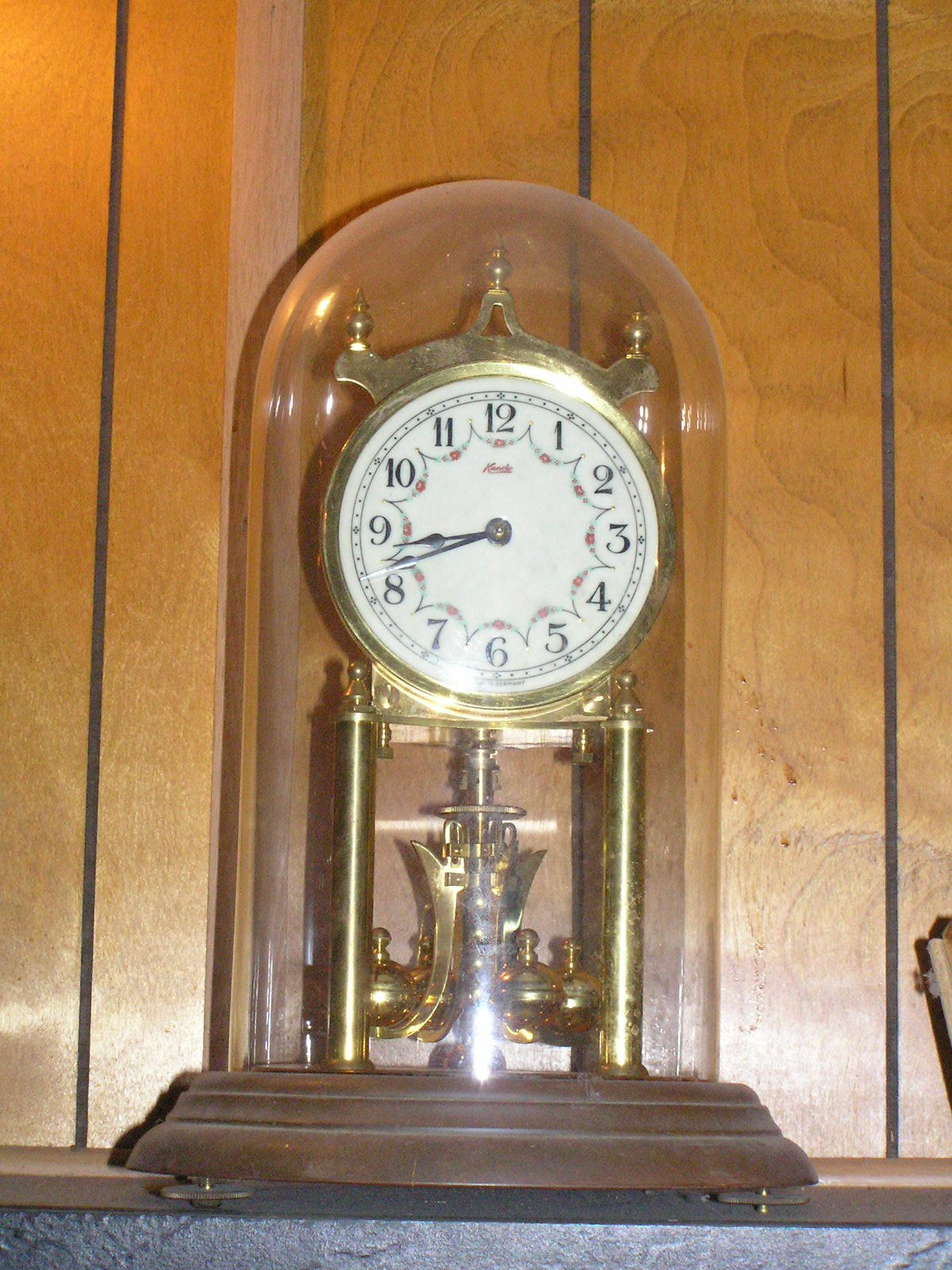
Schatz Jahresuhrenfabrik Model 49 400-day clock imported by Remington Rand circa 1949-1954. This clock is Horolovar plate 1283. The Jahresuhrenfabrik (German for year clock manufacturer) was one of the longest makers of 400 day clocks, going back to the 1880's. The torsion pendulum used in the 400 day clock was invented in New Jersey in the early 1800's, but mass production started in Germany in the late 1870's and early 1880's. This clock is a Schatz (A. Schatz & Son was the company behind Jahresuhrenfabrik) model 49 imported by Remington Rand. The movement is marked RR and there is a Remington Rand sticker still on the glass dome. Remington Rand imported these clocks from 1949 to 1958. A you can see, I need to replace the suspension spring.


Hartford Time Switch, A Hall Berry 8-day time switch circa 1912.Several companies during this time period made electric timer switches that used a wind-up movement to operate the switches. This example uses a modified 8-day Seth Thomas time and strike lever clock movement to operate the switches. Lever or lever clock were the names usually used then for balance wheel controlled movements. This referrers to the lever escapement used with the balance wheel, which was commonly Thomas Mudge's lever ("ratchet tooth") escapement. Later, pin-pallet lever escapements were used. Seth Thomas introduced this movement in the 1870's, as it was exhibited at the Exposition Universelle in Paris in 1878. These Hartford clocks also turn up with a Seth Thomas 'clone' movement that was actually made by Waterbury. These clone movement look very similar, but do not have a Seth Thomas stamp, and the escapement parts are very different, with a 'lugged' balance wheel. This switch uses an A, H & H switch and is 3 pole single throw.

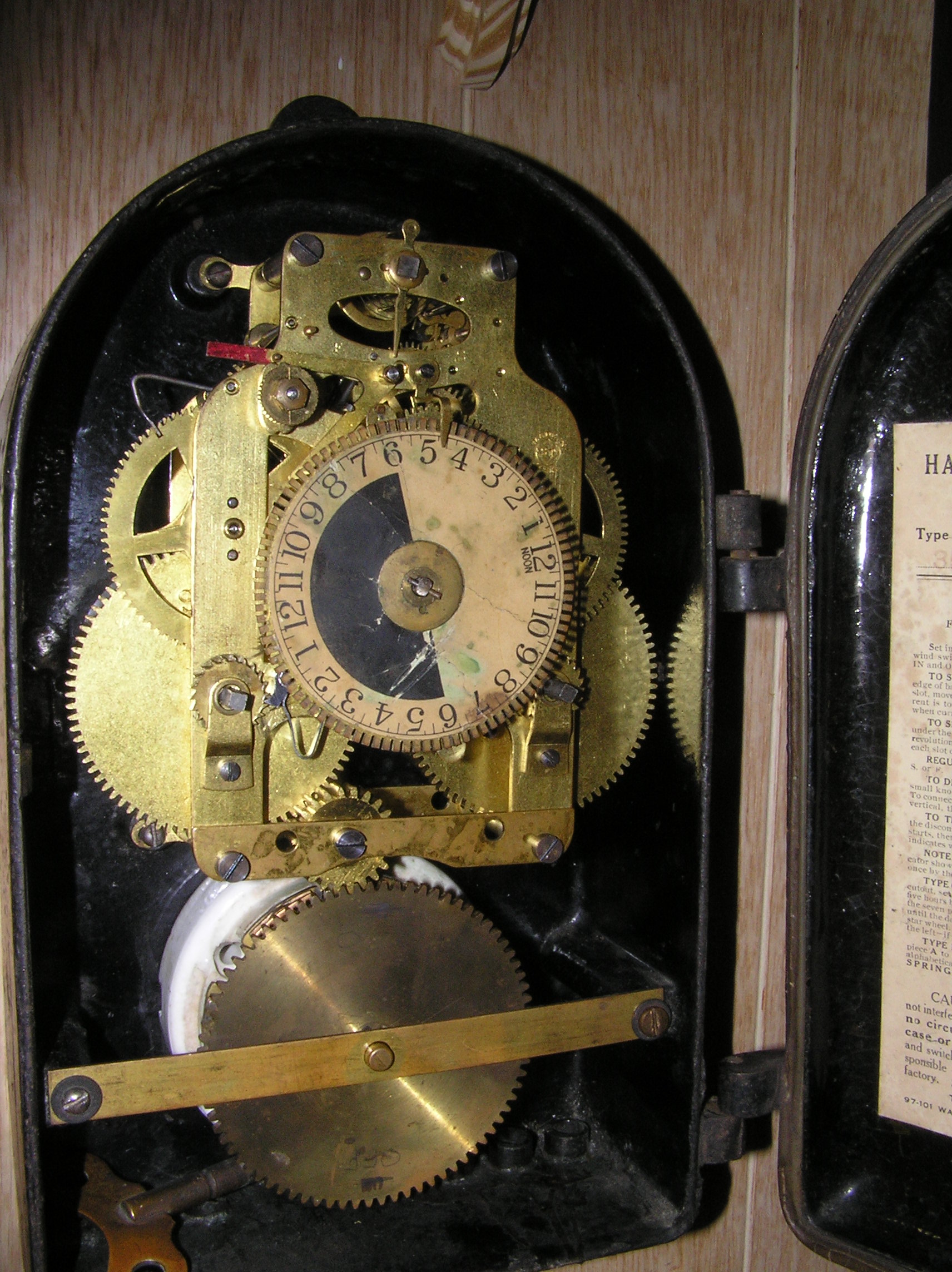
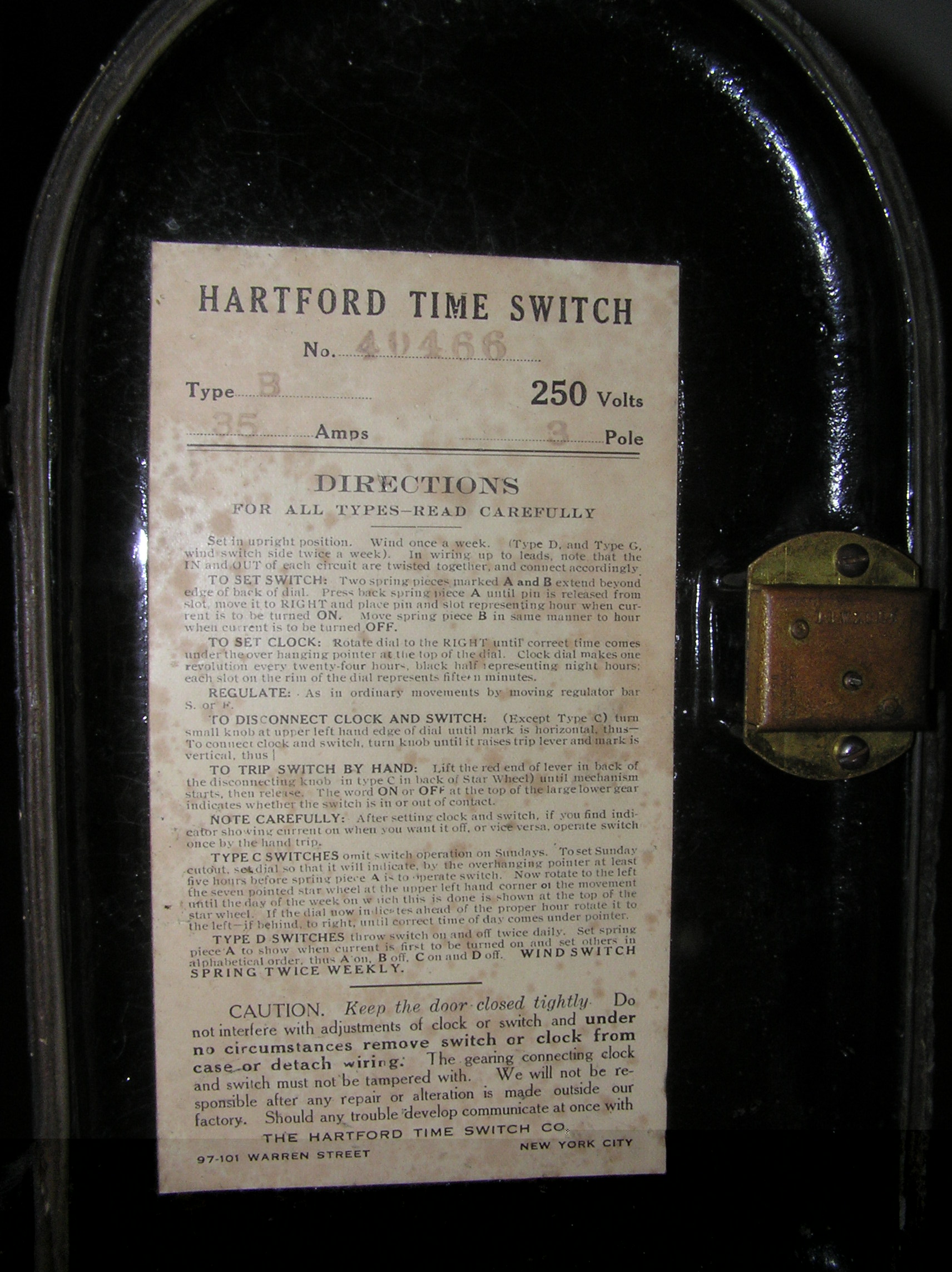
Reliance Automatic Lighting Co. 8-day time switch circa 1915. Several companies during this time period made electric timer switches that used a wind-up movement to operate the switches. This example uses a modified 8-day time and strike lever clock movement to operate the switches. Lever or lever clock were the names usually used then for balance wheel controlled movements. This referrers to the lever escapement used with the balance wheel, which was commonly Thomas Mudge's lever ("ratchet tooth") escapement. Later, pin-pallet lever escapements were used. The movements for these switches were probably not made by Reliance, but by one of the American clock companies. The construction features seem to indicate the movement was made by Waterbury or New Haven.
The first two photos below show the cast-iron housing and the ID tag. The keys are original.


The third and fourth photos below show the complete mechanism, switch and all, removed form the housing. The mechanism is designed to be easily removed from the housing, and has two screws which merely have to be loosened to rotate two latch plates 1/4 turn to release the mechanism mounting frame. The switch is a double-pole single-throw switch. There are two time tripper trip fingers on the dial that can be set to the time when the switch is to be turned on and off. The countwheel disc has four slots and the switch requires 1/4 turn for each operation.
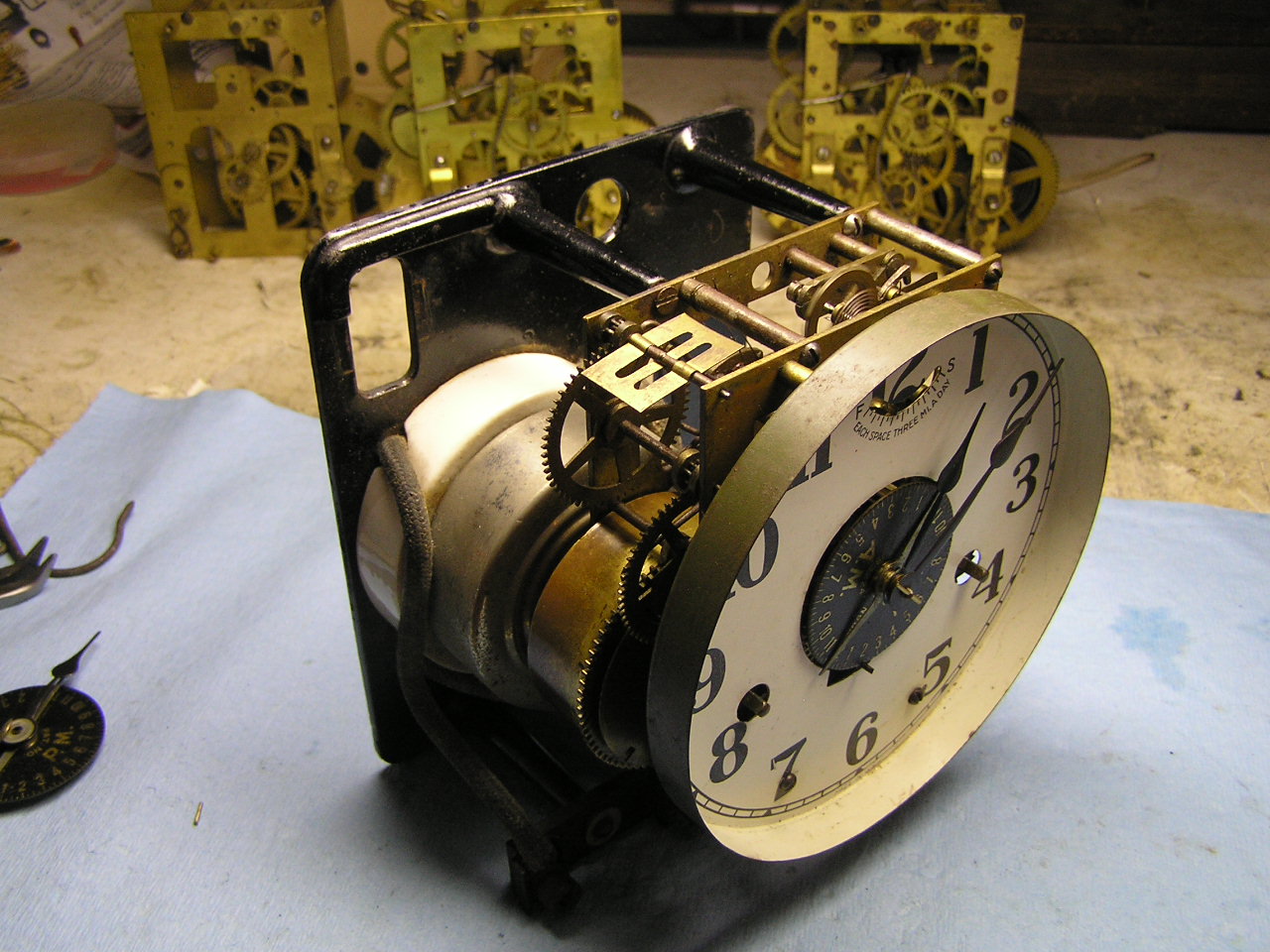

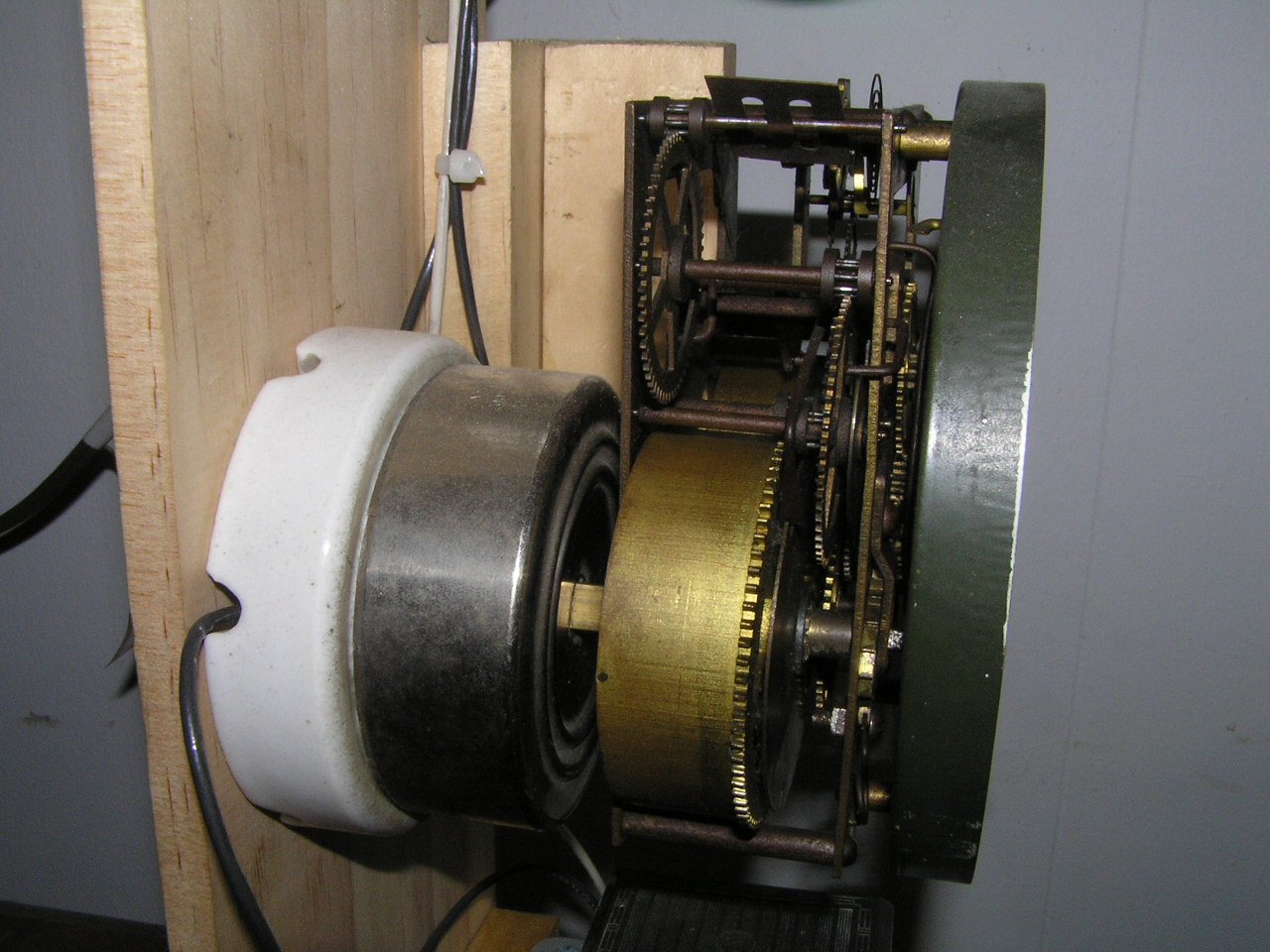
The fifth and sixth photos below give details of the movement construction. As you can see, it is a modified time and strike lever movement. The square drive at the back of the movement operates the switch. The switch is an ordinary A H & H surface mount switch with the thumb-piece replaced by a square drive coupler.


The seventh and eighth photos shown below are of a complete mechanism mounted to a demonstration frame. This example has three time trippers on the dial instead of two, and a single-pole double throw switch. The countwheel disc has three slots, and the switch requires 1/3 turn for each operation. The way the switch is made it not like an ordinary SPDT switch. Please see my three videos on Youtube which demonstrate how these movements work. A variety of different switch and dial tripper arrangements were made. Dials could have 2, 3 or 4 trippers depending on the switch and desired operation. Additional details are covered in US patent 983,224.

Alarm clocks, being generally less expensive than other clocks, where the first clocks I collected. Many of them were Westclox models. Westclox clocks are very durably made, and many have survived in good condition.
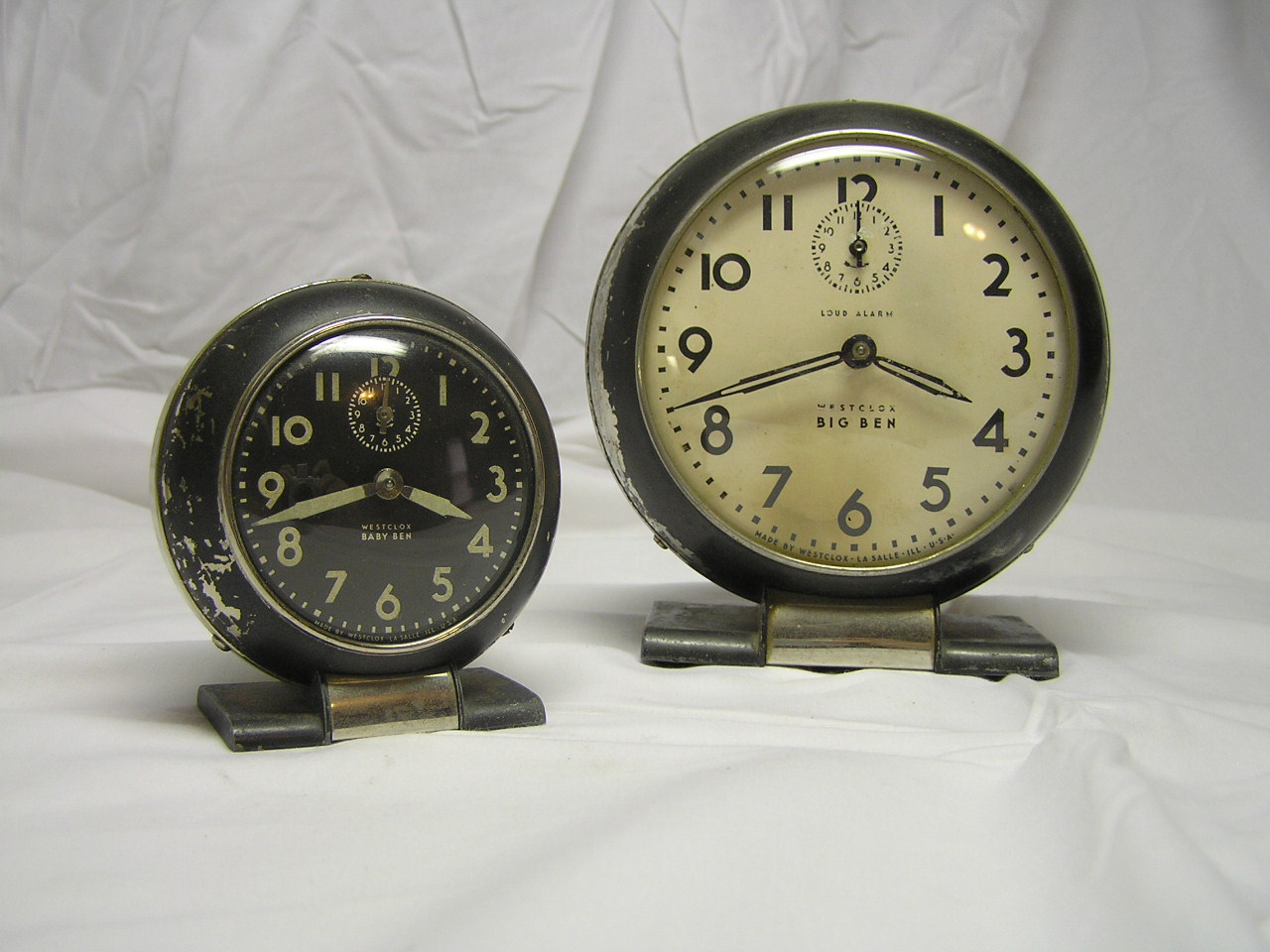
Early models-these are 7 of the most commonly encountered older Westclox models, from left to right: Ben Hur with original blue paint; Big Ben Deluxe, this clock was originally crackle blue; America, a bell-top clock; Big Ben, with a black luminous dial; Sleep-Meter, this is basically a "peg-leg" version of the Ben Hur; Big Ben, this is the plain dial version; and Baby Ben. The Ben Hur and Big Ben Deluxe were made from 1927 to 1932, the others were made from circa 1910 to 1930, with the examples shown here all dating to the 1920's. Westclox stamped the date of manufacture on its movements, so it is always possible to date a Westclox to the month it was made.

Peg-leg models: the clocks with legs and bows. Left to right: America, Big Ben, Baby Ben, and Sleep-Meter. The America was produced as a bell-top model with only slight variations from the late 1880's until 1930.

Base models: Introduced in 1927: The Ben Hur, left, was a base version of the Sleep-Meter, and The Big Ben Deluxe, right. The Big Ben was repainted at some later date, but the gold base of the original blue crackle finish can be seen where the paint is chipped. The Ben Hur was not available in a crackle finish. You can see the blue crackle finish Big Be Deluxe, as well as a red (called Old Rose by Westclox) Baby Ben Deluxe in the 1927 magazine ad. The crackle green clock is the time-only Tiny Tim. All four cast-base models were available in three colors or nickel finish. In 1930, the crackle finish was discontinued in favor of solid color finish.
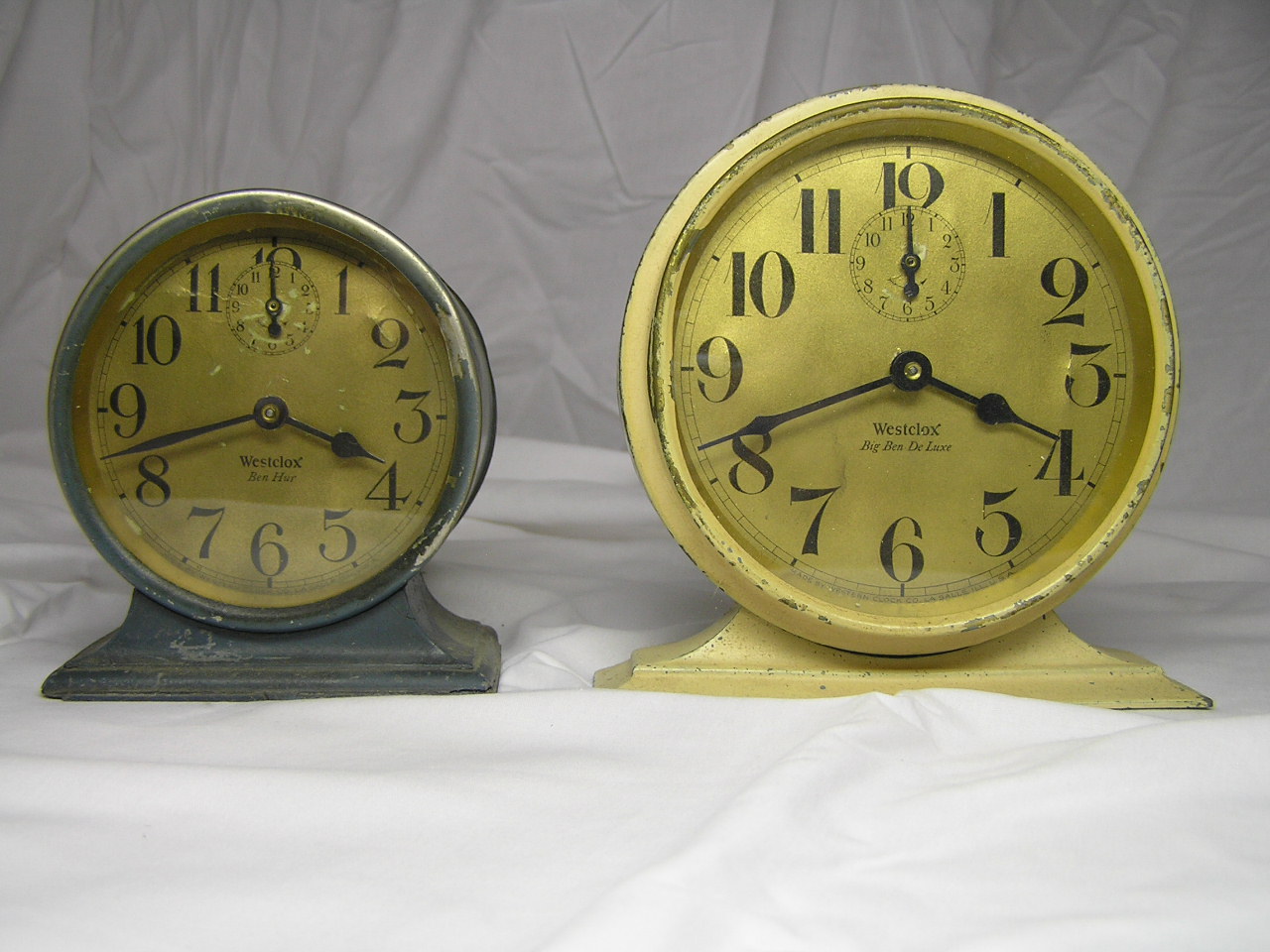
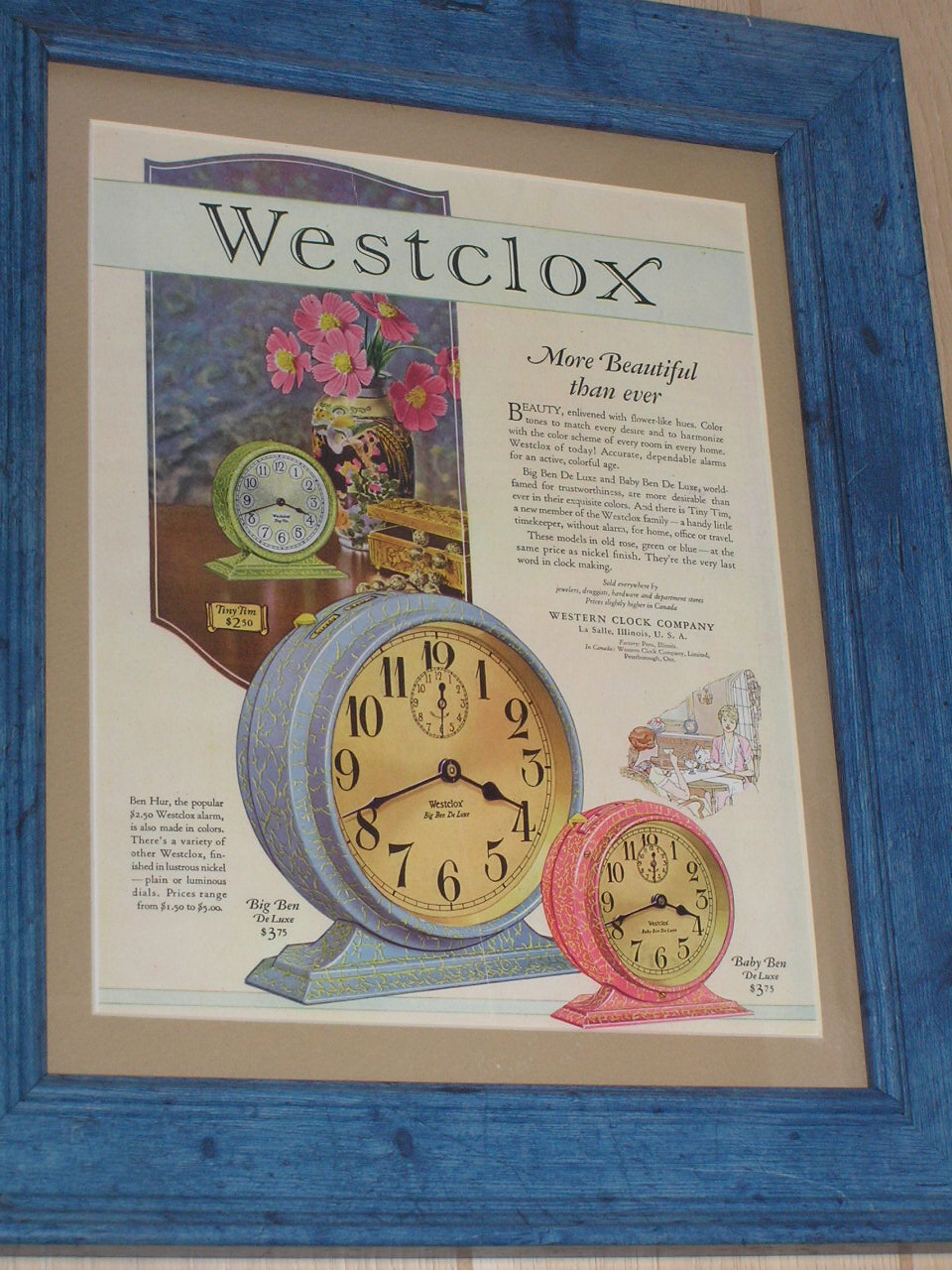
Base model Bens: Left to right: same clock as above photo; this is an example of the 1928-1930 non-luminous dial. Blue 1930-32 solid finish Big Ben Deluxe. Paint is not original, but close to the pastel shade that was offered. Dial is original. The numbers are gilded and the hands are fancy skeleton hands; this same dial & hands was also used on brushed nickel "Butler" finished style 2's from 1930-32. Center Big Ben, the "Deluxe" was dropped from all style 2's around 1930. The Baby Ben, foreground, is in its original crackle 'Old Rose' finish. Crackle 'Old Rose' Big Ben, this example shows the luminous gold dial, which was used from about 1928-1932 on all paint finished (and maybe butler finished) style 2's. Right, style 2 nickel finished luminous dial.

Early model luminous dial versions. Here's a nice view to compare the different luminous dials and hands on the early models. Note the Jack O'Lantern, which is a luminous Sleep Meter. This is one of only a very few models that had separate luminous dial names. Note the fancy skeleton hands used on the gold dial style 2.

The gilded dial style 2 must have seemed quite extravagant in the early 1930's.

While the peg-leg Big Ben was produced until 1935, the Big Ben and Baby Ben Deluxe were made until 1932. I do not know when production of Ben Hur and Tiny Tim stopped.
Westclox middle models: Style 3 Big Ben, left; style 4 Baby Ben, middle; and style 5 Big Ben, right. The style 3 Big Ben was made from 1931-1934, and was available as a chime alarm only. No loud alarm option was available from 1932-1934. When the style 4 Big and Baby Bens were introduced in 1934, the Big Ben was available as a loud alarm or chime alarm, and will be identified as such on the dial. The style 4 Bens were made until 1939, when the style 5 case was introduced.

The style three Bens:

Westclox style 5 Big, right, and Baby, left, Bens. This case style was made from 1939 to 1949, with a few years interruption due to WWII. The case was designed by Henry Dreyfuss, who also designed the round Honeywell Thermostat. The Baby Ben bears this resemblance much stronger than the Big Ben. The Baby Ben shown here is interesting for a few reasons. The date stamped on the movement is 6 5 44-that's right, during WWII! Apparently, a few were made during the war. This one has an absolute minimum of nickel. Baby Ben movements were normally nickel plated until about 1951, but this one is plain brass. The keys and knobs on the back are also finished differently. Black clocks normally had nickel keys and knobs, this clock has blackened brass finish knobs and keys.
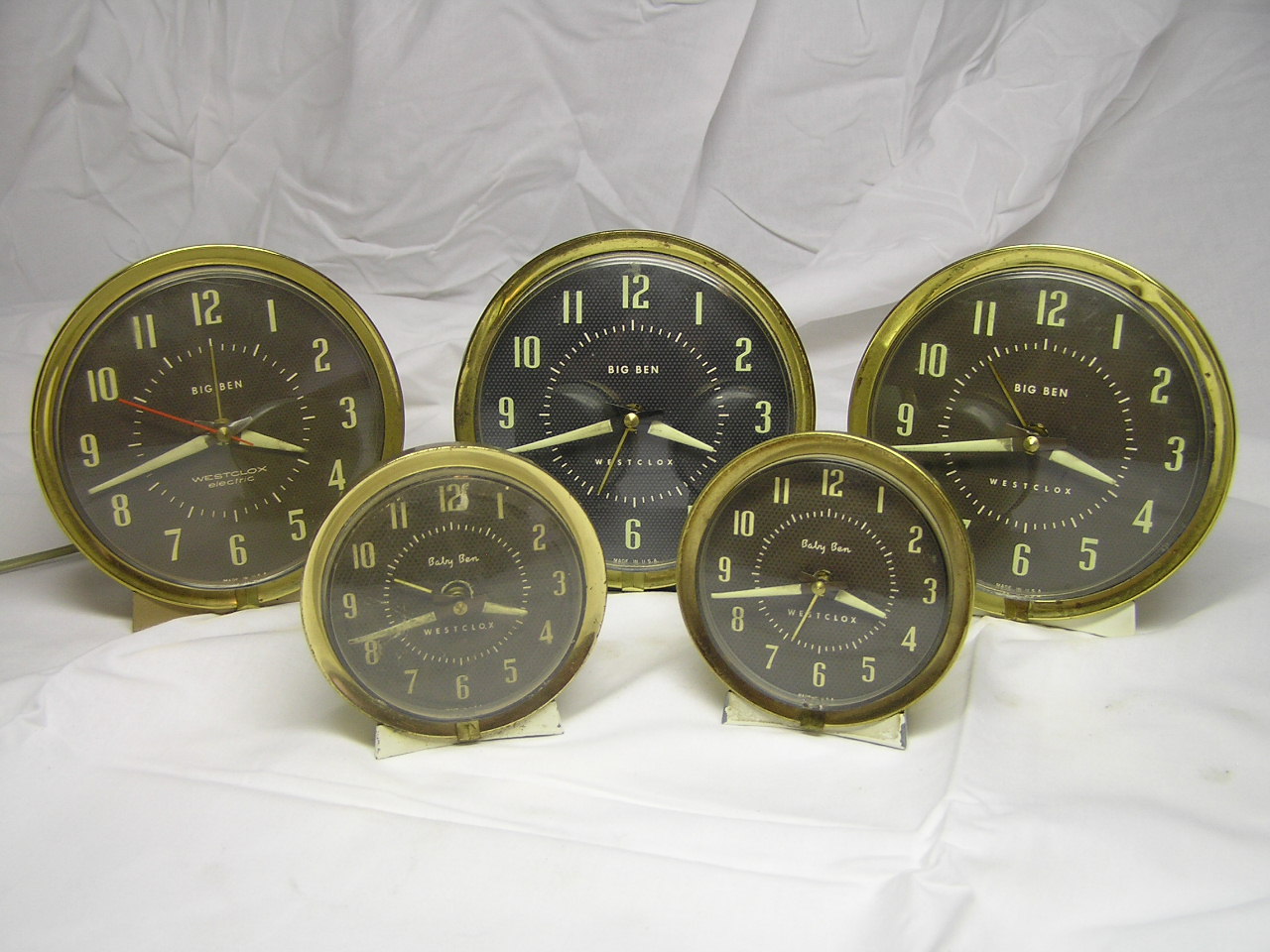
Westclox style 7 Bens: Big Bens on the back row, Baby Ben on the front. For continuity, I have included a Big Ben Electric. This case style was made from 1956-1964
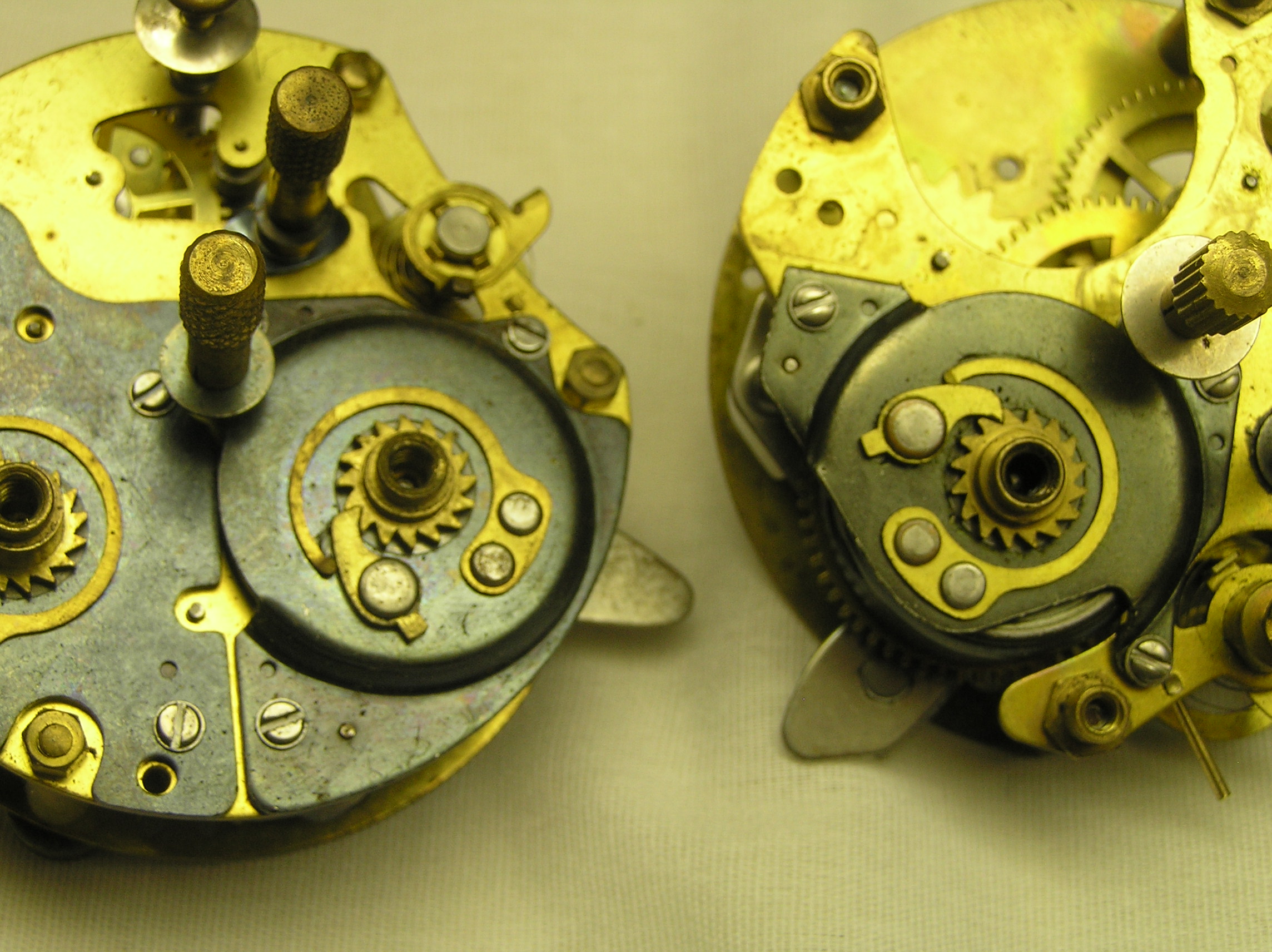
The early style 7 Baby Bens made prior to 1960 were the last to use the old 2-key Baby Ben movement. Other than changes to accommodate the changing case styles, the movement had not changed in any substantial way since the mid 1920's. The new single key movement would go on to be the last American made Westclox movement. Below, early on left, late on right.

This photo illustrates the style 6 and two style 7 movements. Note that the alarm barrel bridge on the early style 7 movement is missing in this view.

Barrel bridges on style 7 movements are slightly different, and bridges off of 6 and earlier movements will not fit. Below, 6 on left, 7 on right. Note the larger plate nuts on the 7 and use of less material on 7 bridge.
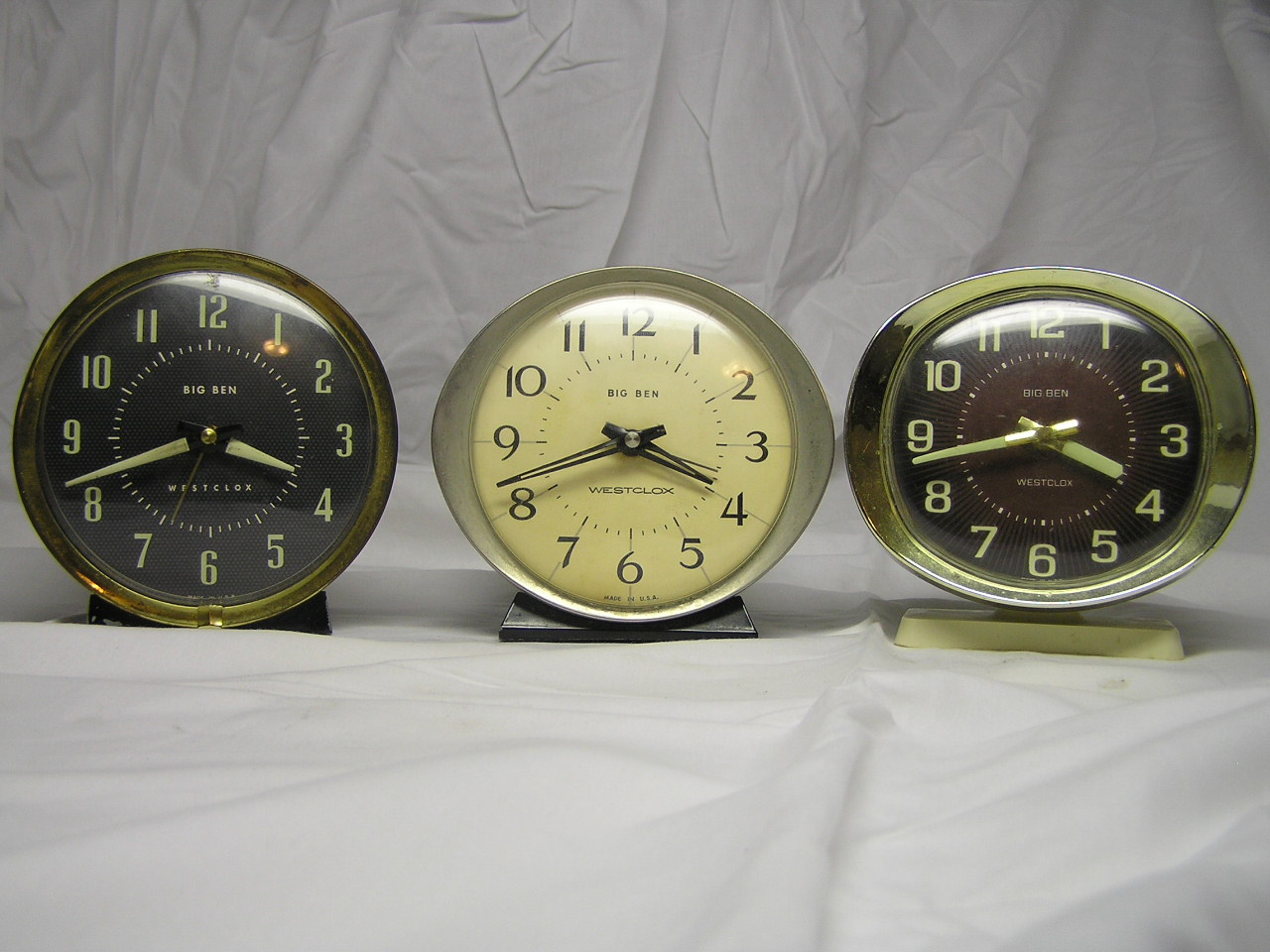
Westclox late models: Big Ben style 7, left; Big Ben style 8, middle, and Big Ben style 9, right. The style 8 Bens were made from 1964 until 1980. The Style 8 Bens were the last Bens made in Illinois. The style 9 Bens were made from 1980 until 2001. The style 9 Bens were the last Westclox Bens to be made in the United States.
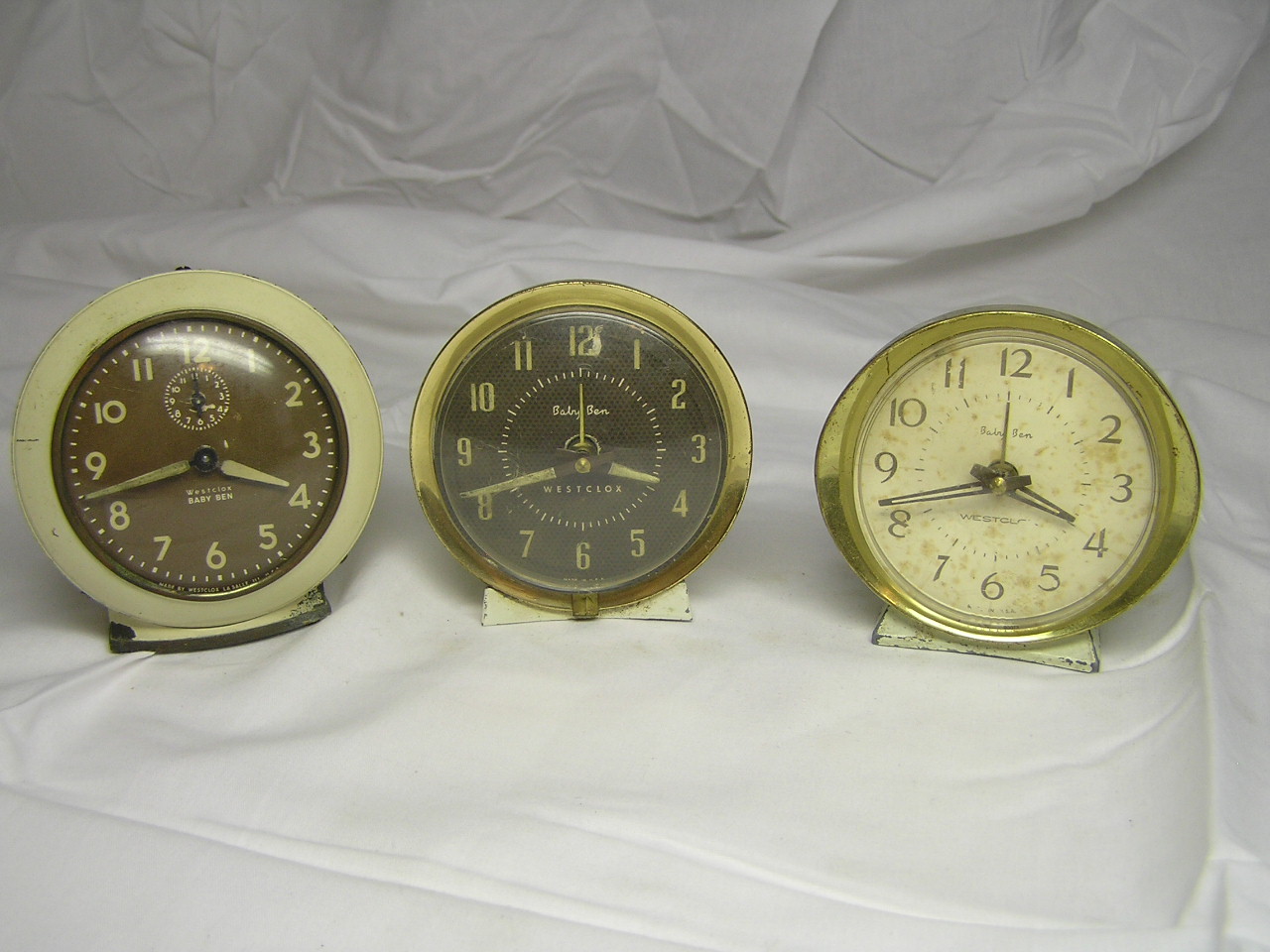
Westclox Baby Bens: these three are clocks I have pieced together. Left, a style 6 Baby Ben. The style 6 Bens were made from 1949 to 1956. Middle, a style 7 Baby Ben. Right, a style 8 Baby Ben.
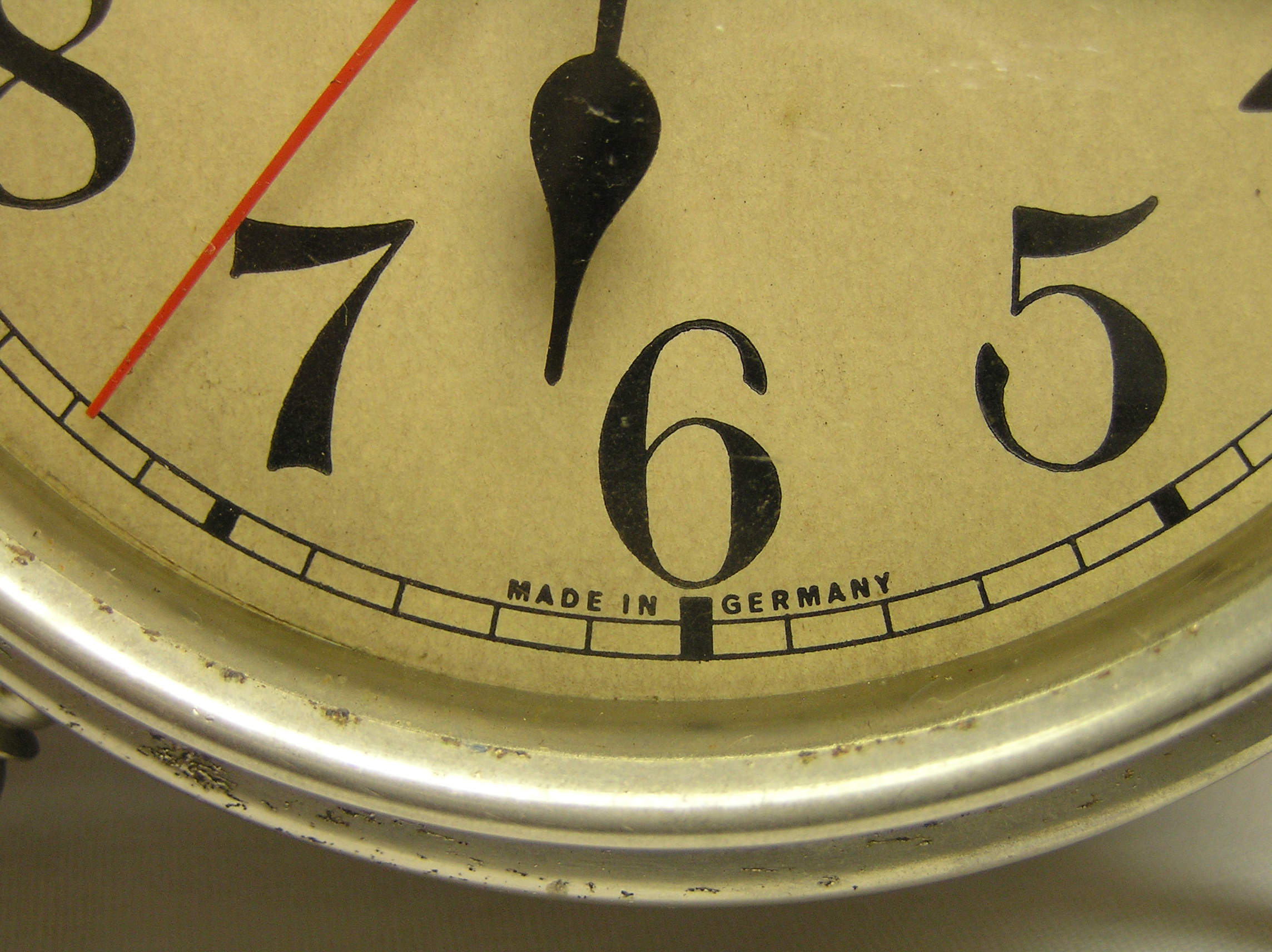
For years it has bothered me that Westclox chose to put the fourth wheel exactly in line with the center wheel and alarm hand on the Big Ben movement, but never had a Big Ben with a seconds hand in the 6 o'clock position like a pocket watch or many contemporary German clocks. So I did. The fourth wheel is exactly 1" below the center wheel, and using a Big Ben parts clock and a scanned copy of the dial off my 1922 peg-leg Big Ben, I made a dial with a seconds bit at the 6 o'clock position.
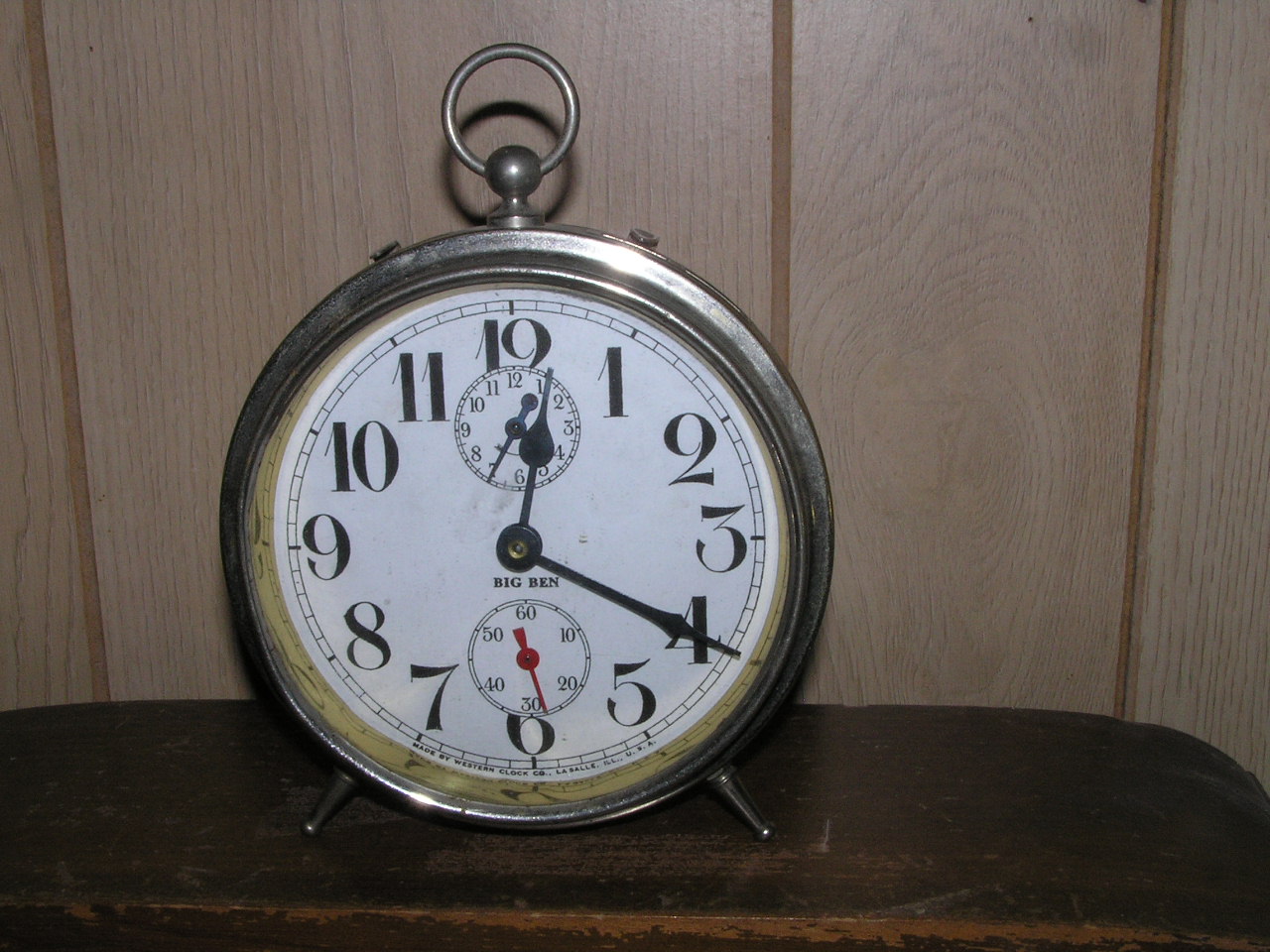
The red seconds hand came off a late model twin bell parts clock, and though I'd like to use another alarm hand for the seconds bit, I rather like the red hand and may do a little filing on it so it will better match the other hands. It was very easy to extend the fourth wheel arbor. All Westclox wheels are built-up castings using brass wheels, and wires for the pinion leaves and pivots. The fourth wheel, escape wheel, and verge all use the same size wire for the pivot, so a piece was salvaged and pushed into the fourth wheel to extend the pivot to mount the hand. Why Westclox didn't make the Big Ben like this is a good question. The dial looks rather interesting with the additional and useful seconds bit. Many of the good quality European alarm clocks had a 6 o'clock seconds bit, and the Westclox Big Ben was also a good quality clock, so why not? (Note: Westclox did make some models with a seconds bit for specialist uses. The time only Tom Thumb, for example, normally did not have a seconds hand, but some were made for the US Medical Association with a seconds hand.)
This is a question I get occasionally, and it is an interesting one, given the choices I have. I've put this in the Westclox section because I very rarely use anything but the Westclox models, though I do have a nice Ansonia 8-day automatic. I am currently working on I'd like to try! I do rotate which clock stands on the night stand every few weeks or so, though if there is one I like, I'll use it for months at a time.
In late 2012, I picked up a nice clean Seth Thomas fleet series clock with an alarm, described above in the Seth Thomas section. The case had been heavily modified by previous owners, so I decided to wall mount the clock and use it as a daily alarm. So far, it has been my favorite alarm clock to use. It is on the wall above my nightstand. The slow, soft tick is much less annoying than the fast metallic tick of balance wheel alarm clocks. I wind the time & strike on Sunday night at bedtime. I wind the alarm every night before I want to get up in the morning. I do not find the hour or half-hour striking to be annoying or a hindrance to sleep. I sleep right thru them. If I wake in the night, I find it convent to listen for the hour strike to know the time rather than try to look and see. I often fall back to sleep before I know the time while waiting for the clock to strike
As for balance wheel clocks, let me start by listing the ones I don't use, or try to avoid actually using: any of the gold dial models. They are simply too hard to read in the dark. Any style 8 or 9. They look and feel cheap, and I don't like the sound of the alarms. Any model that uses the single key Baby Ben movement for pretty much the same reason.
Ones I like usually have the following: easy to read dial, luminous hands, nice sounding alarm bell. Here's what I've used most frequently in the past 4 or 5 years: Any style 1-6 loud alarm (usually just the 1 or 5, though it doesn't matter too much; I usually leave the 1's and 2's on repeat), style 5 Baby Ben ,style 7 Big and Baby Ben, and style 6 chime alarm. I think the longest used single model though was an early 1920's America, which I used for nearly 4 years until I got my first style 1. Sometimes I find the loud tick helpful to sleep, I opt for the loud alarms. Sometimes I want it quite I go for the 7's or the chime alarms.
This clock is rather interesting for one reason; it is an outright copy of a Westclox style 1A Big Ben. The F. Mauthe Clock Co. was in business from the 1880's until 1976. I am not sure when this clock was produced, but I'd guess the 1930's or 1950's. The case is made like most German bell back alarm clocks; there is no inner case back, the bell is the actual back and attaches to a mounting bridge on the back of the movement. This clock also features an orange sweep seconds hand, mounted between the hour hand and dial. A second hand bridge carries a hand tube & idler, which take their drive from the fourth wheel, which is mounted at the 6'oclock position. Note that the alarm bit dial is much closer to the center post, and all of the number 12 is visible.
In looking at the pictures below, it is remarkable what a close copy it is. The 1st photo shows the clock by itself, second photo is the Mauthe logo in the alarm bit. In the third photo is the Mauthe clock sitting next to a Westclox Big Ben. Both clocks are the same size, and the dial are very similar.


The steady/repeat and alarm/silent levers are in the same arrangement as the 1A Big Ben

The back of the Mauthe, left; and right, the Mauthe and Big Ben side by side. Note that even the keys are copied. The regulator slot is under the rear foot.


Left, back of clock with bell removed showing movement and position in clock. Right, time train of movement and steady/repeat mechanism.


Two side by side comparison shot of the dials; Mauthe is on the left in both sets.


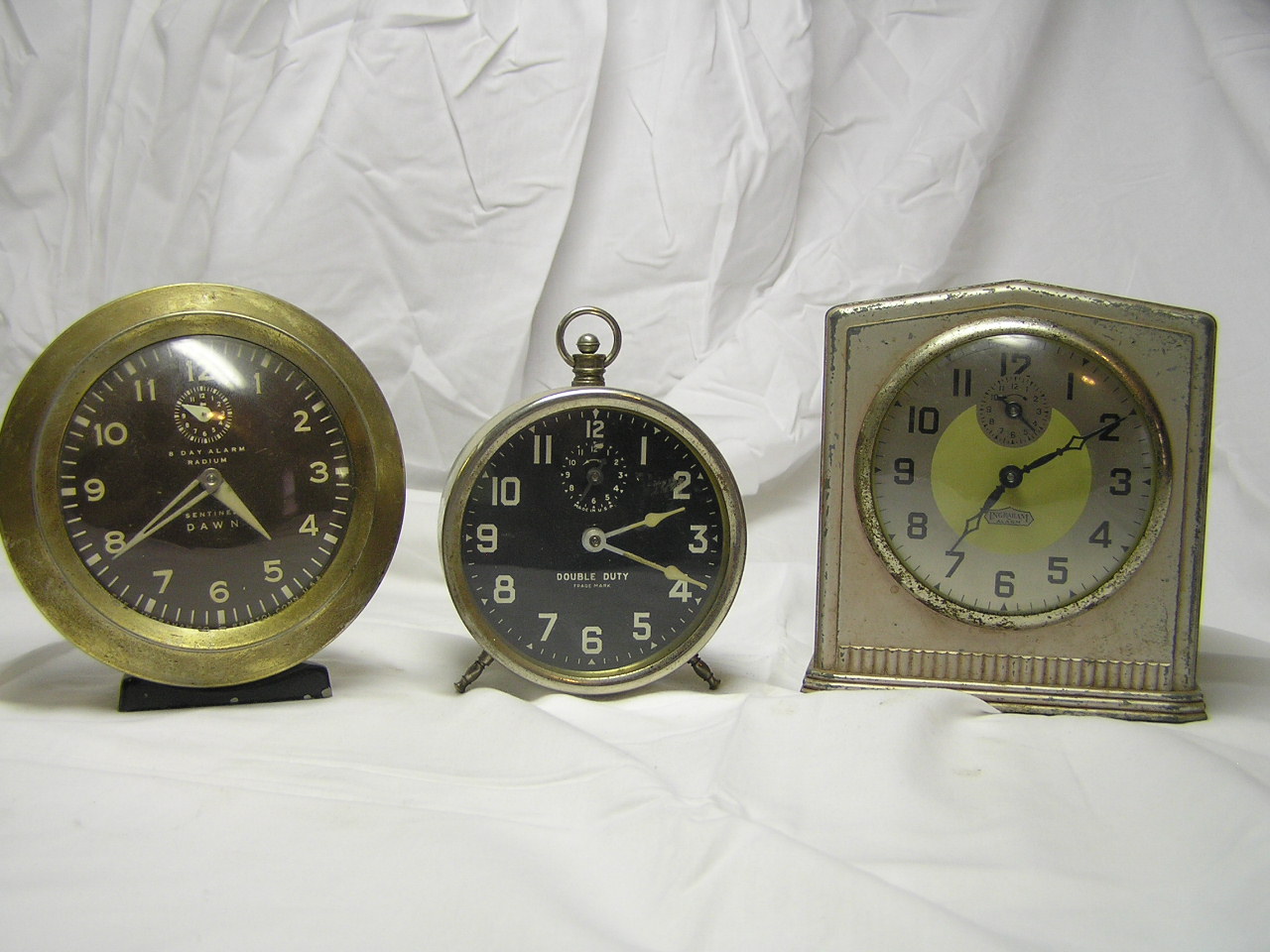
Here are three models made by the E. Ingraham Clock Co.: left, a 1930's or 40's era 8-day alarm clock "Sentinel Dawn"; middle, a 1930 "Double Duty" 30-hr alarm; and right, a 1920's or 1930's 30-hr alarm in a cast case. The two 30-hr clocks both use the same movement, as shown in the second photo. This is the most commonly found Ingraham 30-hour alarm movement. It was made from the 1910's to the 1950's. Starting sometime in the 1930's a solid cut pinion was substituted for the lantern pinion. The lantern pinions seem to last a very ling time, but the cut pinions tend to be found very worn. My first Ingraham alarm was so badly worn that the great wheel spun freely at one point. Another Ingraham clock I had was apparently only slightly used, but after using it, the pinion started to show noticeable wear. It is a good idea to have older parts clocks with the lantern pinions for parts.


Secron/Gilbert Timer circa 1955. This little stop-clock timer is basically a modified Gilbert 30-hour alarm clock. The minute and seconds hands can be individually set from the back. The red button stops the clock, and the green button starts it. The escapements of Gilbert alarm clocks are rather interesting. They are basically Mudge lever escapements, but instead of a solid verge holding the pallets, a brass arm holds individual pallets like a pin-pallet escapement.
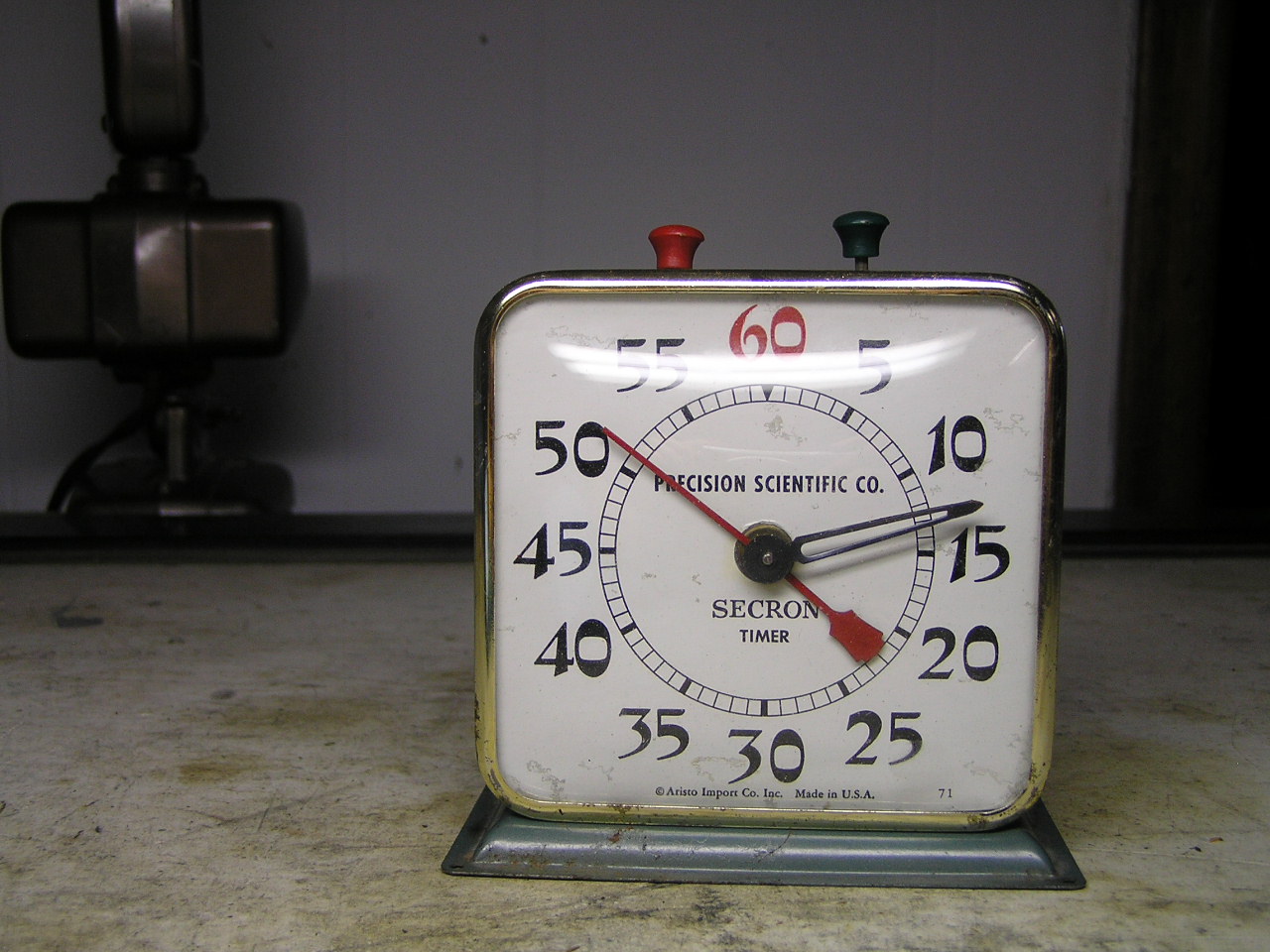
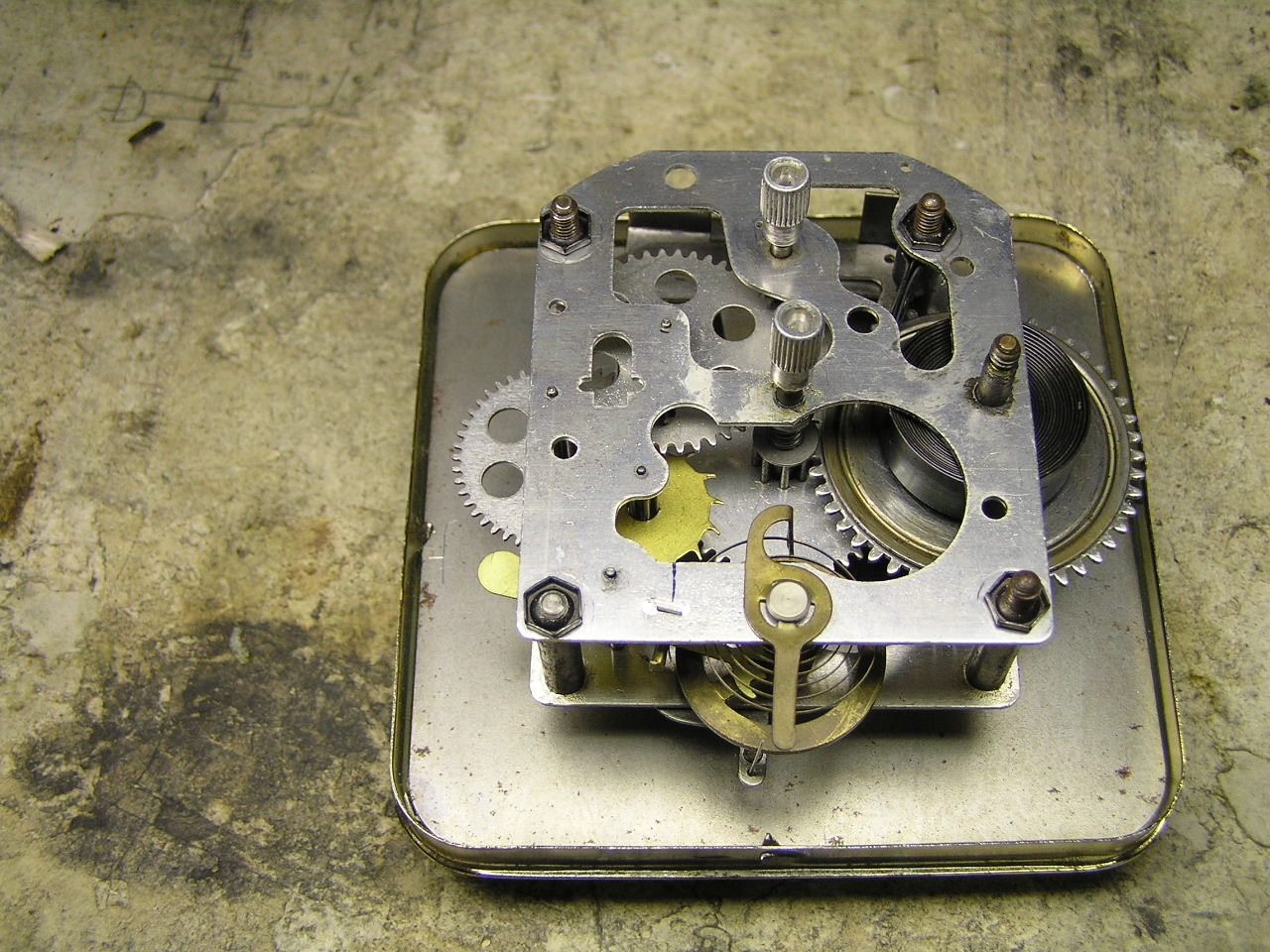
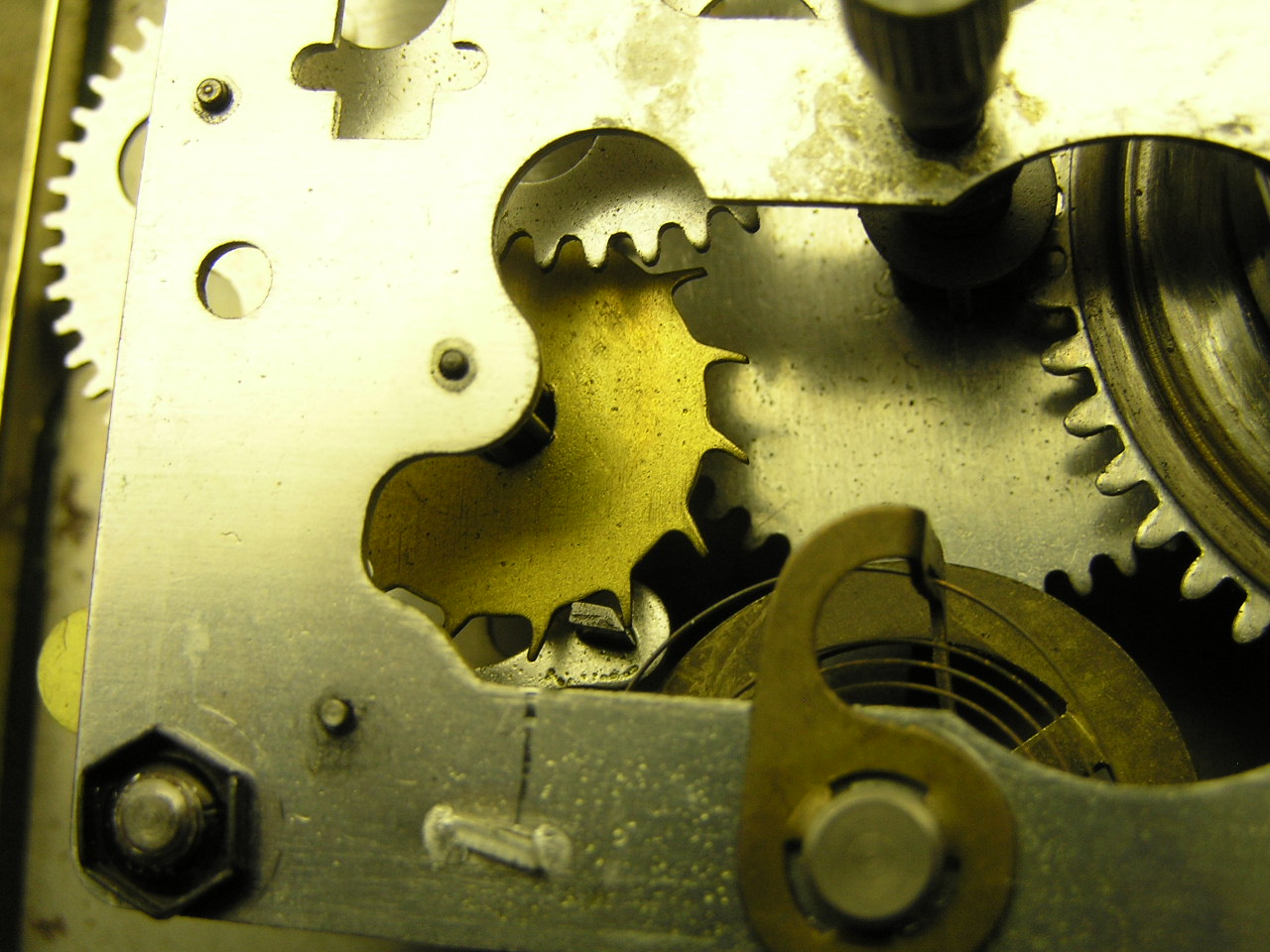
This is a 2-hour timer. Was probably used for timing X-ray equipment and other processes. I use it as a cooking timer.
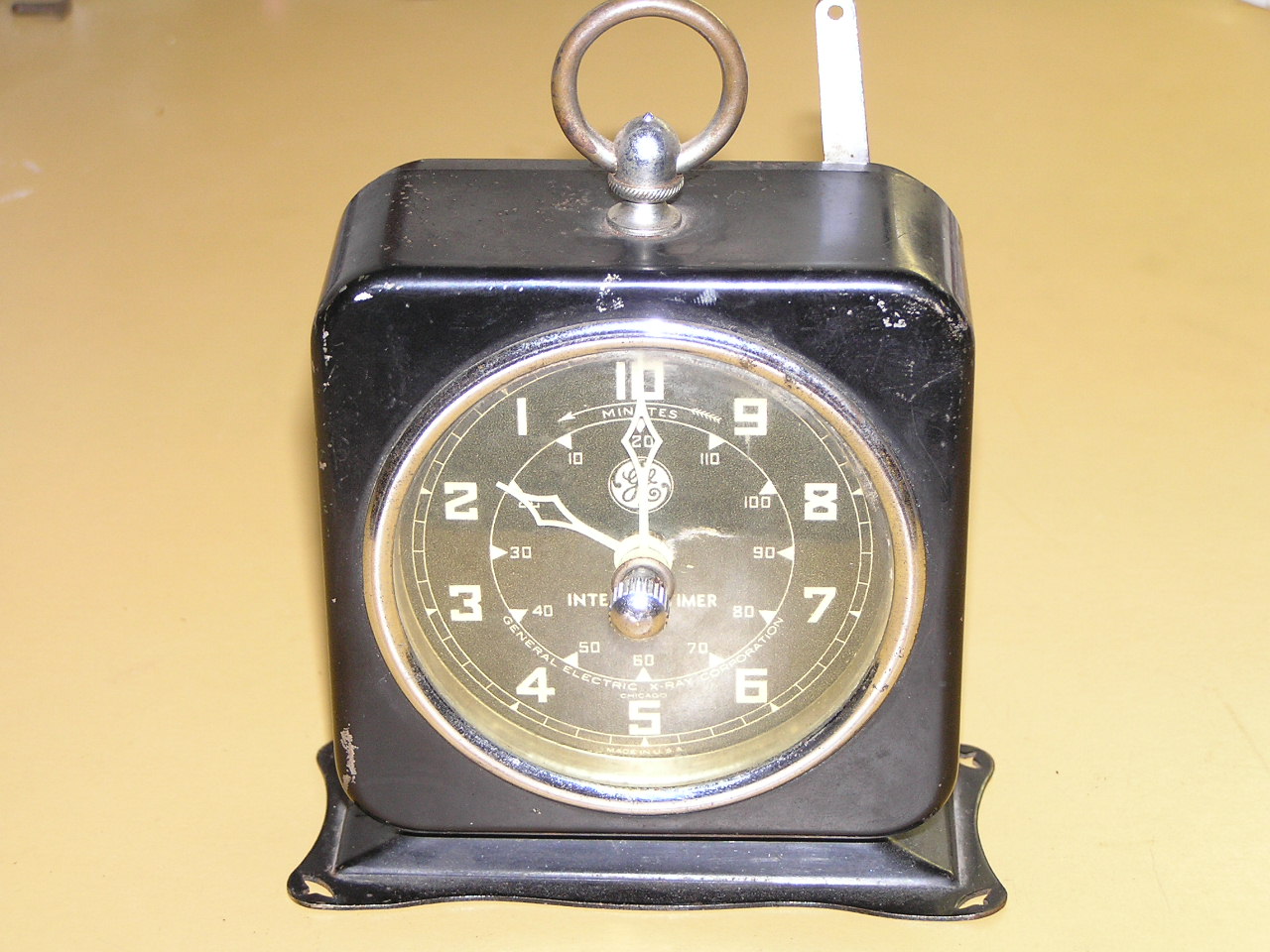
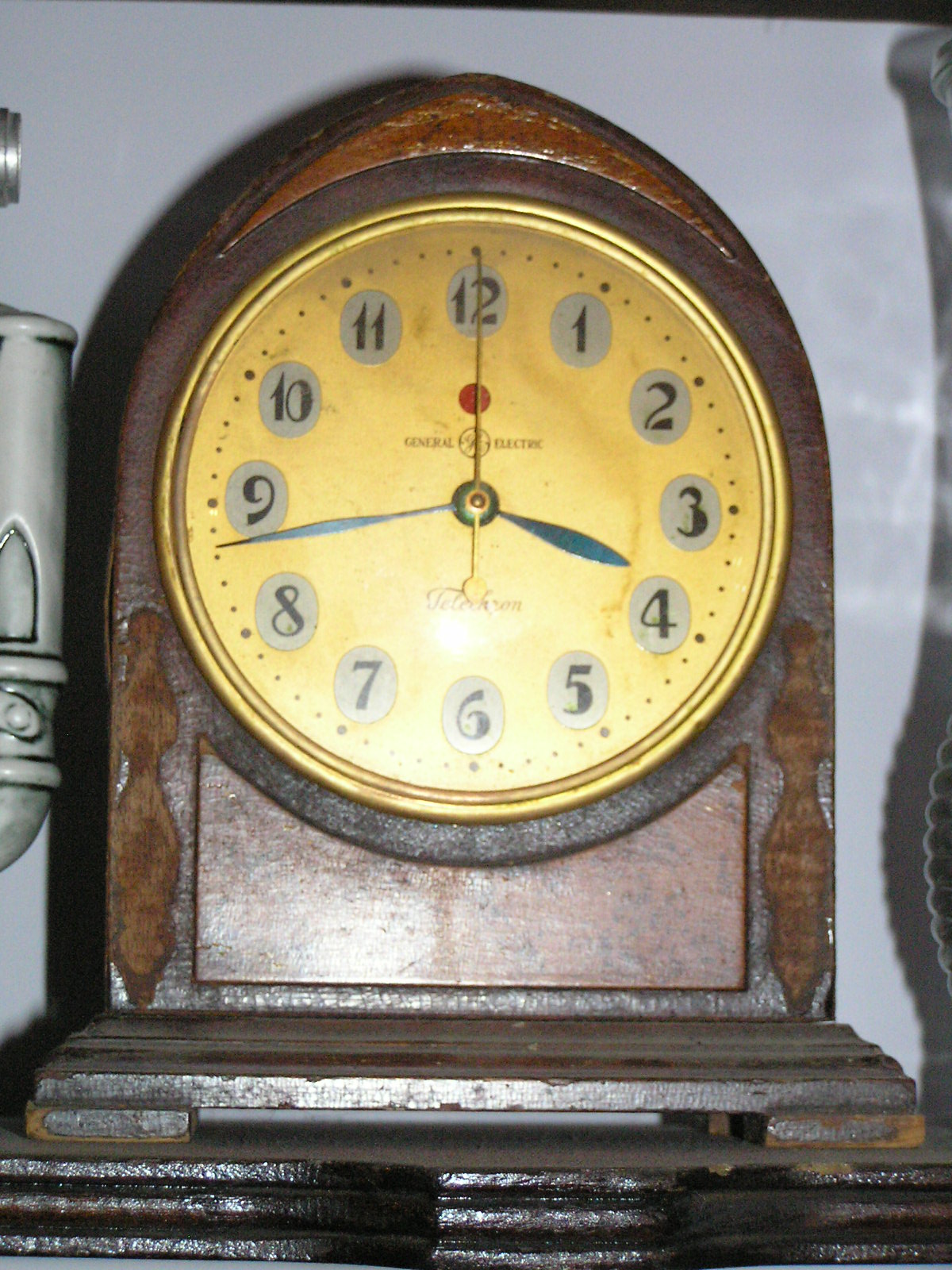
General Electric Telechron Clock Model 531, "The Lorraine", 1929.
This part will detail the movements themselves. The first two sections show details of a Sessions and Gilbert front-mount mantle clock movement. These movements have short drop pendulums and regulate through the dial, so the pendulum bobs do not have rating nuts. The third section is an overview of different Seth Thomas movements.
Gilbert - This movement was designed to strike the hours on a gong, and a bell on the half hours. In some pictures, you will note that the hour hammer has been bent to strike the bell. It is similar in general details, to the movement used in the Gilbert Tambour clock shown above. This movement has a 1902 date stamp.
Striking train: The count wheel is attached directly to the strike great wheel. The count wheel has slots to strike up to 12 twice, and makes one turn every 24 hours.
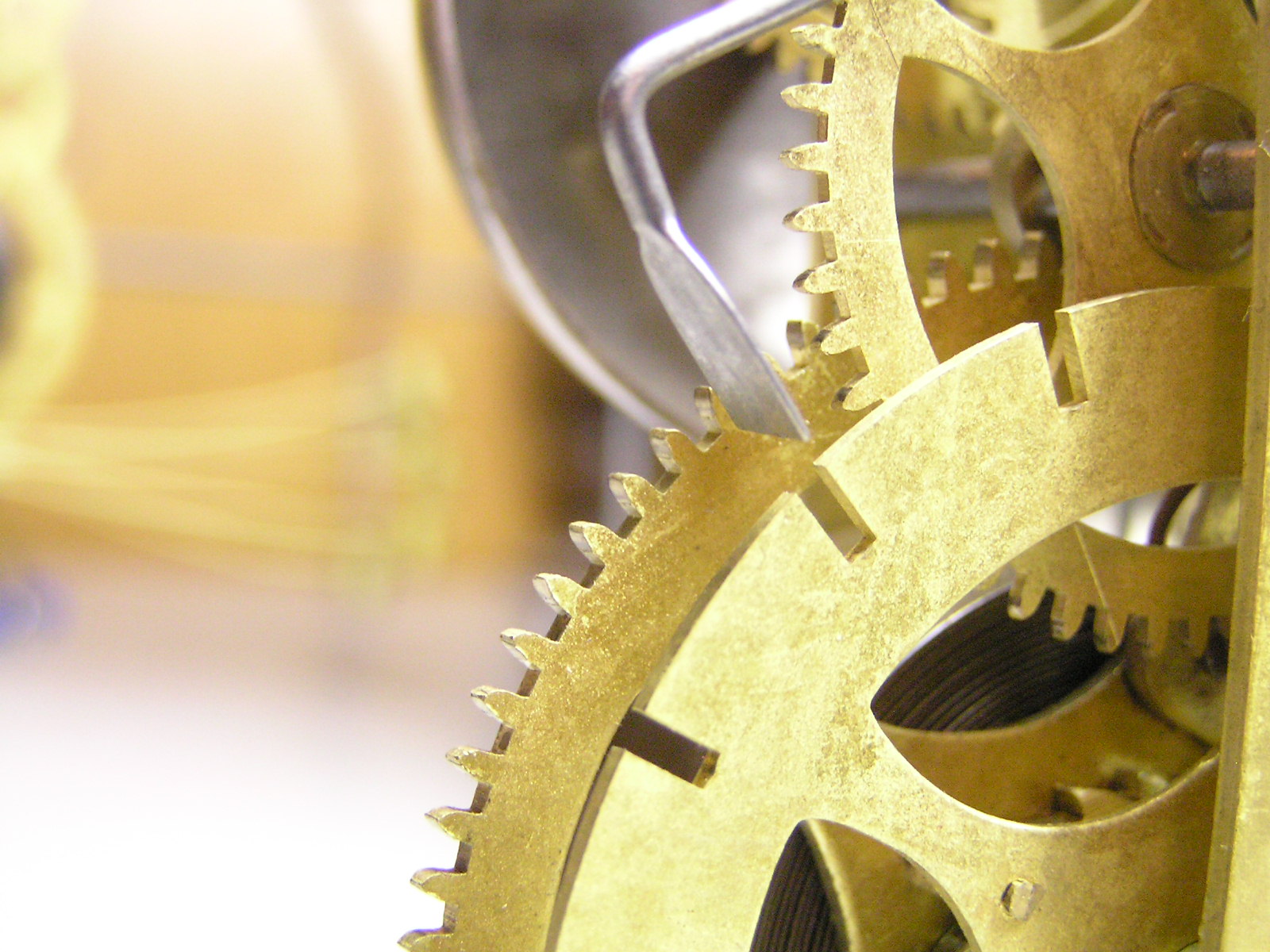
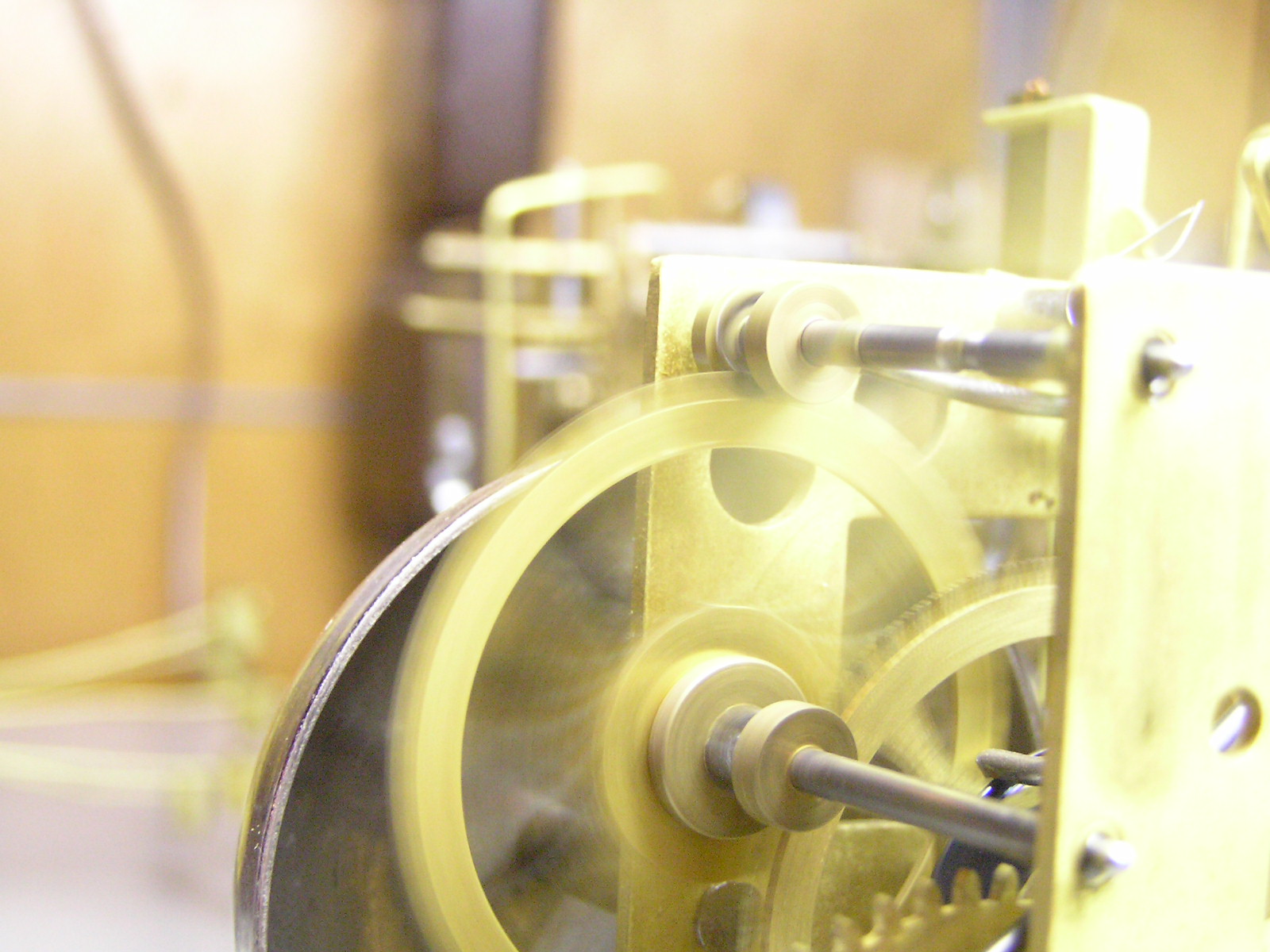
Train wheels and pinions:
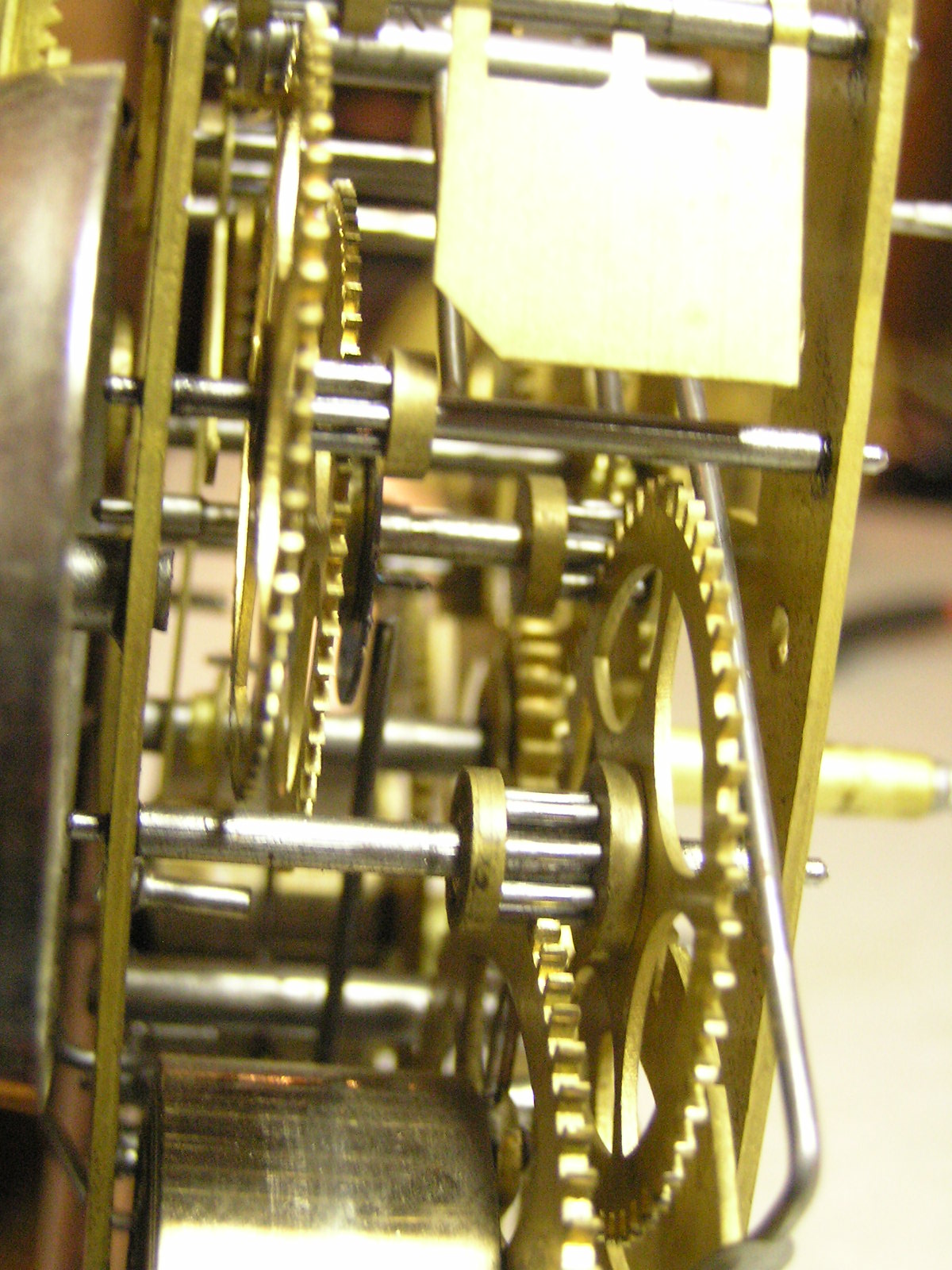
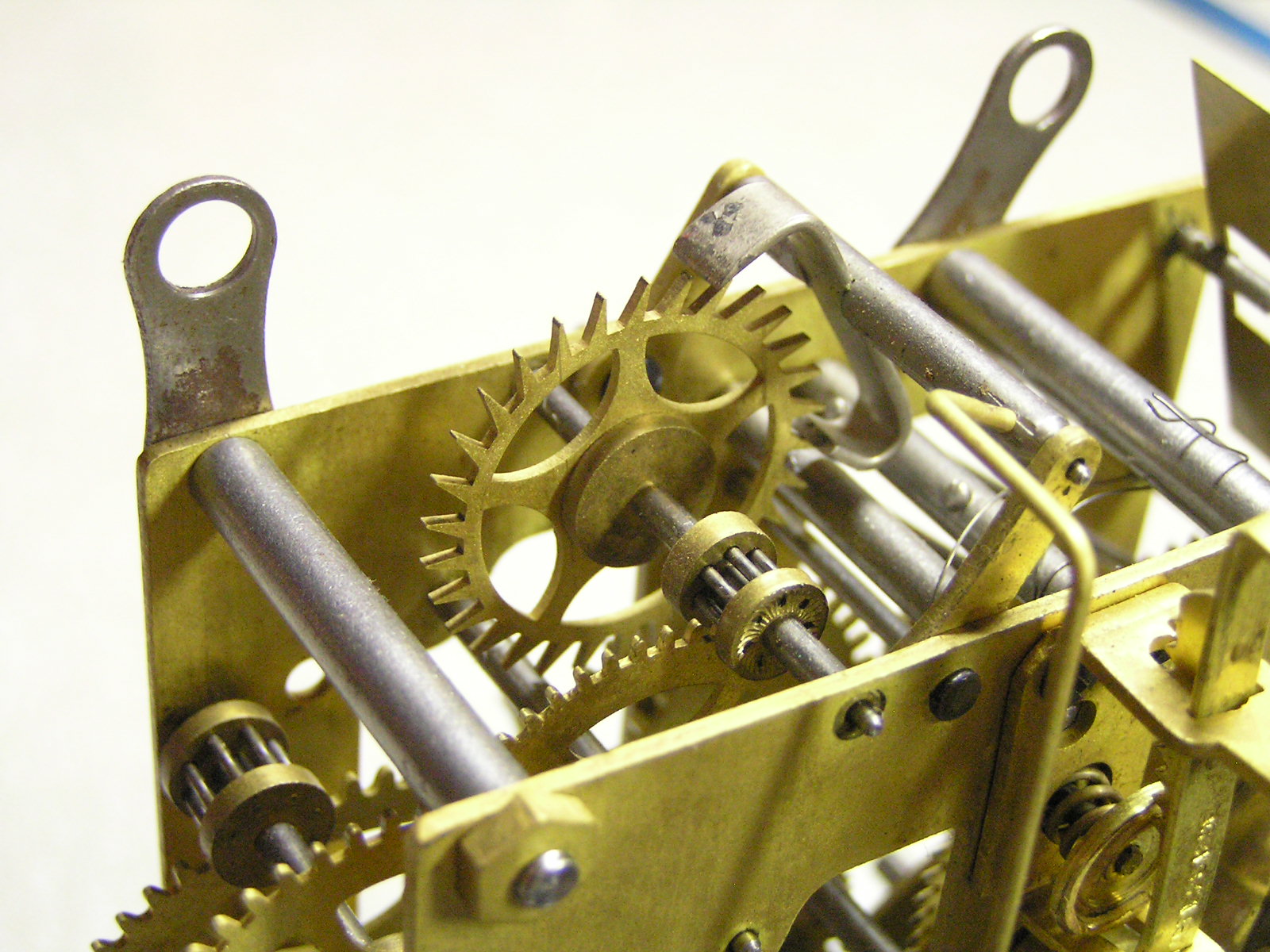
The escapement:
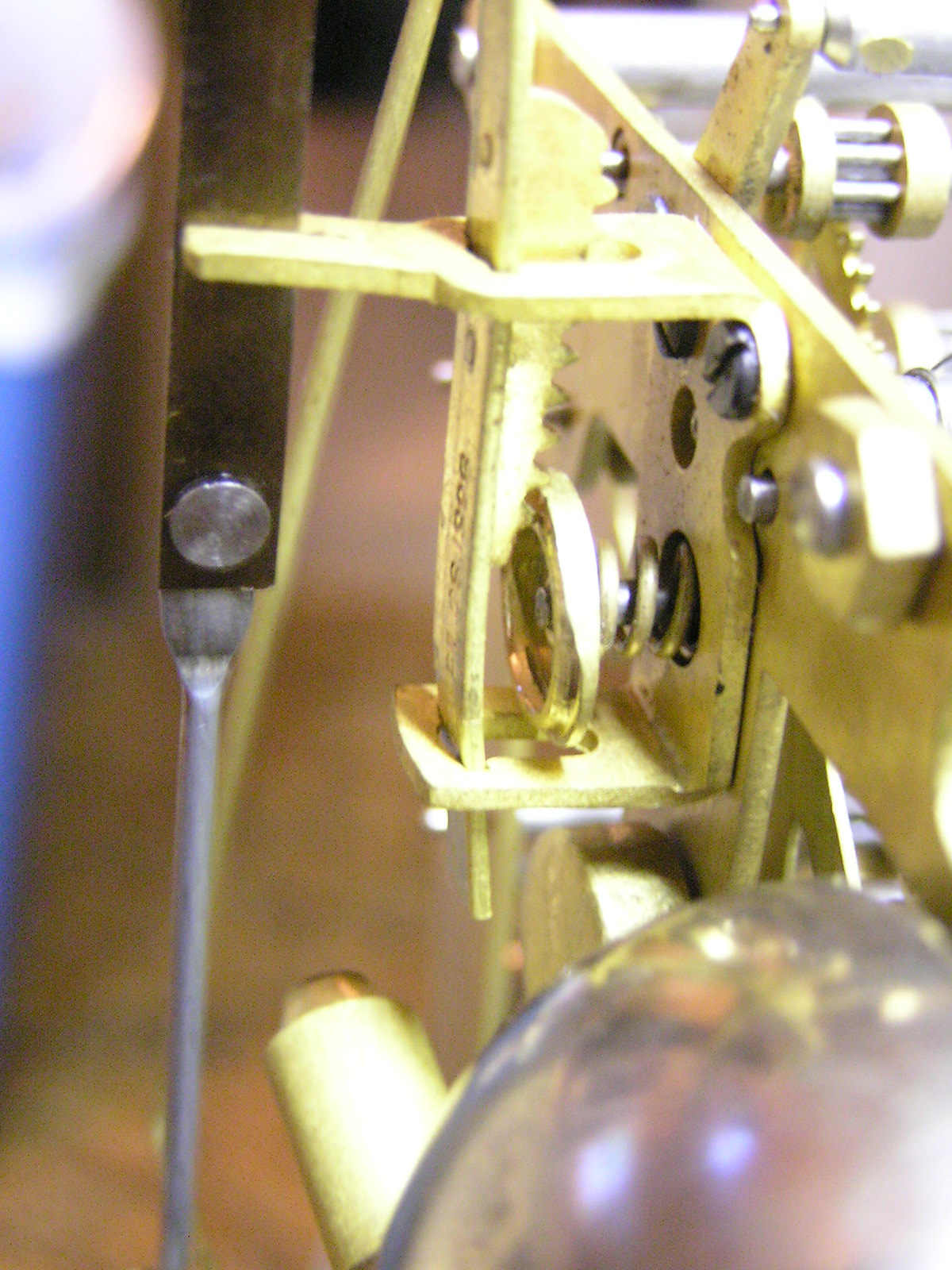
Regulator: This is a major weak point of Gilbert movements. Regulation is very course. Gilbert movements tend to be well made with substantial wheels and plates, but the regulators are weak.
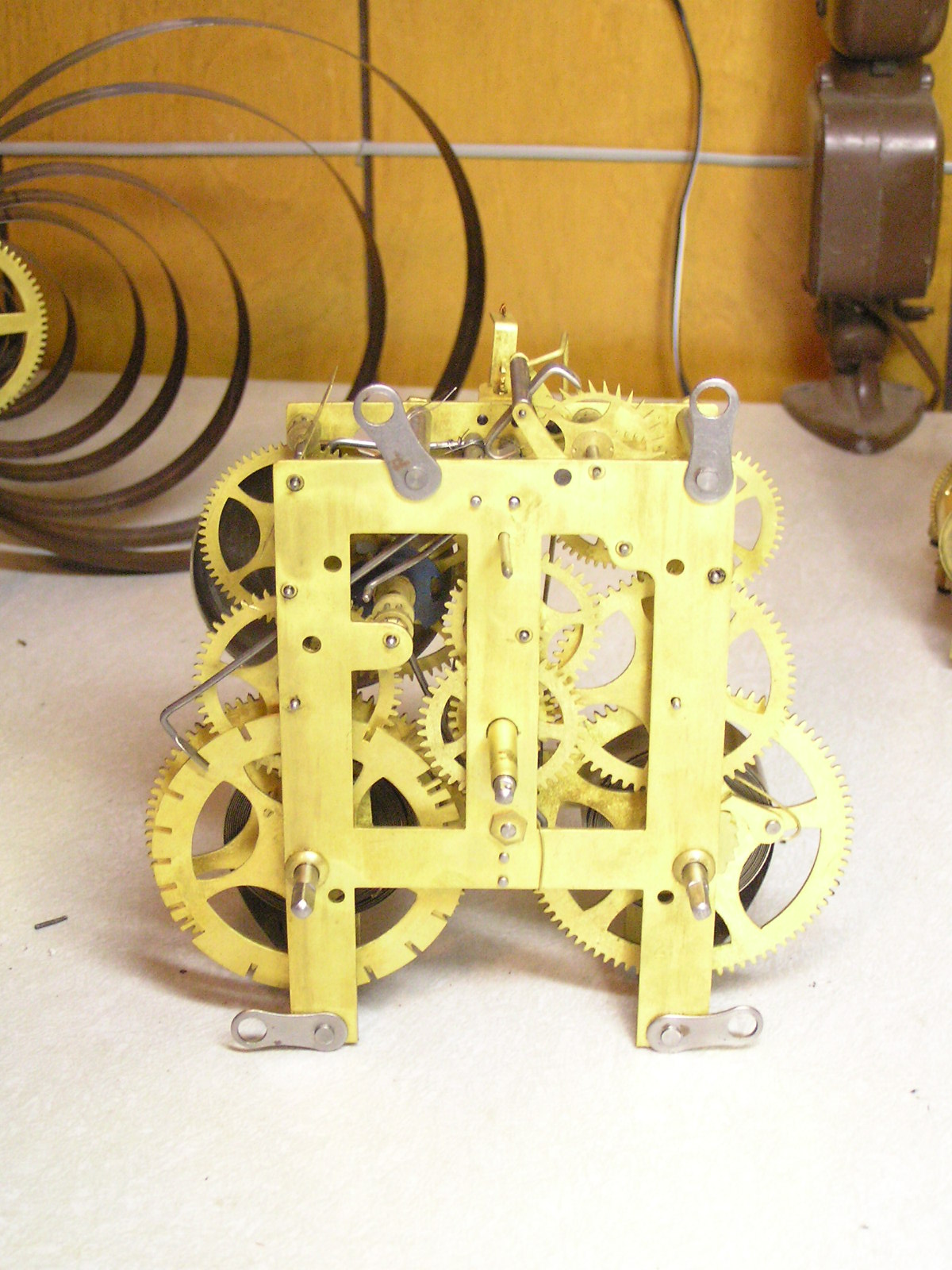
General view of movement:
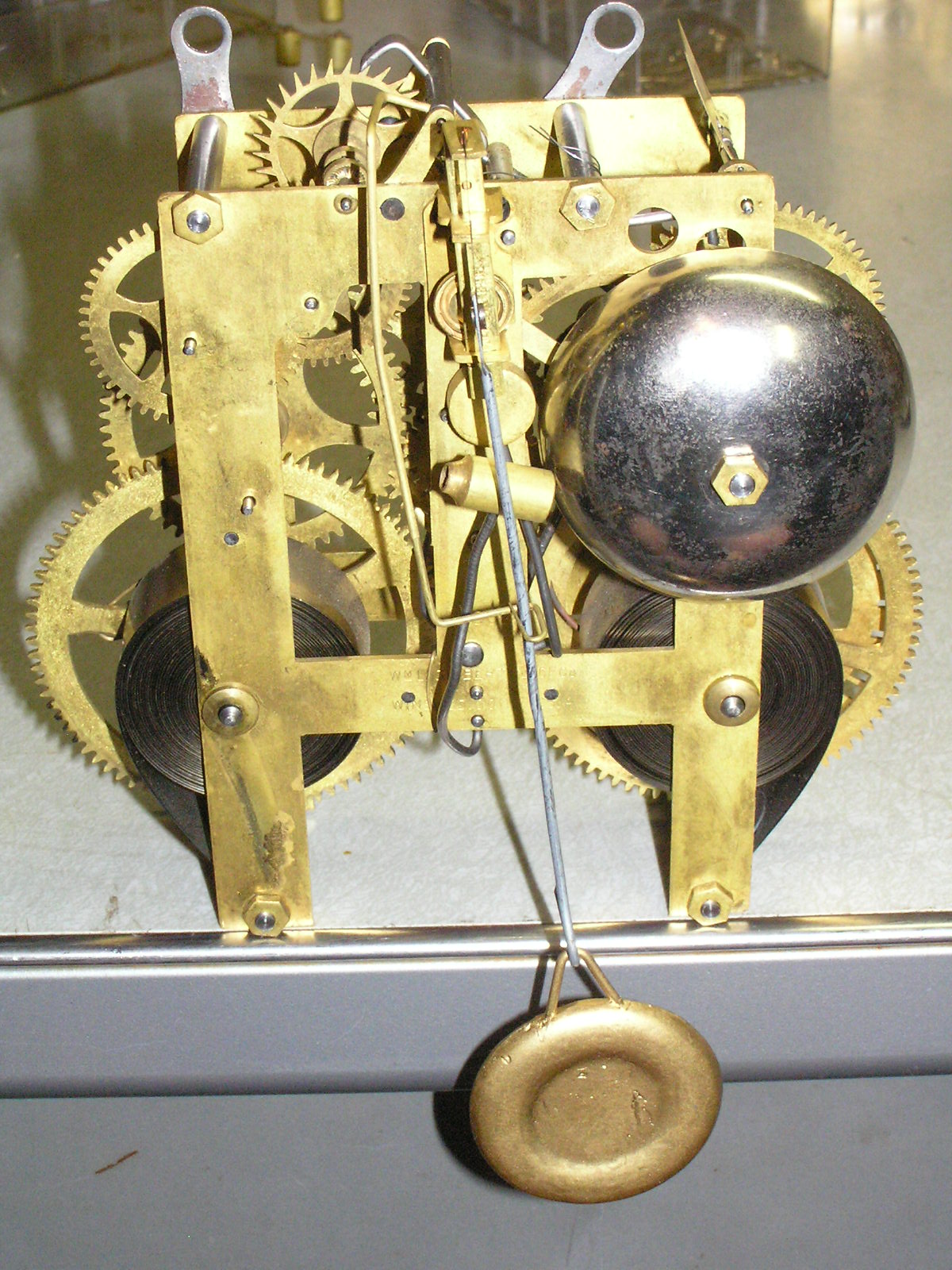
After having the movement fall on the floor a time or two, I built a test/demonstration stand and found a Gilbert dial appropriate to the movement. I built the stand tall so a second movement could be mounted on it from time to time.


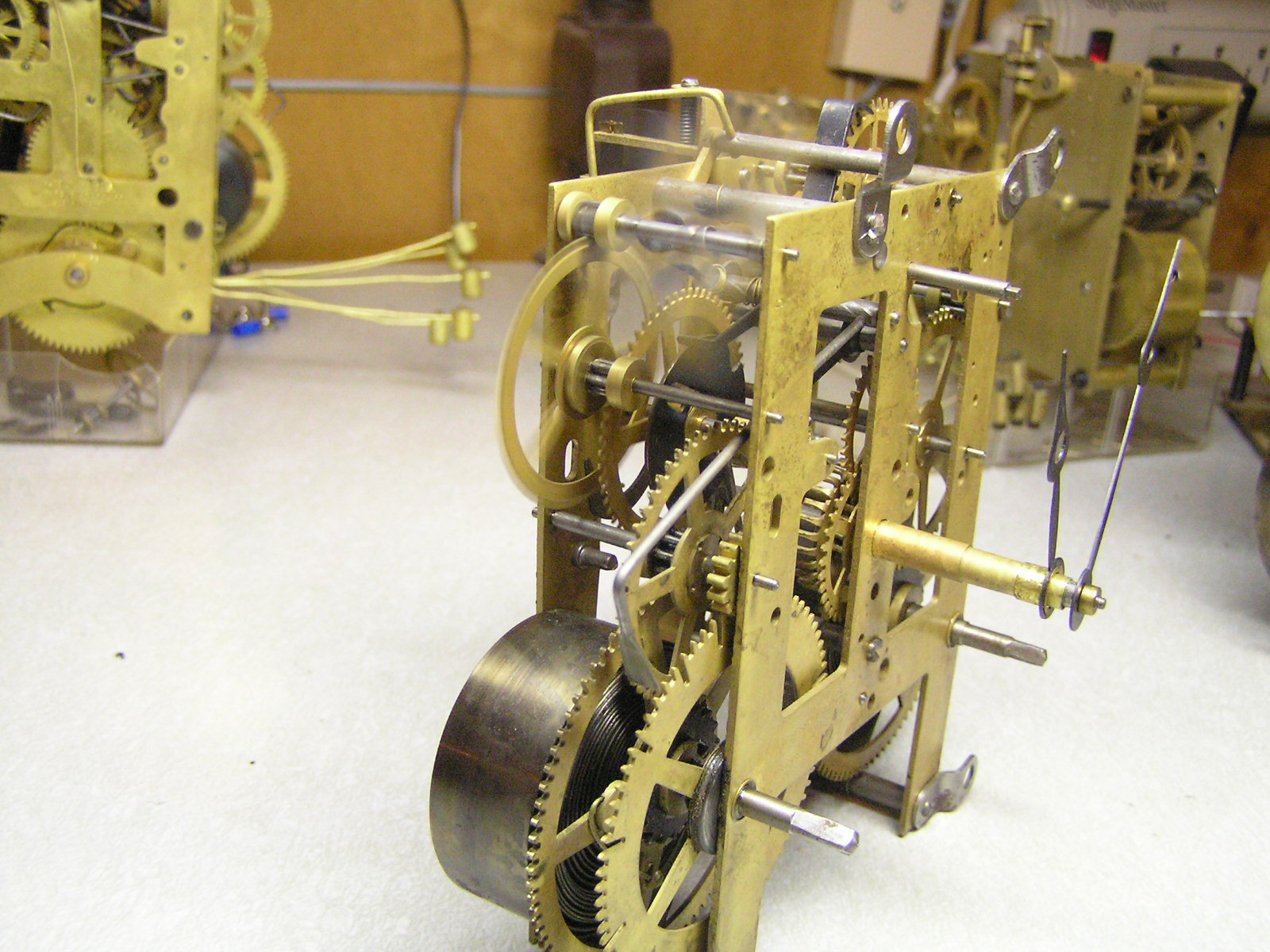
Sessions - The movement shown here is similar to the one in the complete clock listed above in the Sessions section, however, it is designed to strike the half-hour on the same gong that the hours are counted on. To do this and use the same count wheel as the half-hour bell models, an extra arm has been added to hammer shaft so that the cam in the minute arbor will activate it without the use of the strike train. This is called a passing strike. Contrast this to the two New Haven clocks which used the strike train to strike both the hour and half hour.
Strike train:

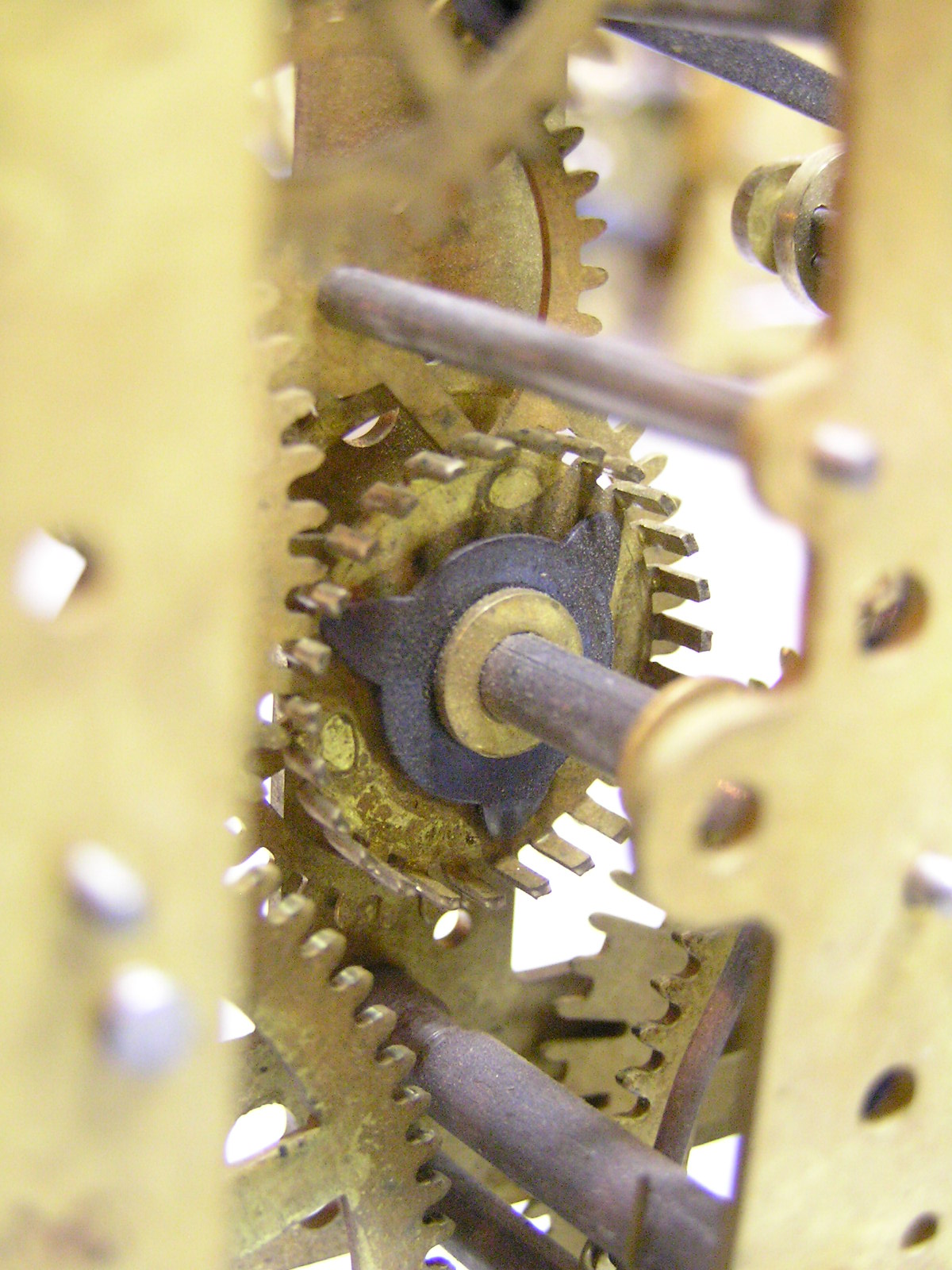
Center wheel pinion:
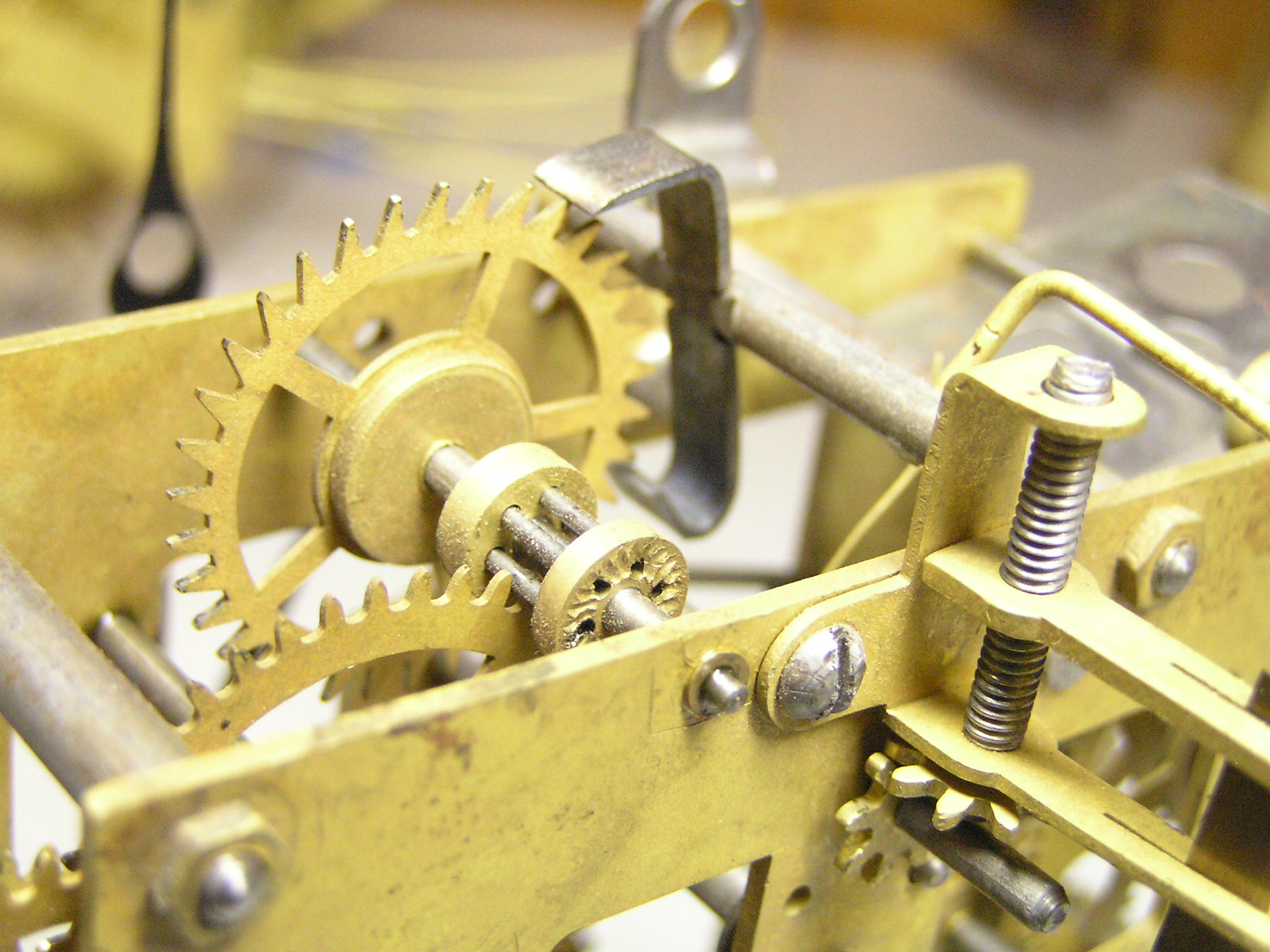
Escapement and Regulator: Contrast this regulator with the Gilbert one.
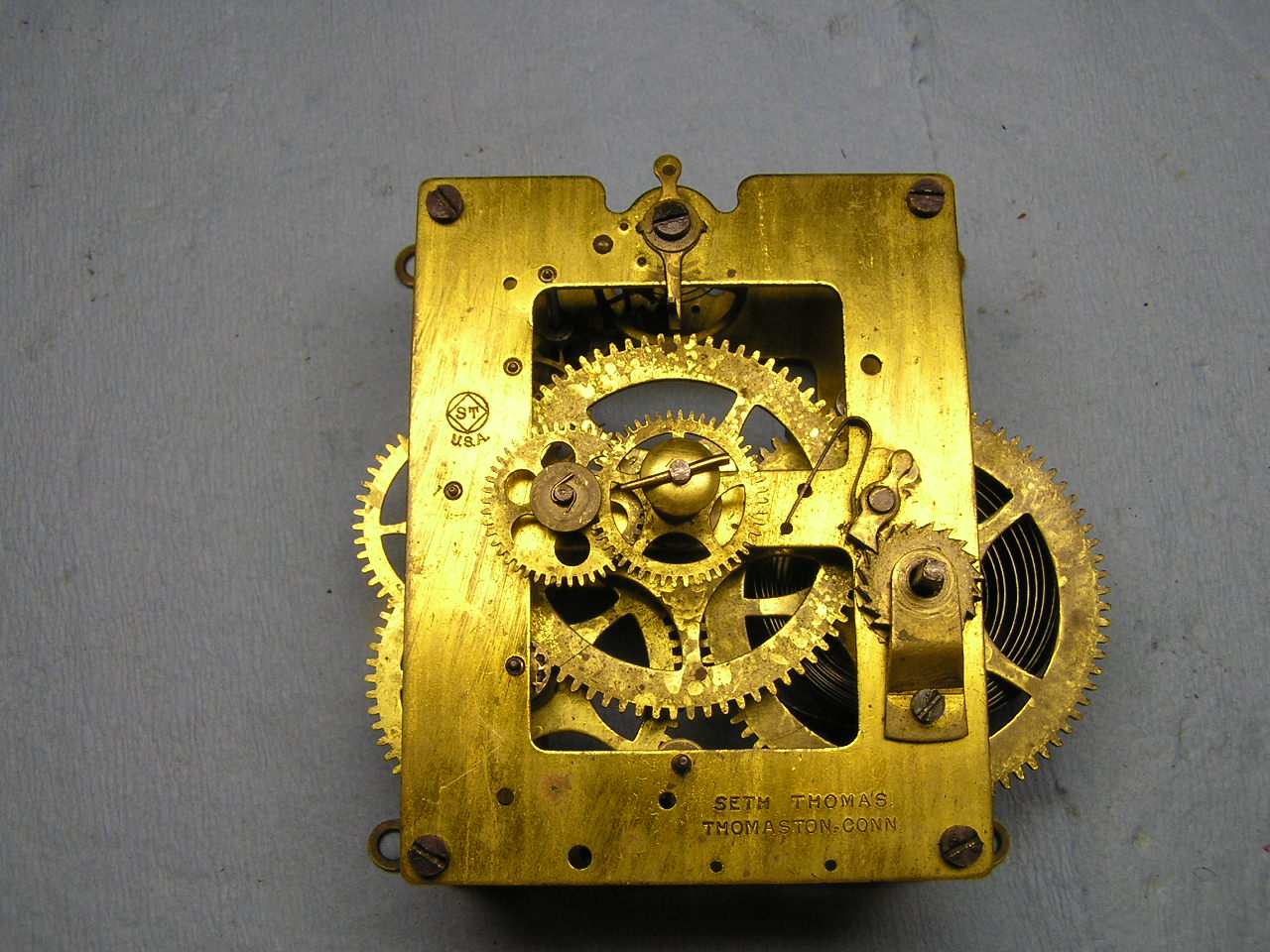
General view of movement:

Seth Thomas - This is a highly incomplete photographic guide to common Seth Thomas movements found in many clocks. Most Seth Thomas movements are rather unique when compared to other American clocks. They are often not just a simple rectangle. The Model 89 movement introduced around 1900 ended this. Although readily identifiable, it is a basic rectangular movement like all the others.
Lyre Movements: These are both 8-day weight movements, the one on the left is found in larger cases, about 29" tall, the right movement is in shorter '30-hour size' cases 25" tall. Versions of these movements using springs were also made and are very similar.


Hip Movements: Series 44 movement on left, predecessor to the 89 movement in center, 30-hour movement on right.


Other: 89 movement with front pendulum on left, 30-hour lever movement on right.

I will add additional photos and other information as I acquire them.
Telechron Clocks-A really great site covering GE/Telechron clocks to 1959, covering virtually every model.
Bob's Antique and Collectible Clocks-A nice online gallery of clocks owned or repaired by a Maryland collector.
A Chauncey Jerome Clock Collector-An online goldmine of information on these clocks, their movements, and dials.
Westclox Clock History-Focus on Big/Baby Bens
Antique and Vintage Westclox Identification Homepage- For all Westclox models
Cloxmonkey-Very high Quality restorations and repair of Westclox clocks. It is my clock dream to have my luminous dial Big Ben restored by him... check out his bragging sheet for factory new/museum quality restorations.
Owari Clock Co (English). Owari Clock Co (Japanese). Some information on the Japanese Owari Clock Company.
Dan & Diana's Lux Clock Collection A very nice online gallery of clocks made by the Lux Clock Co.
Please read the notes on contacting me on the Main Page.
Thank you for visiting.
Back to Main Page